Aparna RMC

Category: Specialised Ready-Mix Concrete

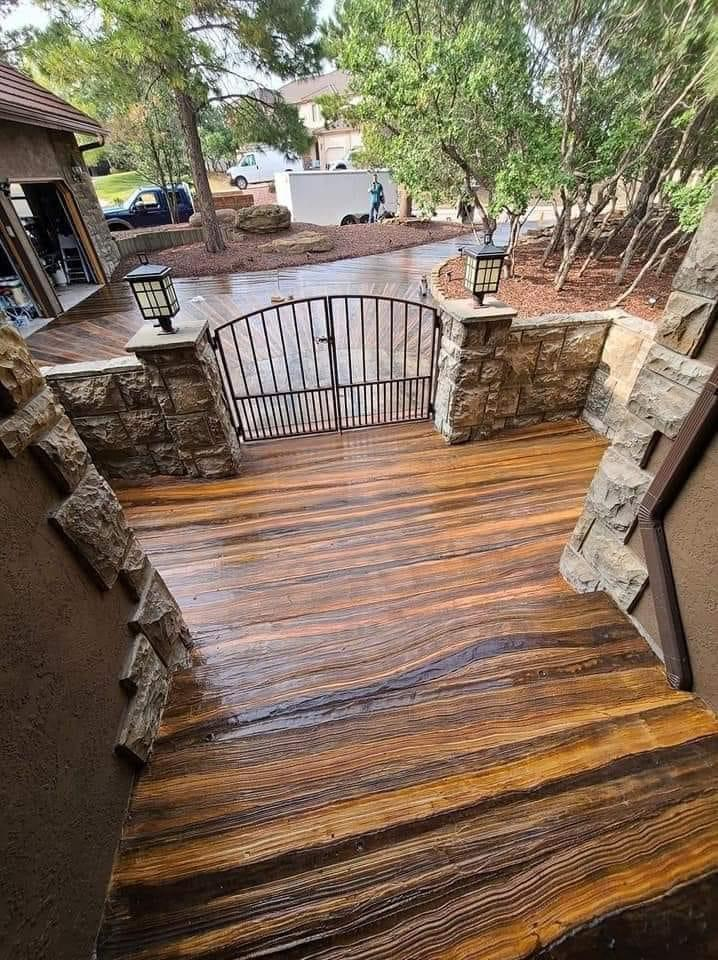
  • 10 Concrete Driveway Design Ideas with Stamp Concrete

    10 Concrete Driveway Design Ideas with Stamp Concrete

    10 Driveway Design Ideas with Stamped Concrete

    When it comes to enhancing your home’s curb appeal, the driveway is one of the most noticeable features. A well-designed driveway can not only add to the aesthetic charm of your home but also boost its value. Stamped concrete driveways offer a versatile, durable, and cost-effective solution for homeowners looking to upgrade their exterior. In this post, we’ll explore 10 creative driveway design ideas using stamped concrete that will transform your outdoor space into a stunning visual experience.

    1. Timeless Cobblestone Pattern

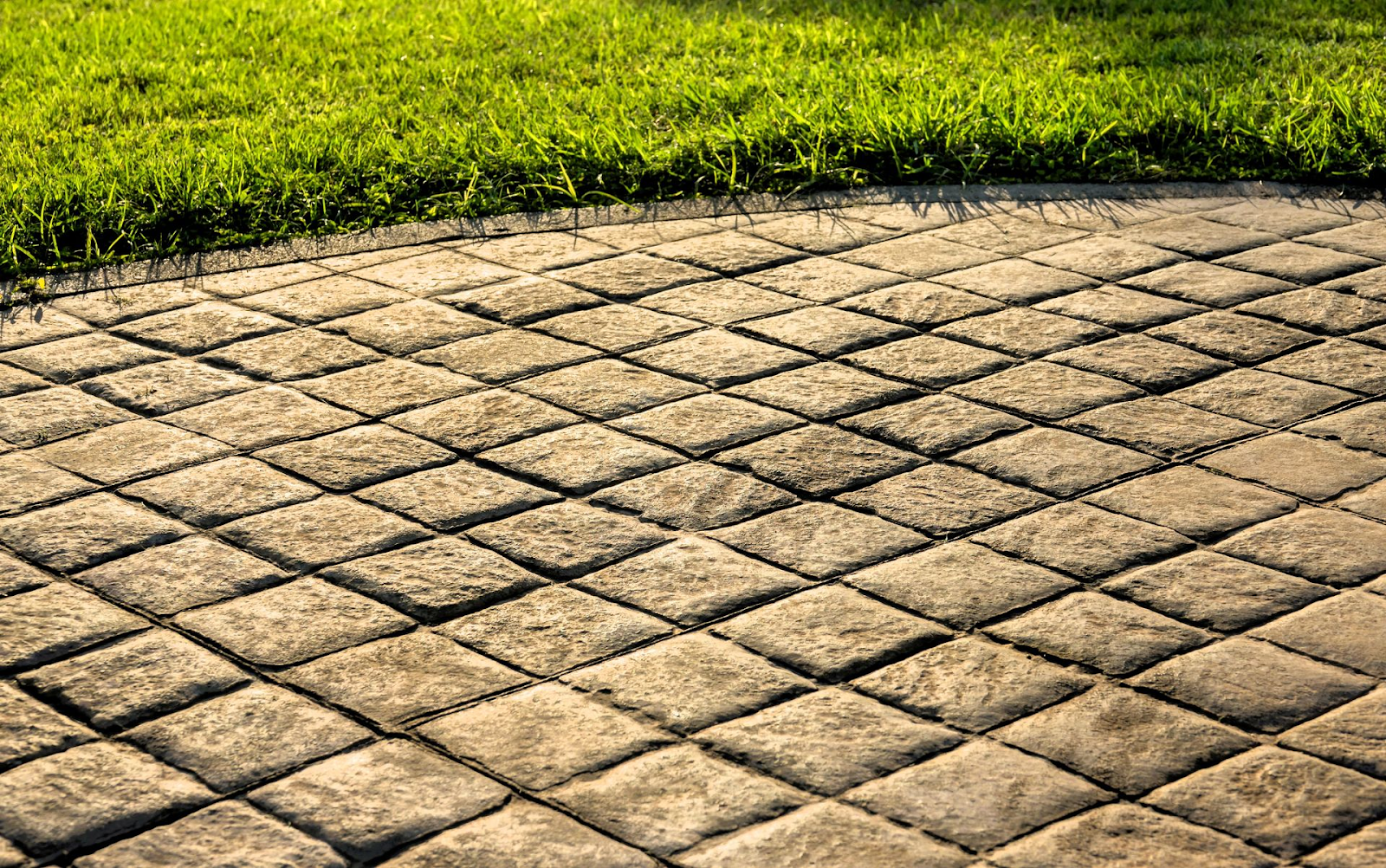
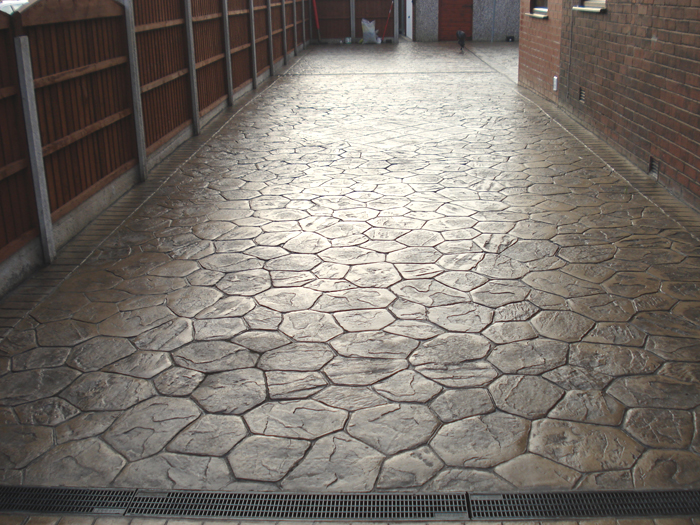
    One of the most popular choices for stamped concrete driveways is the cobblestone pattern. This design mimics the look of traditional European streets, bringing an air of old-world charm to your home. The texture of the cobblestones combined with the durability of concrete makes this option both practical and visually appealing. It’s perfect for homeowners looking to create a classic driveway design. Aparna RMC’s “Cobbledew” pattern offers homeowners an authentic cobblestone look with enhanced durability.

    2. Sleek Slate Finish

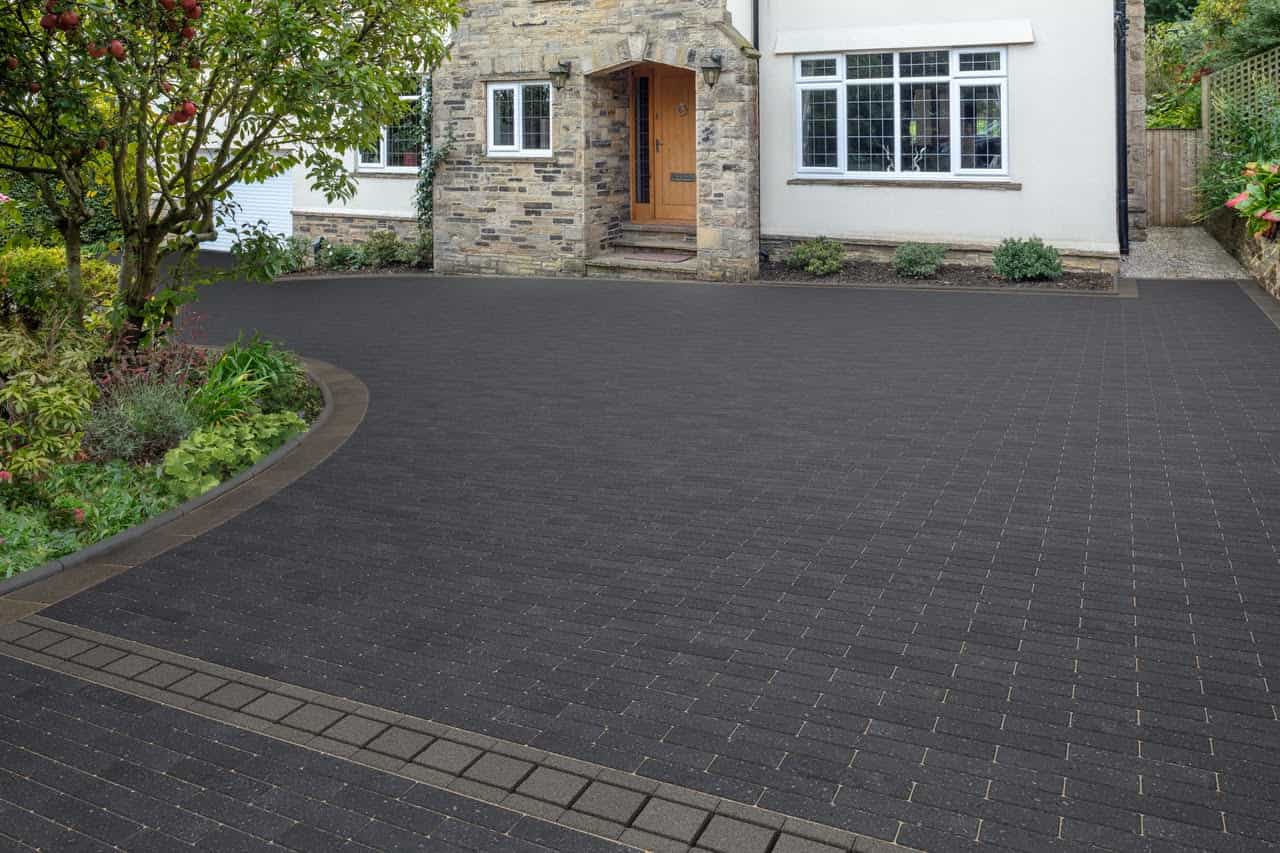
    The slate finish is a top choice for those who prefer a modern, sleek look. This design creates the appearance of natural slate stone, adding a sophisticated and polished feel to your driveway. The versatility of stamped concrete allows you to select from various shades of gray, charcoal, or even subtle earth tones to match the exterior of your home. Aparna RMC’s “BrickBoard” offers a versatile range of shades, from soft grays to dark charcoals, for a contemporary touch that complements modern architecture.

    3. Elegant Ashlar Cut Stone

    An Ashlar cut stone design is perfect for homeowners looking for a refined and sophisticated driveway. The pattern replicates the appearance of hand-cut stone blocks laid in a geometric arrangement. This design gives your driveway a high-end look without the cost of real stone, offering both style and strength. Aparna RMC’s “Flowstone” seamlessly blends precision with elegance, providing the luxury of stone without the associated cost.

    4. Brick Border with Stamped Concrete

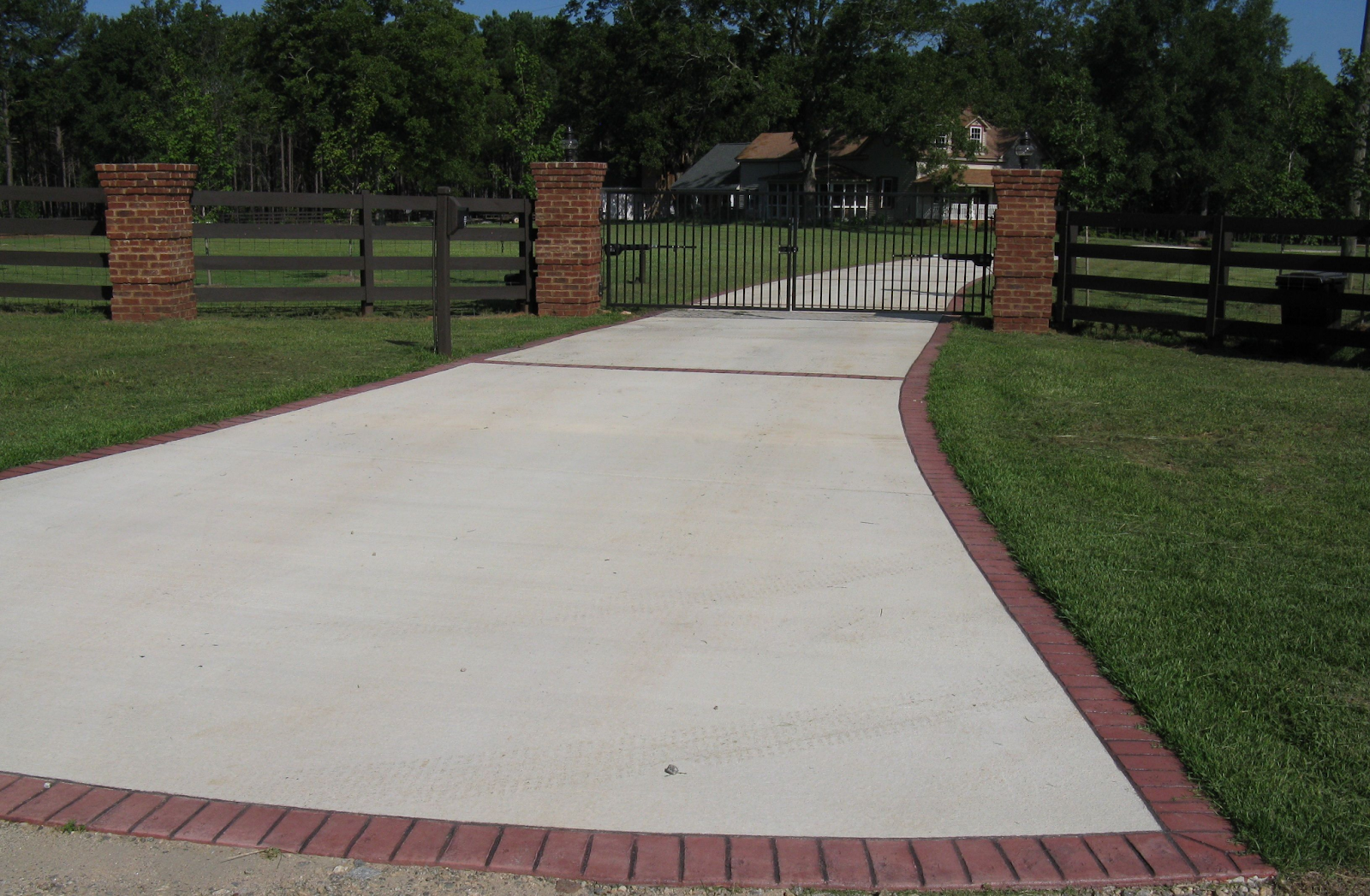
    Adding a brick border around your driveway provides a visually striking frame that elevates the overall design. You can combine a brick pattern with a different stamped concrete texture in the center, like slate or stone, to create contrast and visual interest. This combination works well for both traditional and modern homes, giving your driveway a personalized touch.  “BrickBoard” by Aparna RMC gives the perfect brick texture, adding a classic appeal to any driveway.

    5. Natural Flagstone Design

    If you love the look of natural stone, a stamped concrete flagstone pattern is an excellent option. Flagstone driveways create a rustic, earthy aesthetic that blends seamlessly into your landscape. With stamped concrete, you can replicate the irregular shapes and textures of flagstone without the maintenance required by real stone, giving you the best of both worlds. “Artifex” by Aparna RMC offers a perfect replication of natural stone, giving your driveway a natural, weathered look that integrates seamlessly with the surrounding landscape.

    6. Rustic Wood Plank Texture

    Bring the warmth and texture of wood to your driveway with a wood plank stamped concrete design. This pattern imitates the look of wooden planks, adding a unique rustic touch to your home’s exterior. The wood plank texture pairs beautifully with farmhouse-style homes or properties with natural surroundings, offering a charming and creative alternative to traditional driveway surfaces. “Oakgrain” by Aparna RMC mimics the charm of wooden planks, adding a rustic, farmhouse-style touch to your home’s exterior.

    7. Random Stone Pattern

    A random stone pattern is a great option for those seeking a more organic and natural look for their driveway. This design mimics the irregular arrangement of stones, creating a natural, earthy vibe. The random stone pattern works well for homes in rural or suburban settings, blending effortlessly with the surrounding environment. Aparna RMC’s “Flowstone” gives a natural feel while offering the longevity and strength of concrete.

    8. Geometric Tile Pattern

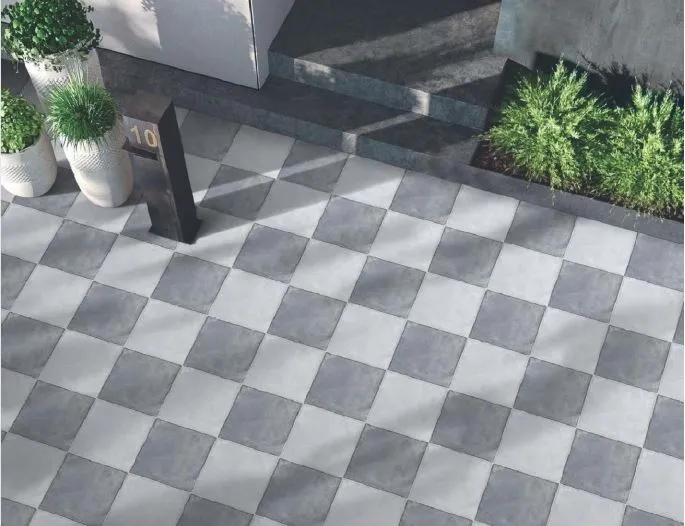
    For homeowners with a contemporary design sensibility, a geometric tile pattern can add a modern twist to your driveway. With stamped concrete, you can achieve clean lines and intricate shapes that bring a fresh, updated look to your outdoor space. Choose from a variety of colors and patterns to create a driveway that stands out. “Elluzions” by Aparna RMC brings contemporary design to life, perfect for making a statement with your driveway.

    9. Classic Herringbone Brick

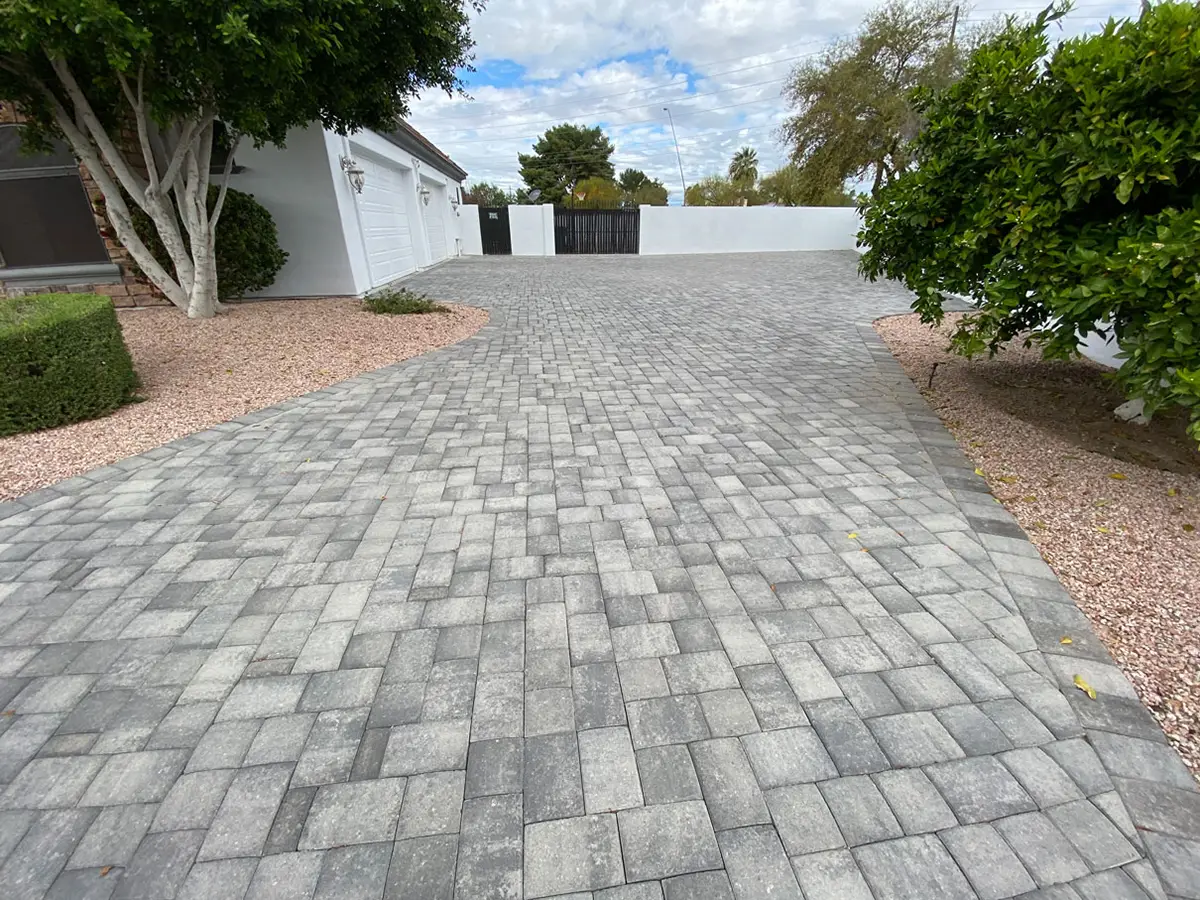
    The herringbone brick pattern is a timeless design that adds both texture and elegance to your driveway. Stamped concrete allows you to replicate the intricate arrangement of bricks in a herringbone pattern, providing the look of brick with the strength and durability of concrete. This design suits homes with traditional or classic architecture and offers long-lasting curb appeal. Aparna RMC’s “BrickBoard” brings the intricacy of herringbone patterns combined with the durability of concrete, making it suitable for homes with traditional architecture.

    10. River Rock Finish

    For a natural and textured driveway, consider a river rock finish using stamped concrete. This design imitates the look of smooth river stones, giving your driveway a unique, rustic charm. The river rock finish adds depth and texture to your home’s exterior while providing a surface that is both slip-resistant and durable. Aparna RMC’s “Greydesert” mimics the look of smooth river stones, providing a durable and slip-resistant finish with a rustic charm. 

    Benefits of Stamped Concrete Driveways

    Choosing stamped concrete for your driveway offers a range of benefits. It’s a cost-effective alternative to real stone, brick, or wood, and offers superior durability and low maintenance. Stamped concrete can withstand heavy traffic, and weather changes, and requires only occasional sealing to maintain its appearance.

    Additionally, stamped concrete driveways are customizable. You can choose from various patterns, colors, and textures to create a driveway that complements your home’s architectural style and personal taste.

    Conclusion

    Whether you’re looking to enhance the curb appeal of a traditional home or add a modern touch to a contemporary property, stamped concrete driveways offer endless design possibilities. From the elegance of cobblestone to the rustic charm of wood planks, these 10 stamped concrete driveway design ideas are sure to inspire your next home improvement project.

    With the right design, you can create a beautiful, long-lasting driveway that not only complements your home but also enhances its overall value. 

    Why Choose CraftCrete Stamped Concrete by Aparna RMC?

    For homeowners looking for premium quality and innovative designs, CraftCrete Stamped Concrete by Aparna RMC is an excellent choice. Known for its exceptional durability and customizability, CraftCrete offers a wide range of textures, colors, and patterns that can transform any driveway into a work of art. Whether you’re aiming for a sleek, modern finish or a rustic, natural look, CraftCrete stamped concrete delivers superior results with minimal maintenance. Additionally, it is designed to withstand heavy traffic, weather fluctuations, and the wear and tear of daily use, ensuring your driveway remains beautiful and functional for years to come. Backed by the expertise and trusted reputation of Aparna RMC, CraftCrete solutions provide homeowners with not only aesthetic appeal but also long-lasting value.

  • Advantages of Glass Fiber Reinforced Concrete in Modern Design

    Advantages of Glass Fiber Reinforced Concrete in Modern Design

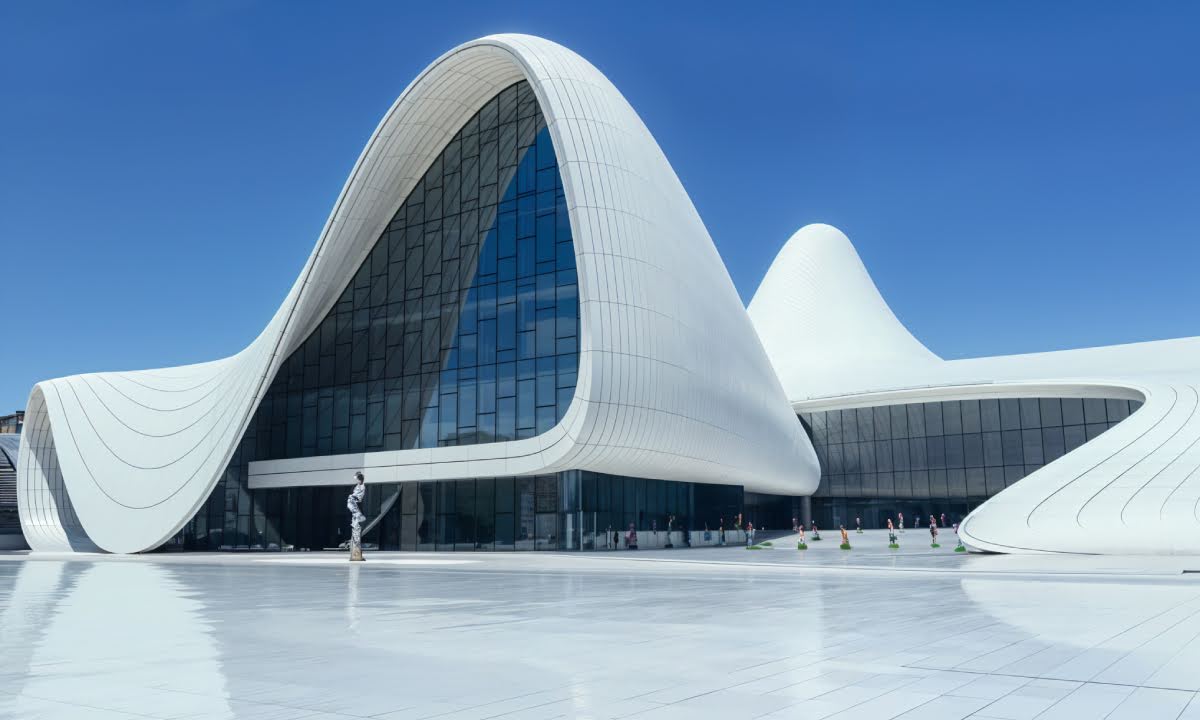
    The evolution of construction materials has led to innovative solutions that offer superior performance and versatility. One such breakthrough is Glass Fiber Reinforced Concrete (GFRC), a composite material that combines the strength of concrete with the flexibility and durability of glass fibers.  Glass Fiber Reinforced Concrete (GFRC) is revolutionizing modern design by offering unmatched strength, reduced weight, and stunning aesthetics.

    What Is Glass Fiber Reinforced Concrete (GFRC)?

    Glass Fiber Reinforced Concrete (GFRC) is a specialized type of concrete reinforced with glass fibers to improve its tensile strength, durability, and aesthetic appeal. Unlike traditional concrete, GFRC is lightweight yet incredibly robust, making it ideal for a wide range of architectural applications.

    Key Features of Glass Fiber Reinforced Concrete (GFRC):

    • High Strength-to-Weight Ratio: Lighter than conventional concrete yet stronger and more flexible.
    • Thin Section Capability: Allows for intricate designs and reduced material usage.
    • Durability: Resistant to cracking, weathering, and fire.
    • Eco-Friendly: Requires less cement and incorporates sustainable materials.
       

    Why Is Glass Fiber Reinforced Concrete (GFRC) Essential for Modern Design

    The demands of modern construction extend beyond strength and durability to include aesthetics, sustainability, and adaptability.  Glass Fiber Reinforced Concrete (GFRC): addresses these needs by providing:

    1. Versatility in Design: This can be molded into intricate shapes, patterns, and textures, enabling architects to push the boundaries of creativity.
    2. Lightweight Properties: Its reduced weight makes it ideal for applications where traditional concrete would be impractical, such as facades, ceilings, and furniture.
    3. Enhanced Durability: Glass Fiber Reinforced Concrete (GFRC)’s resistance to cracking, moisture, and temperature changes ensures longevity, even in harsh environments.
    4. Sustainability: Reduces cement consumption and can incorporate recycled materials, aligning with green building practices.
    5. Fire Resistant: Provides an additional safety measure by being resistant to fire.

    Applications of Glass Fiber Reinforced Concrete

    Architectural Facades

     Glass Fiber Reinforced Concrete (GFRC), is a popular choice for creating lightweight yet durable building facades that offer aesthetic and functional benefits.

    Decorative Panels

    • Cladding Panels: Add style and character to interiors and exteriors.
    • 3D Wall Panels: Create dynamic designs that captivate attention.

    Infrastructure Projects

    • Bridge Components: High strength and low weight make  Glass Fiber Reinforced Concrete (GFRC), ideal for complex infrastructure projects.
    • Noise Barriers: Used along highways to reduce sound pollution with customizable designs.

    Custom Furniture and Fixtures

     Glass Fiber Reinforced Concrete (GFRC), can be shaped into bespoke furniture pieces, countertops, and sinks, combining functionality with aesthetic appeal.

    Innovations in GFRC Technology

    • Sustainable Additives: Modern  Glass Fiber Reinforced Concrete (GFRC) formulations include recycled materials, such as glass or fly ash, to reduce environmental impact.
    • Embedded Lighting and Smart Features: Designers are now integrating LED lighting and embedded sensors for multifunctional applications.
    • Advanced Textures and Colors: New techniques allow  Glass Fiber Reinforced Concrete (GFRC) to mimic materials like stone, wood, or metal, broadening its design potential.

    Challenges in Adopting GFRC

    Despite its benefits,  Glass Fiber Reinforced Concrete (GFRC) faces certain challenges:

    • Higher Initial Costs: Custom molds and production techniques can raise upfront expenses.
    • Specialized Expertise Required: Proper handling and installation demand skilled professionals.
    • Limited Awareness: Broader education is needed to highlight its advantages over traditional materials.

    Introducing GlassCrete : Glass Fiber Reinforced Concrete by Aparna RMC

    To address the growing demand for innovative construction materials, Aparna RMC presents GlassCrete Glass Fiber Reinforced Concrete. GlassCrete is a cutting-edge GFRC solution designed to empower architects and builders with unmatched performance and design flexibility.

    Why Choose GlassCrete?

    • Superior Quality: Developed using state-of-the-art technology and rigorous quality control.
    • Custom Aesthetics: Available in a variety of colors, textures, and finishes.
    • Sustainability Commitment: Aligns with green building standards and practices.
    • Trusted Expertise: Backed by Aparna RMC’s legacy of delivering high-performance construction solutions.

    With GlassCrete, Aparna RMC is redefining the possibilities of  Glass Fiber Reinforced Concrete (GFRC):, offering a perfect blend of functionality and aesthetics for contemporary architecture.

  • Building Resilience: The Role of Ready-Mix Concrete in Disaster-Resilient Construction

    Building Resilience: The Role of Ready-Mix Concrete in Disaster-Resilient Construction

    In the face of increasing climate uncertainties and natural disasters, the importance of resilient construction practices cannot be overstated. One of the chief components in achieving disaster resilience is ready-mix concrete, a versatile material that significantly enhances the structural integrity of buildings. This blog explores the crucial role of ready-mix concrete in disaster-resilient construction and how it contributes to building a safer and more sustainable future.

    Understanding Ready-Mix Concrete

    Ready-mix concrete is a precise and consistent solution that is prepared in a controlled environment, usually a batching plant. It is composed of carefully proportioned ingredients including cement, aggregates, water, and admixtures. The controlled mixing process ensures uniformity and consistency, resulting in a high-quality product that surpasses traditional on-site mixed concrete in strength and durability. The mix is produced through careful measurement and precise mixing in high-tech infrastructural facility which makes it better controlled, stronger and more consistent than on-site mixed concrete.

    Strength in Structure

    One of the primary reasons ready-mix concrete is essential for disaster-resilient construction lies in its superior strength characteristics. Buildings constructed with ready-mix concrete are better equipped to withstand the forces exerted by earthquakes, cyclones, and other natural disasters. The material’s robustness helps prevent structural failures, providing a critical layer of protection for occupants. The robustness is achieved  through careful technologically equipped mixing in batches with the help of industrial experts which isn’t found in on-site mixing.

    How does RMC’S Rapid Deployment and Efficiency figure in Disaster Management?

    In the aftermath of a disaster, time is of the essence. Ready-mix concrete offers a rapid and efficient solution, as it can be transported to the construction site and poured immediately. This speed of deployment is crucial for emergency response efforts, enabling the quick reconstruction of essential infrastructure and minimizing disruptions to communities affected by disasters.    

    How does Ready-Mix Concrete maintain Consistency and Quality Control?

    Consistency is key to ensuring the structural integrity of buildings, especially in

    disaster-prone areas. Ready-mix concrete’s controlled production process eliminates the variability associated with on-site mixing. This consistency not only enhances the

    material’s strength but also facilitates precise engineering calculations, ensuring that

    structures meet or exceed safety standards.

    Is Ready-Mix Concrete truly a friend of the environment?

    Ready-mix concrete exhibits remarkable resistance to environmental factors such as fire, corrosion, and moisture. This resistance is pivotal in disaster-resilient construction, as it helps maintain the structural integrity of buildings even in adverse conditions. The material’s durability ensures that structures remain safe and habitable for an extended period, reducing the need for frequent repairs or reconstruction.

    Ready-Mix Concrete is Sustainable and Cost-Effective

    Beyond its resilience, ready-mix concrete contributes to sustainable construction

    practices. The controlled production process minimizes waste, and the durability of the material reduces the need for frequent replacements. Additionally, the energy efficiency associated with ready-mix concrete production makes it an environmentally friendly choice.

    Conclusion

    In the face of an unpredictable climate and the increasing frequency of natural disasters, the construction industry must prioritize disaster resilience. Ready-mix concrete emerges as a vital enabler in this endeavour, offering unparalleled strength, efficiency, and sustainability. By incorporating this advanced building material into construction practices, we can build communities that are better equipped to face the challenges of the future, creating a safer and more resilient world.

    Through innovation and collaboration, we here at Aparna RMC are making buildings that are more disaster-resilient and sustainable.

  • Building a Sustainable Future: The Role of Ready-Mix Concrete in Green Construction

    Building a Sustainable Future: The Role of Ready-Mix Concrete in Green Construction

    Sustainability has become a cornerstone of modern construction practices, driven by the urgent need to mitigate the environmental impact of the built environment. As the construction industry evolves, materials play a crucial role in determining the ecological footprint of a project.

    One such material that has gained prominence for its sustainable attributes is ready-mix concrete. This versatile and eco-friendly construction material is proving to be a key player in advancing green building practices.

    How Does RMC Reduce Environmental Impact?

    Ready-mix concrete offers a more sustainable alternative to traditional on-site mixed concrete. The production process of ready-mix concrete is highly efficient, with precise measurements of ingredients that reduces waste and minimizes the environmental impact. This results in lower energy consumption and fewer greenhouse gas emissions compared to the traditional mixing process on construction sites.

    What steps does RMC take in Energy efficiency?

    The production of ready-mix concrete is conducted in specialized RMC batch plants, allowing for a more controlled and energy-efficient process. These plants are equipped with advanced technology to optimize resource utilization, including water and energy. Additionally, the transportation of ready-mix concrete from the RMC batch plant to the construction site is often more efficient, contributing to energy savings.

    How does the Green Manufacturing of RMC help Sustainability Projects?

    Another factor in low-carbon ready-mix concrete’s environmental friendliness is the production process. Advanced production techniques are employed to optimize energy use and material sourcing, further lowering its carbon footprint. Energy-efficient procedures are being adopted by more of our modern concrete production plants. Using renewable energy sources and streamlining the production process are two ways to do this. Responsible Material Obtaining: Sustainability is taken into consideration while obtaining raw materials. To cut down on emissions associated with transportation, this entails choosing suppliers who use environmentally friendly mining and processing techniques as well as employing locally produced resources.

    How does Waste Reduction in RMC help achieve Sustainability?

    Traditional on-site concrete mixing can lead to overordering of materials and increased waste. Ready-mix concrete addresses this issue by providing a precisely measured and mixed product,

    significantly reducing waste at construction sites. This not only minimizes the environmental impact but also is cost-effective for construction projects.

    How Durable is RMC? Does this durability help the environment?

    Green building practices emphasize the importance of durability and longevity in construction materials. Ready-mix concrete, when properly designed and installed, offers exceptional durability, it’ll last you years on end without the need for frequent repairs and replacements. This longevity contributes to sustainable practices by extending the lifespan of structures and reducing the overall demand for raw materials. As materials last longer there will be less use for repairs and consequently, less production is required which makes RMC a key contributor to sustainability.

    How does RMC’s use of recyclable material as ‘Sustainable Aggregates’ help Sustainability?

    Ready-mix concrete can be customized to include sustainable aggregates, such as recycled materials like crushed concrete or Ry ash. The use of these recycled components not only diverts waste from landfills but also reduces the demand for virgin materials, further contributing to the sustainability of the construction industry.

    What does RMC do for Water Conservation?

    Water scarcity is a growing concern globally, making water-efficient construction materials essential for sustainable building practices. Ready-mix concrete can be designed to require less water during the mixing process, contributing to water conservation efforts in construction projects.

    Does RMC help achieve LEED Certification and Green Building Standards?

    The Leadership in Energy and Environmental Design (LEED) certification and other green building standards provide guidelines for environmentally responsible construction. Ready-mix concrete aligns with these guidelines, with its eco-friendly features, and its reduced carbon footprint. This makes RMC the top choice for projects aiming to achieve sustainable certifications.

    Conclusion

    The choice of construction materials is paramount in the quest for sustainable and green building practices. Ready-mix concrete stands out as a key contributor to eco-friendly construction, offering reduced environmental impact, energy efficiency, waste reduction, and the flexibility to incorporate sustainable aggregates. As the construction industry continues to evolve, the adoption of ready-mix concrete is not just a step forward; it’s a solid foundation for building a sustainable future.

  • The Art of Colouring RMC: Exploring Decorative Concrete Options – Aparna RMC

    The Art of Colouring RMC: Exploring Decorative Concrete Options – Aparna RMC

    In modern architecture and landscaping, decorative concrete is capturing widespread attention. Coloured RMC enhances curb appeal, infusing vibrant aesthetics into ready-mix concrete surfaces for lasting visual impact. Its durability and resistance to fading ensure a long-lasting vibrancy that withstands diverse environmental conditions, making it a robust choice for both aesthetic and functional purposes.

    The blog delves into the influence of decorative concrete on both the visual and functional dimensions of Ready-Mix Concrete (RMC). It also explores the intricate technical considerations that play a pivotal role in shaping contemporary construction practices.

    What are the types of decorative concrete colouring?

    Exploring the vibrant world of decorative concrete colouring reveals a spectrum of techniques that redefine the aesthetics of Ready-Mix Concrete (RMC).

    Integral colouring introduces pigments directly into the concrete mix, ensuring a uniform hue throughout the material. This method, deeply integrated into the composition, provides a consistent and enduring colouration, making it a preferred choice for projects seeking reliability and homogeneity.

    On the other hand, surface-applied colourants, like acid stains or dyes, offer a more diverse palette, granting designers the flexibility to explore a broad spectrum of shades and intricate patterns. These colourants, through interaction with the concrete’s surface, create distinctive visual effects. This makes them a dynamic option for projects where a range of customizable aesthetics is desired.

    Innovative colouring techniques such as stamping, engraving, and stencilling enhance the aesthetics of Ready-Mix Concrete (RMC). Additionally, cutting-edge technologies like laser engraving and 3D printing further contribute to elevating the visual appeal of RMC. These methods introduce intricate patterns and textures, pushing the boundaries of traditional applications. 

    Advanced colouring approaches, including reactive stains and UV-resistant pigments, enhance the durability of ready-mix concrete, ensuring vibrant and multi-dimensional designs. Together, these innovations redefine the possibilities of coloured RMC, offering a sophisticated and visually stunning dimension to modern construction.

    Knowing the right way to choose an apt colour palette for your project is just as important as it involves consideration of various construction and environmental factors, depending on the project type. 

    How to choose the right palette?

    Understanding the impact of natural light on colour perception is crucial in the selection process. Colours may vary under different lighting conditions. To account for this, choose hues that maintain visual appeal throughout the day. Thoughtful consideration of natural light dynamics ensures a consistent and pleasing appearance for coloured RMCs in diverse environments. 

    Aparna RMC consultants leverage their expertise to guide you in making informed colour choices that align with both design preferences and natural light dynamics.

    Is coloured RMC cost-efficient?

    Comprehending the cost implications of colouring Ready-Mix Concrete (RMC) versus traditional concrete is essential for informed decision-making. While the initial investment in colouring additives may incur additional expenses, the long-term benefits often outweigh these costs. The enhanced aesthetic appeal and durability of coloured RMC contribute to potential savings in maintenance and repair, making it a cost-effective choice over the lifespan of the project.

    Beyond immediate costs, the investment in coloured RMC can lead to increased property value. The visual impact and uniqueness achieved through colour customization can elevate the overall aesthetic appeal of a property, making it more attractive to potential buyers or tenants. Coloured RMC goes beyond being a mere financial investment. It improves the surroundings and increases property value over time.

    How to safeguard coloured RMC?

    Proper sealing is vital for safeguarding coloured Ready-Mix Concrete (RMC) against environmental elements, ensuring longevity and colour integrity. Intact sealant acts as a barrier, preventing moisture, UV exposure, and stains. Emphasizing this sealing process is crucial for preserving both aesthetic appeal and structural integrity.

    To sustain colour vibrancy, proactive maintenance is key. Regular cleaning with mild, pH-neutral cleansers prevents surface dullness. Swiftly addressing stains and spills avoids prolonged exposure. Periodic resealing, recommended every few years, enhances the protective layer, prolonging the lifespan of coloured RMC and preserving its vivid visual impact.

    Why Choose Aparna RMC?

    Aparna RMC plants offer Color Concrete known for both durability and attractive looks. It outperforms traditional flooring systems, making it suitable for various areas like pathways, driveways, basements, and landscaping. This concrete not only enhances the appearance of surfaces but also ensures longer durability compared to conventional flooring systems, making it a reliable choice for different applications, including VDF flooring surfaces.

    As the industry evolves, Aparna RMC stays at the forefront of decorative concrete advancements. Our consultants specialize in guiding emerging technologies, including sustainable colouring options and eco-friendly additives. They ensure that projects align with the latest standards in environmentally conscious construction practices.

    This commitment to innovation ensures that our partners benefit from cutting-edge solutions while making environmentally responsible choices in their decorative concrete projects.

  • Types of Concrete: Grades, Uses & Properties Explained

    Types of Concrete: Grades, Uses & Properties Explained

    Concrete is a manufactured building material made by mixing cement, water, sand (fine aggregate), and gravel (coarse aggregate), combined with chemical admixtures. The construction industry classifies concrete in five ways: binder type, density, reinforcement, production and placement, and performance. Modern construction uses a wide range of concrete types, classified by binder, density, reinforcement, production and placement, and performance.

    The five most common types of concrete are plain concrete for non-structural bases and pavements, reinforced concrete for beams, columns and slabs, prestressed concrete for long spans and bridges, precast concrete manufactured in factories and assembled at the site, and ready-mix concrete produced at a batching plant and delivered ready for pouring.

    This article explains different types of concrete based on their classification and common uses.

    Key takeaways

    • Concrete is classified based on its materials, density, reinforcement, production method, placement method, and performance.
    • The four main structural types are plain, reinforced, prestressed, and precast concrete. Each type is used for different construction needs.
    • In a grade like M20, M means Mix, and 20 means the concrete has a characteristic compressive strength of 20 MPa after 28 days.
    • Concrete grades start from M5 and can go up to M80 and above. Special high-performance concrete can have a strength of more than 200 MPa.
    • The right type of concrete depends on the load, site conditions, exposure, and how the concrete will be placed.

    What Is Concrete? Composition and How Types Are Classified?

    The Four Core Ingredients

    Concrete is made from four main ingredients: cement, water, coarse aggregate, and fine aggregate.

    • Cement binds the other materials together.
    • Water reacts with cement through a process called hydration, which makes concrete harden.
    • Coarse aggregate, such as crushed stone or gravel, gives concrete strength and volume.
    • Fine aggregate, usually sand, fills the gaps between coarse aggregate and improves workability.

    Concrete does not harden because the water simply dries out. It hardens because cement reacts chemically with water.

    By volume, concrete typically consists mainly of aggregate, with cement, water and air making up the remaining portion; the exact proportions vary with the mix design. The water cement ratio is usually between 0.40 and 0.60. A lower water cement ratio generally gives higher strength but can make the concrete less workable.

    Admixtures can be added to change the properties of concrete. Plasticisers improve workability, retarders slow setting, accelerators speed up setting, and air-entraining agents add controlled air bubbles.

    Materials such as fly ash, GGBS, and silica fume can replace part of the cement in a mix.

    How Concrete Types Are Classified?

    Concrete can be classified in different ways, and one type can belong to more than one category. For example, ready-mix concrete can also be self-compacting or fibre-reinforced. This is why different sources may list different numbers of concrete types.

    Classified byWhat variesExamples
    BinderWhat holds the aggregate togetherPortland cement concrete, limecrete, polymer concrete, geopolymer concrete
    DensityUnit weight of the hardened concreteLightweight, normal-weight, heavyweight
    ReinforcementWhat carries the tensile loadPlain, reinforced, prestressed, fibre-reinforced, ferrocement
    PerformanceWhat property is it engineered forHigh-strength, high-performance, self-compacting, rapid-set, pervious

    Nominal Mix vs Design Mix

    Concrete mixes are mainly of two types: nominal mix and design mix.

    Nominal mix uses fixed proportions of cement, sand, and aggregate. As per IS 456:2000, it is permitted up to M20. The standard ratios are:

    • M5: 1:5:10
    • M7.5: 1:4:8
    • M10: 1:3:6
    • M15: 1:2:4
    • M20: 1:1.5:3

    Nominal mix is mainly suitable for small-scale and lower-grade construction where simple and consistent proportions are needed.

    The design mix is prepared using laboratory trials to achieve the required strength and performance. The mix proportions are designed as per IS 10262. It provides better control and is generally more suitable for higher grades of concrete. As per IS 456, grades above M20 require a design mix.

    All Types of Concrete at a Glance

    The table below gives a quick overview of the concrete types covered in this article, including their main property and common uses:

    Type Classified by Key property Typical strength / range Main uses
    Plain (PCC) Reinforcement No steel reinforcement 10–20 MPa Levelling, sub-base, flooring
    Normal-strength Performance General-purpose concrete 10–40 MPa Residential and general construction
    Reinforced (RCC) Reinforcement Steel carries tension M20 and above Beams, columns, slabs, footings
    Prestressed Reinforcement Tensioned tendons M30–M40 minimum Bridges, long-span roofs
    Precast Production Made off-site Varies Staircases, lintels, slabs
    High-strength Performance Higher strength Above 40 MPa High-rise columns, precast work
    High-performance (HPC) Performance Better durability and performance Varies Marine and coastal structures
    Ultra-high-performance (UHPC) Performance Very high strength, often with fibres 150–200 MPa Bridge joints, thin panels
    Rapid-set / rapid-hardening Performance Gains strength quickly Varies Road repairs, emergency work
    Temperature-controlled concrete Performance Controls concrete temperature and heat of hydration Grade-dependent Mass pours, raft foundations, high-rise and infrastructure projects
    Lightweight Density Uses lightweight aggregates Below 1,920 kg/m3 Blocks, bridge decks, insulation
    Heavyweight Density Uses dense aggregates 3,000–4,000 kg/m3 Radiation shielding, counterweights
    Air-entrained Performance Contains small air bubbles 3–6% air Freeze-thaw applications
    Steel fibre reinforced Reinforcement Steel fibres control cracking Varies Industrial floors, tunnels
    Glass fibre reinforced Reinforcement Glass fibres provide reinforcement Varies Façades, mouldings
    Synthetic fibre Reinforcement Helps control cracks Varies Slabs, screeds
    Polymer concrete Binder Uses resin instead of cement 60–100 MPa Chemical floors, linings
    Ferrocement Reinforcement Uses layers of wire mesh; typically 10–40 mm thick Varies Tanks, boats, domes
    Ready-mix (RMC) Production Plant-batched concrete Varies Medium and large projects
    Slab concrete Production Ready-mix concrete designed for slab and residential applications Grade-dependent Residential slabs, basements, floors
    Bag concrete Production Portable concrete supplied in bags for small or access-restricted pours Grade-dependent Column starters, small columns, staircases, trenches
    Site-mixed Production Mixed at the site Varies Small and remote projects
    Self-compacting (SCC) Performance Flows without vibration 650–750 mm slump flow Congested reinforcement
    Smart Dynamic Concrete (SDC) Performance High-flow, self-consolidating concrete designed for smooth placement Grade-dependent Mivan construction, load-bearing walls, congested sections
    Pumped Production Designed for pumping 100–150 mm slump High-rise construction
    Shotcrete / guniting Production Sprayed onto the surface Varies Tunnels, slope stabilisation
    Vacuum concrete Production Excess water is removed Higher early strength Floors, deck slabs
    Roller-compacted Production Compacted using rollers Varies Pavements, dams
    Tremie / underwater Production Placed through a pipe underwater 150–200 mm slump Piles, diaphragm walls
    Mass concrete Performance Controls heat from hydration Varies Dams, raft foundations
    Fly ash concrete Sustainability Part of the cement is replaced with fly ash Varies Mass and marine structures
    GGBS / slag concrete Sustainability Uses GGBS as part of the binder Varies Foundations, marine structures
    Green concrete Sustainability Reduces environmental impact Varies General construction
    Recycled aggregate concrete Sustainability Uses recycled aggregates Varies Sub-bases, non-structural work
    Limecrete Binder Uses lime as a binder Low Heritage buildings

    Standard and Structural Types of Concrete

    Plain or Ordinary Concrete (PCC)

    PCC has no steel reinforcement. It is strong in compression but weak in tension.

    • Common mixes: 1:2:4 (M15), 1:3:6 (M10)
    • Strength: 10–20 MPa
    • Uses: Levelling courses, sub-bases, flooring and kerbs.

    Normal-Strength Concrete

    Normal-strength concrete is used for general construction and usually has a strength of 10–40 MPa.

    Reinforced Cement Concrete (RCC)

    RCC contains steel bars or mesh. Concrete carries compression, while steel carries tension and bending.

    • Minimum grade: M20 under mild exposure, as per IS 456:2000.
    • Uses: Beams, columns, slabs, footings, retaining walls and bridge decks.

    Prestressed Concrete

    Prestressed concrete uses tensioned steel tendons to improve load capacity and allow longer spans.

    • Pre-tensioning: Tendons are tensioned before casting.
    • Post-tensioning: Tendons are tensioned after casting.

    Minimum grade: M40 for pre-tensioned and M30 for post-tensioned work, as per IS 1343.

    Uses: Bridges, long-span roofs, parking structures and transfer beams.

    Precast Concrete

    Precast concrete is made and cured away from the site and then installed at the site. It can be plain, reinforced, or prestressed.

    • Benefits: Faster construction and better quality control.
    • Limitations: Transport and lifting.
    • Uses: Staircases, lintels, hollow-core slabs, poles, drainage units and facade panels.

    RCC vs PCC: What’s the Difference?

    PCC RCC
    No steel Steel reinforcement
    Compression Compression + tension
    Non-structural work Structural work
    Levelling, flooring, sub-bases Beams, slabs, columns, footings

    Strength and Performance-Based Types

    These types are classified based on the strength or performance required.

    High-Strength Concrete

    High-strength concrete has a compressive strength above 40 MPa (M40 and above) in India. It uses a low water-cement ratio and may contain materials such as silica fume.

    Uses: High-rise columns, bridge components, transfer structures and precast elements.

    High-Performance Concrete (HPC)

    HPC is designed to meet specific requirements such as strength, durability, low permeability and workability.

    It may use fly ash, GGBS or silica fume.

    Uses: Marine structures, infrastructure and structures exposed to harsh conditions.

    Ultra-High-Performance Concrete (UHPC)

    UHPC has a compressive strength of 120 MPa or more, commonly around 150–200 MPa.

    It uses a very low water-binder ratio and usually contains fine sand, cement, silica fume and steel fibres, without coarse aggregate.

    Uses: Bridge joints, thin panels, structural repairs and blast-resistant structures.

    Rapid-Set and Rapid-Hardening Concrete

    These types are designed to set or gain strength quickly, often within hours.

    Uses: Road and runway repairs, emergency work, precast production and fixing posts or anchors.

    Temperature controlled concrete

    This concrete manages heat of hydration and setting behavior using chilled water, ice, SCMs, and admixtures. It maintains workability and reduces thermal and plastic-shrinkage cracking.

    Uses: Mass pours, raft/bridge foundations, high-rises, and extreme-temperature infrastructure.

    Density-Based Types

    These types are classified based on the density of the concrete.

    Lightweight Concrete

    Lightweight concrete has a dry density below 1,920 kg/m³. It uses lightweight aggregates such as LECA, pumice, perlite and vermiculite.

    It reduces the dead load and provides better insulation but generally has lower strength.

    Uses: Bridge decks, blocks, floor screeds, roof insulation and fire protection.

    High-Density or Heavyweight Concrete

    Heavyweight concrete has a density of about 3,000–4,000 kg/m³. It uses dense aggregates such as barytes, magnetite, and haematite.

    Uses: Radiation shielding, X-ray and radiotherapy rooms, counterweights and offshore ballast.

    Air-Entrained Concrete

    Air-entrained concrete contains 3–6% small air bubbles. These bubbles help protect concrete from freeze-thaw damage and improve workability.

    Uses: Pavements, hydraulic structures, and areas exposed to freezing conditions.

    Fibre-Reinforced and Composite Types

    These types use fibres or other materials to improve crack control, strength or durability.

    Steel Fibre Reinforced Concrete (SFRC)

    SFRC contains steel fibres mixed throughout the concrete. The fibres help control cracks and improve toughness and impact resistance.

    Uses: Industrial floors, tunnel linings, shotcrete, precast units and airport pavements.

    Glass Fibre Reinforced Concrete (GFRC)

    GFRC uses alkali-resistant glass fibres and is mainly used for thin, lightweight architectural panels.

    Uses: Facades, cladding, mouldings, permanent formwork and street furniture.

    Polypropylene and Synthetic Fibre Concrete

    Synthetic fibres help control cracking. Micro-fibres control early shrinkage cracks, while macro-fibres provide crack control after hardening.

    They do not corrode and can also improve fire performance.

    Uses: Slabs, screeds, precast units, shotcrete and tunnel linings.

    Polymer Concrete

    Polymer concrete uses polymer resin instead of cement to bind the aggregate. It has high strength, low permeability, and good chemical resistance. The compressive strength of this concrete ranges from 60–100 MPa.

    Uses: Chemical plant floors, drainage channels, sewer linings, repair work, and machine bases.

    Ferrocement

    Ferrocement uses layers of fine steel wire mesh and cement mortar, without coarse aggregate. It is usually 10–40 mm thick and has good crack resistance.

    Uses: Water tanks, boat hulls, domes, shell roofs and precast components.

    Production and Placement Method Types

    These types are classified based on how concrete is made, transported or placed.

    Ready-Mix Concrete (RMC)

    RMC is mixed at a central batching plant and delivered to the site in transit mixers. In India, it is covered by IS 4926.

    • Benefits: Consistent quality, less waste, faster placement, and less on-site storage.
    • Uses: Medium and large construction projects.

    Slab Concrete

    Slab concrete is ready-mix concrete supplied in the required grade for slabs and other residential applications. Plant-controlled mixing provides consistent quality, reduces on-site material handling and labour, and supports economical placement across different residential grades.

    Uses: Residential slabs, basement slabs, floors, villas, individual houses, bungalows and apartments.

    Bag Concrete

    Bag concrete is supplied in portable bags for places where regular concrete delivery or pumping is difficult. It is easy to carry and handle, making it suitable for small concreting jobs and restricted-access areas.

    Uses: Column starters, small columns, staircases, trenches, pothole filling and other small concreting works.

    Site-Mixed and Volumetric Concrete

    Site-mixed concrete is mixed at the construction site. Volumetric concrete uses a mobile mixer to mix concrete as needed.

    Uses: Small pours, remote sites, and locations far from batching plants.

    Self-Compacting Concrete (SCC)

    SCC flows into the formwork and compacts without vibration. Its typical slump flow is 650–750 mm.

    Uses: Congested reinforcement, fair-face concrete, and precast work.

    Smart Dynamic Concrete (SDC)

    Smart Dynamic Concrete is a highly flowable, self-consolidating concrete designed to move efficiently through pumps, congested reinforcement and narrow sections. It reduces the need for conventional compaction, enables faster placement, lowers construction noise, and improves flow where conventional concrete may be difficult to place.

    Uses: Mivan and aluminium-formwork construction, load-bearing walls, congested structural sections, precast elements, bridge decks and piers.

    Pumped Concrete

    Pumped concrete is designed to flow through concrete pumps. It usually has a slump of 100–150 mm.

    Uses: High-rise buildings, tunnels, basements, and difficult-to-reach areas.

    Shotcrete and Guniting

    Shotcrete is sprayed onto a surface at high speed. Guniting generally refers to the dry-mix method.

    Uses: Tunnel linings, slope stabilisation, swimming pools, repairs and canal linings.

    Vacuum Concrete

    Vacuum concrete uses vacuum equipment to remove excess water after placement. This improves surface hardness and wear resistance.

    Uses: Industrial floors, deck slabs, and car parks.

    Roller-Compacted Concrete

    Roller-compacted concrete is a zero-slump mix placed with an asphalt paver and compacted using rollers.

    Uses: Industrial pavements, ports, dams, mining roads, and road shoulders.

    Tremie and Underwater Concrete

    Tremie concrete is placed underwater through a tremie pipe. The pipe remains inside the concrete during placement to prevent water from entering.

    Uses: Bored piles, diaphragm walls, bridge foundations, marine works and cofferdams.

    Mass Concrete

    Mass concrete is used for large pours where heat from cement hydration needs to be controlled.

    Uses: Dams, raft foundations, bridge pier bases, and thick retaining structures.

    Sustainable and Low-Carbon Concrete Types

    These types aim to reduce the environmental impact of concrete.

    Fly Ash Concrete

    Fly ash concrete replaces part of the cement with fly ash from coal-fired power plants.

    It improves workability, reduces heat and permeability, and can improve long-term strength.

    Replacement: 15–35%; high-volume mixes: 35–60%

    Uses: Mass concrete, marine structures, pavements and general construction.

    GGBS or Slag Concrete

    GGBS concrete replaces part of the cement with Ground Granulated Blast-furnace Slag (GGBS) from iron production.

    It improves resistance to sulphates and chloride penetration and reduces heat of hydration.

    Replacement: 25–70%, up to 80% for some mass concrete

    Uses: Marine structures, foundations, mass concrete and sulphate-exposed areas.

    Green Concrete

    Green concrete is designed to reduce environmental impact by using materials such as fly ash, GGBS, recycled aggregates, and manufactured sand.

    Uses: Buildings, roads, bridges, foundations, and other applications where required strength and durability are achieved.

    Recycled Aggregate Concrete

    This concrete uses crushed concrete from demolished structures to replace some natural aggregate.

    It uses more water and may have lower strength than conventional concrete.

    • IS 383:2016: Permits recycled concrete aggregate up to 25% in plain concrete and 20% in reinforced concrete for specified applications.
    • Replacement: Up to 25% for plain concrete; up to 20% for reinforced concrete
    • Uses: Non-structural concrete, sub-bases, kerbs, drainage works and lower-grade structural work.

    Limecrete

    Limecrete uses lime instead of Portland cement as the binder. It is breathable but has lower strength and gains strength more slowly than cement concrete.

    Uses: Heritage buildings, traditional floors, vaults, domes, and lime screeds.

    Geopolymer Concrete

    Geopolymer concrete does not use Portland cement. It uses materials such as fly ash or GGBS with an alkaline solution.

    It can significantly reduce CO₂ emissions and has good resistance to acid attack and high temperatures. Some mixes require heat curing.

    Uses: Precast units, railway sleepers, marine structures and acid-resistant flooring.

    Hempcrete

    Hempcrete uses a mixture of hemp hurds (shives) and a lime-based binder instead of cement and stone aggregates.

    It is lightweight, highly insulating, and carbon-negative as the hemp plant absorbs more CO₂ during its growth than is emitted during manufacturing.

    Uses: Non-structural insulation walls, roof insulation, floor slabs, and timber frame infills.

    Ferrock

    Ferrock is an emerging experimental material made using recycled industrial materials, including iron-rich waste and silica, with carbon dioxide involved in its formation. It is being explored as a potential low-carbon alternative to conventional cement-based materials.

    Because Ferrock has limited commercial use, its performance and applications are still being evaluated.

    Uses: Potential applications include marine and other specialised environments, but commercial use remains limited.

    Silica Fume Concrete

    Silica fume concrete replaces a small portion of cement with ultra-fine silica fume, a byproduct of silicon metal production.

    It creates an extremely dense microstructure, radically increasing compressive strength and lowering permeability to chemicals.

    Replacement: 5–12%

    Uses: High-rise buildings, high-strength structural columns, heavy-wear industrial floors, and bridge decks.

    LC3 (Limestone Calcined Clay Cement) Concrete

    LC3 concrete utilizes a blend of calcined clay, crushed limestone, and gypsum to replace a major portion of traditional clinker.

    It reduces manufacturing CO₂ emissions by up to 40% and achieves high structural strength using widely available low-grade clays.

    Replacement: Clinker replacement: Up to 50%

    Uses: General structural concrete, reinforced concrete frames, masonry mortars, and structural plastering work.

    Decorative and Architectural Concrete Types

    These types mainly involve surface finishes or decorative treatments rather than completely different concrete mixes.

    Coloured Concrete

    Coloured concrete uses pigments added to the mix or applied to the surface.

    Uses: Facades, landscaping, feature floors and precast panels.

    Stamped Concrete

    Stamped concrete is a finishing method where patterns are pressed into fresh concrete. It can resemble stone, brick, tile, or wood.

    Uses: Driveways, patios, pool areas, walkways, and feature floors.

    Polished and Exposed-Aggregate Concrete

    Polished concrete is ground and polished to create a smooth finish. Exposed-aggregate concrete removes the surface layer to show the aggregate underneath.

    Uses: Retail floors, warehouses, driveways, pool decks, and public paving.

    Glass Concrete

    Glass concrete uses recycled crushed glass as aggregate. Fly ash or GGBS, can be used to control the risk of alkali-silica reaction.

    Uses: Decorative flooring, worktops, façade panels and terrazzo.

    Special-Purpose Concrete Types

    These types are designed for specific applications.

    Pervious or Permeable Concrete

    Pervious concrete has an open structure that allows water to pass through it. It usually has a strength of 3.5–28 MPa.

    Uses: Car parks, footpaths, driveways, low-traffic roads and drainage systems.

    Asphalt Concrete

    Asphalt concrete uses bitumen instead of cement to bind the aggregate. It is a flexible pavement material.

    Uses: Highways, urban roads, car parks, airport taxiways, and running tracks.

    Smart and Self-Healing Concrete

    Smart concrete can help monitor structural changes, while self-healing concrete can seal small cracks using methods such as bacteria or healing agents.

    Uses: Seismic structures, tunnels, marine structures, and critical infrastructure.

    3D-Printed Concrete

    3D-printed concrete is placed layer by layer using a robotic or gantry-mounted nozzle, reducing the need for formwork.

    The main challenge is providing reinforcement while printing.

    Uses: Low-rise housing, architectural elements, street furniture, and demonstration bridge projects.

    Concrete Grades Explained: M5 to M80

    What Does the M in M20 Concrete Mean?

    The M stands for Mix. The number shows the characteristic compressive strength in MPa at 28 days.

    For example, M20 means 20 MPa at 28 days.

    Concrete grades range from M5 to M80 and above.

    Ordinary Grades: M5 to M20

    These grades can use nominal mixes up to M20, as permitted by IS 456:2000.

    GradeMix ratioStrengthCommon use
    M51:5:105 MPaLevelling, filling
    M7.51:4:87.5 MPaLean concrete, filling
    M101:3:610 MPaPCC bedding, floor bases
    M151:2:415 MPaPavements, flooring, kerbs
    M201:1.5:320 MPaResidential RCC, slabs, beams, and columns

    Standard Grades: M25 to M55

    These grades use a design mix based on laboratory trials under IS 10262.

    GradeStrengthCommon use
    M2525 MPaResidential RCC
    M3030 MPaCommercial structures, pavements
    M3535 MPaPrecast and commercial work
    M4040 MPaHigh-rise columns, bridges, prestressed work
    M4545 MPaPrestressed girders, industrial structures
    M5050 MPaBridge girders, high-rise structures
    M5555 MPaSpecialised structural work

    High-Strength Grades: M60 to M80

    These grades are used for applications requiring higher strength and tighter quality control.

    GradeStrengthCommon use
    M6060 MPaTall building columns, bridges
    M6565 MPaHeavily loaded columns, precast
    M7070 MPaHigh-rise cores, transfer structures
    M7575 MPaLong-span bridges, infrastructure
    M8080 MPaTall buildings, major bridges, precast
     
    ApplicationConcrete typeTypical grade
    House foundationRCCM20–M25
    Ground-floor slabPCC or RCCM15–M20
    Suspended slabRCCM20–M25
    Columns and beamsRCCM20–M30
    Boundary wallPCC or precastM10–M15
    DrivewayPCCM20–M25
    Patio / decorative pavingColoured or stamped PCCM15–M20
    Industrial / warehouse floorSFRC or RCCM30–M40
    Water tankLow-permeability RCCM30+
    Swimming poolRCC or SCCM30+
    Road pavementPQC or RCC pavementM30–M40
    Basement retaining wallRCCM25–M30

    How to Choose the Right Type of Concrete?

    Choosing concrete doesn’t mean picking a random mix from a list because it is a critical structural decision.
    To get the best results, you need to match the technical properties of the mix with the physical demands of your project.

    Choosing by application

    Think what the concrete need to do. Does it need to hold up a heavy roof, bend without breaking, or keep water out? What you are building tells you exactly what kind of concrete mix you need.

    What you are buildingConcrete TypeStrengthSimple Reason
    House foundationStandardM20–M25Stops the house from sinking.
    Ground-floor slabPlainM15–M20Makes a flat floor over the dirt.
    Suspended slabReinforcedM25Stops upper floors from bending or sagging.
    Columns and beamsStrong ReinforcedM25–M30Carries the heavy weight of the building.
    Boundary wallStandardM20Stands firm against strong wind.
    DrivewayFibre-reinforcedM20–M25Stops cracks from vehicle tires.
    Patio / Decorative pavingSmoothM20Easy to shape and make look nice.
    Industrial / Warehouse floorExtra StrongM30+Won’t break under heavy trucks and forks.
    Water tankWaterproofM30Blocks water from leaking out.
    Swimming poolWatertightM30Keeps water safely locked inside.
    Road pavementHeavy-dutyM30–M40Takes constant traffic pounding.
    Basement retaining wallWaterproofM30Keeps wet mud and outside water out.

    Choosing by Environment and Exposure

    • Coastal or marine: Use GGBS or fly ash blends, with at least M30 and suitable reinforcement cover.
    • Sulphate-bearing soil: Use sulphate-resisting cement or high GGBS content.
    • Hot climate: Use retarders, place concrete during cooler hours, and cure properly.
    • Heavy monsoon: Use at least M30 for severe exposure.
    • Freeze-thaw areas: Use air-entrained concrete.
    • Industrial chemical exposure: Consider polymer concrete or protective coatings.
    • Higher exposure: Follow IS 456:2000 requirements for increased reinforcement cover.

    A Six-Point Checklist Before You Order

    1. What load will the concrete carry?
    2. Will the element be exposed to harsh conditions?
    3. How will the concrete be placed?
    4. What finish is required?
    5. How quickly is strength needed?
    6. How much concrete is required, and can the pour be completed continuously?

    Types of Concrete Aparna RMC Supplies

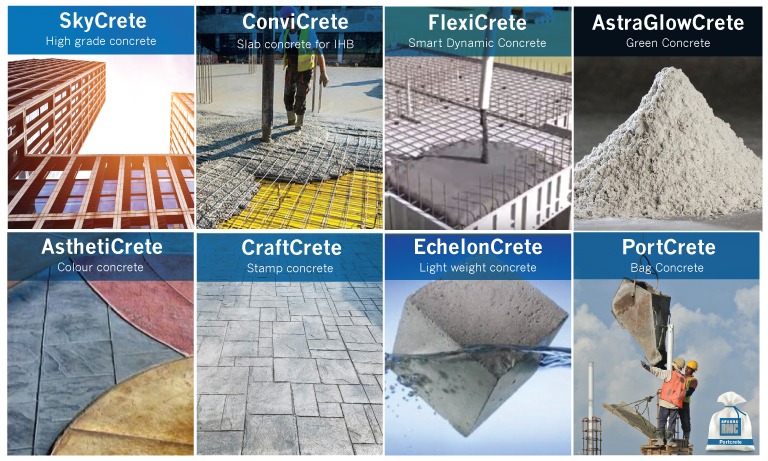
    Aparna RMC supplies ready-mix concrete for residential, commercial and infrastructure projects. Its range includes high-grade, slab, self-compacting, smart dynamic, green, colour, stamp, lightweight, fibre-reinforced, steel fibre-reinforced, and temperature-controlled concrete. Its product range also includes glass fibre reinforced, porous, and bag concrete.

    Aparna RMC produces concrete grades from M5 to M80, with customised mixes for different project requirements.

    Aparna RMC at a Glance

    For the right concrete type and grade, the mix should be selected based on the project requirements, application, and site conditions.

    Frequently Asked Questions

    The four common types are plain, reinforced, prestressed, and precast concrete. Plain has no reinforcement, reinforced uses steel, prestressed uses tensioned steel, and precast is made off-site.

    M20, M30, and M40 indicate compressive strengths of 20, 30, and 40 MPa at 28 days.

    The number of concrete types varies because concrete can be classified by binder, density, reinforcement, production and placement, and performance.

    Ultra-high-performance concrete (UHPC) is among the strongest, reaching 120–200 MPa. Conventional grades can reach M80 and above.

    PCC has no steel reinforcement and is mainly used for non-structural work. RCC contains steel reinforcement and is used for structural elements such as beams, slabs, and columns.

    M20–M25 is commonly used for residential slabs, while commercial slabs may use M25–M30, depending on load and exposure.

    Reinforced cement concrete (RCC) is widely used for structural work, often supplied as ready-mix concrete.

    M20–M25 is commonly used for residential foundations and M25–M30 for commercial foundations. Higher grades may be required for severe exposure conditions.

    References and Standards

    • IS 456:2000 — Plain and Reinforced Concrete, Code of Practice
    • IS 10262:2019 — Concrete Mix Proportioning, Guidelines
    • IS 383:2016 — Coarse and Fine Aggregate for Concrete, Specification
    • IS 1343:2012 — Prestressed Concrete, Code of Practice
    • IS 4926:2003 — Ready-Mixed Concrete, Code of Practice
    • IS 3812 — Pulverized Fuel Ash, Specification
    • IS 16714:2018 — Ground Granulated Blast Furnace Slag for Use in Cement, Mortar and Concrete