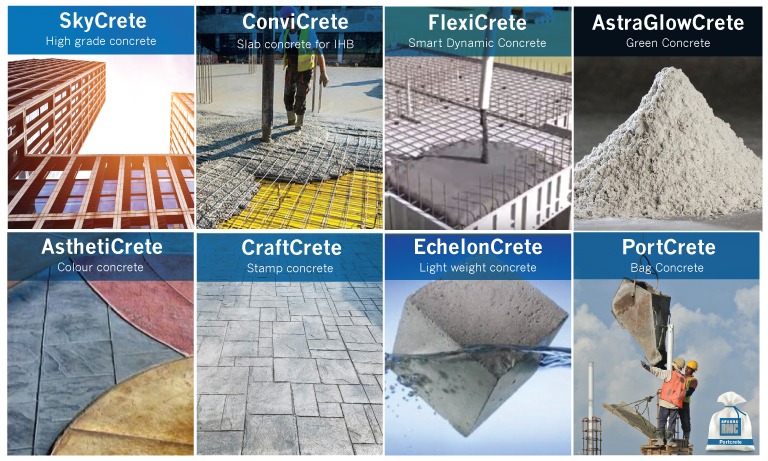
Concrete is a manufactured building material made by mixing cement, water, sand (fine aggregate), and gravel (coarse aggregate), combined with chemical admixtures. The construction industry classifies concrete in five ways: binder type, density, reinforcement, production and placement, and performance. Modern construction uses a wide range of concrete types, classified by binder, density, reinforcement, production and placement, and performance.
The five most common types of concrete are plain concrete for non-structural bases and pavements, reinforced concrete for beams, columns and slabs, prestressed concrete for long spans and bridges, precast concrete manufactured in factories and assembled at the site, and ready-mix concrete produced at a batching plant and delivered ready for pouring.
This article explains different types of concrete based on their classification and common uses.
Key takeaways
- Concrete is classified based on its materials, density, reinforcement, production method, placement method, and performance.
- The four main structural types are plain, reinforced, prestressed, and precast concrete. Each type is used for different construction needs.
- In a grade like M20, M means Mix, and 20 means the concrete has a characteristic compressive strength of 20 MPa after 28 days.
- Concrete grades start from M5 and can go up to M80 and above. Special high-performance concrete can have a strength of more than 200 MPa.
- The right type of concrete depends on the load, site conditions, exposure, and how the concrete will be placed.
What Is Concrete? Composition and How Types Are Classified?
The Four Core Ingredients
Concrete is made from four main ingredients: cement, water, coarse aggregate, and fine aggregate.
- Cement binds the other materials together.
- Water reacts with cement through a process called hydration, which makes concrete harden.
- Coarse aggregate, such as crushed stone or gravel, gives concrete strength and volume.
- Fine aggregate, usually sand, fills the gaps between coarse aggregate and improves workability.
Concrete does not harden because the water simply dries out. It hardens because cement reacts chemically with water.
By volume, concrete typically consists mainly of aggregate, with cement, water and air making up the remaining portion; the exact proportions vary with the mix design. The water cement ratio is usually between 0.40 and 0.60. A lower water cement ratio generally gives higher strength but can make the concrete less workable.
Admixtures can be added to change the properties of concrete. Plasticisers improve workability, retarders slow setting, accelerators speed up setting, and air-entraining agents add controlled air bubbles.
Materials such as fly ash, GGBS, and silica fume can replace part of the cement in a mix.
How Concrete Types Are Classified?
Concrete can be classified in different ways, and one type can belong to more than one category. For example, ready-mix concrete can also be self-compacting or fibre-reinforced. This is why different sources may list different numbers of concrete types.
| Classified by | What varies | Examples |
|---|---|---|
| Binder | What holds the aggregate together | Portland cement concrete, limecrete, polymer concrete, geopolymer concrete |
| Density | Unit weight of the hardened concrete | Lightweight, normal-weight, heavyweight |
| Reinforcement | What carries the tensile load | Plain, reinforced, prestressed, fibre-reinforced, ferrocement |
| Performance | What property is it engineered for | High-strength, high-performance, self-compacting, rapid-set, pervious |
Nominal Mix vs Design Mix
Concrete mixes are mainly of two types: nominal mix and design mix.
Nominal mix uses fixed proportions of cement, sand, and aggregate. As per IS 456:2000, it is permitted up to M20. The standard ratios are:
- M5: 1:5:10
- M7.5: 1:4:8
- M10: 1:3:6
- M15: 1:2:4
- M20: 1:1.5:3
Nominal mix is mainly suitable for small-scale and lower-grade construction where simple and consistent proportions are needed.
The design mix is prepared using laboratory trials to achieve the required strength and performance. The mix proportions are designed as per IS 10262. It provides better control and is generally more suitable for higher grades of concrete. As per IS 456, grades above M20 require a design mix.
All Types of Concrete at a Glance
The table below gives a quick overview of the concrete types covered in this article, including their main property and common uses:
| Type | Classified by | Key property | Typical strength / range | Main uses |
|---|---|---|---|---|
| Plain (PCC) | Reinforcement | No steel reinforcement | 10–20 MPa | Levelling, sub-base, flooring |
| Normal-strength | Performance | General-purpose concrete | 10–40 MPa | Residential and general construction |
| Reinforced (RCC) | Reinforcement | Steel carries tension | M20 and above | Beams, columns, slabs, footings |
| Prestressed | Reinforcement | Tensioned tendons | M30–M40 minimum | Bridges, long-span roofs |
| Precast | Production | Made off-site | Varies | Staircases, lintels, slabs |
| High-strength | Performance | Higher strength | Above 40 MPa | High-rise columns, precast work |
| High-performance (HPC) | Performance | Better durability and performance | Varies | Marine and coastal structures |
| Ultra-high-performance (UHPC) | Performance | Very high strength, often with fibres | 150–200 MPa | Bridge joints, thin panels |
| Rapid-set / rapid-hardening | Performance | Gains strength quickly | Varies | Road repairs, emergency work |
| Temperature-controlled concrete | Performance | Controls concrete temperature and heat of hydration | Grade-dependent | Mass pours, raft foundations, high-rise and infrastructure projects |
| Lightweight | Density | Uses lightweight aggregates | Below 1,920 kg/m3 | Blocks, bridge decks, insulation |
| Heavyweight | Density | Uses dense aggregates | 3,000–4,000 kg/m3 | Radiation shielding, counterweights |
| Air-entrained | Performance | Contains small air bubbles | 3–6% air | Freeze-thaw applications |
| Steel fibre reinforced | Reinforcement | Steel fibres control cracking | Varies | Industrial floors, tunnels |
| Glass fibre reinforced | Reinforcement | Glass fibres provide reinforcement | Varies | Façades, mouldings |
| Synthetic fibre | Reinforcement | Helps control cracks | Varies | Slabs, screeds |
| Polymer concrete | Binder | Uses resin instead of cement | 60–100 MPa | Chemical floors, linings |
| Ferrocement | Reinforcement | Uses layers of wire mesh; typically 10–40 mm thick | Varies | Tanks, boats, domes |
| Ready-mix (RMC) | Production | Plant-batched concrete | Varies | Medium and large projects |
| Slab concrete | Production | Ready-mix concrete designed for slab and residential applications | Grade-dependent | Residential slabs, basements, floors |
| Bag concrete | Production | Portable concrete supplied in bags for small or access-restricted pours | Grade-dependent | Column starters, small columns, staircases, trenches |
| Site-mixed | Production | Mixed at the site | Varies | Small and remote projects |
| Self-compacting (SCC) | Performance | Flows without vibration | 650–750 mm slump flow | Congested reinforcement |
| Smart Dynamic Concrete (SDC) | Performance | High-flow, self-consolidating concrete designed for smooth placement | Grade-dependent | Mivan construction, load-bearing walls, congested sections |
| Pumped | Production | Designed for pumping | 100–150 mm slump | High-rise construction |
| Shotcrete / guniting | Production | Sprayed onto the surface | Varies | Tunnels, slope stabilisation |
| Vacuum concrete | Production | Excess water is removed | Higher early strength | Floors, deck slabs |
| Roller-compacted | Production | Compacted using rollers | Varies | Pavements, dams |
| Tremie / underwater | Production | Placed through a pipe underwater | 150–200 mm slump | Piles, diaphragm walls |
| Mass concrete | Performance | Controls heat from hydration | Varies | Dams, raft foundations |
| Fly ash concrete | Sustainability | Part of the cement is replaced with fly ash | Varies | Mass and marine structures |
| GGBS / slag concrete | Sustainability | Uses GGBS as part of the binder | Varies | Foundations, marine structures |
| Green concrete | Sustainability | Reduces environmental impact | Varies | General construction |
| Recycled aggregate concrete | Sustainability | Uses recycled aggregates | Varies | Sub-bases, non-structural work |
| Limecrete | Binder | Uses lime as a binder | Low | Heritage buildings |
Standard and Structural Types of Concrete
Plain or Ordinary Concrete (PCC)
PCC has no steel reinforcement. It is strong in compression but weak in tension.
- Common mixes: 1:2:4 (M15), 1:3:6 (M10)
- Strength: 10–20 MPa
- Uses: Levelling courses, sub-bases, flooring and kerbs.
Normal-Strength Concrete
Normal-strength concrete is used for general construction and usually has a strength of 10–40 MPa.
Reinforced Cement Concrete (RCC)
RCC contains steel bars or mesh. Concrete carries compression, while steel carries tension and bending.
- Minimum grade: M20 under mild exposure, as per IS 456:2000.
- Uses: Beams, columns, slabs, footings, retaining walls and bridge decks.
Prestressed Concrete
Prestressed concrete uses tensioned steel tendons to improve load capacity and allow longer spans.
- Pre-tensioning: Tendons are tensioned before casting.
- Post-tensioning: Tendons are tensioned after casting.
Minimum grade: M40 for pre-tensioned and M30 for post-tensioned work, as per IS 1343.
Uses: Bridges, long-span roofs, parking structures and transfer beams.
Precast Concrete
Precast concrete is made and cured away from the site and then installed at the site. It can be plain, reinforced, or prestressed.
- Benefits: Faster construction and better quality control.
- Limitations: Transport and lifting.
- Uses: Staircases, lintels, hollow-core slabs, poles, drainage units and facade panels.
RCC vs PCC: What’s the Difference?
| PCC | RCC |
|---|---|
| No steel | Steel reinforcement |
| Compression | Compression + tension |
| Non-structural work | Structural work |
| Levelling, flooring, sub-bases | Beams, slabs, columns, footings |
Strength and Performance-Based Types
These types are classified based on the strength or performance required.
High-Strength Concrete
High-strength concrete has a compressive strength above 40 MPa (M40 and above) in India. It uses a low water-cement ratio and may contain materials such as silica fume.
Uses: High-rise columns, bridge components, transfer structures and precast elements.
High-Performance Concrete (HPC)
HPC is designed to meet specific requirements such as strength, durability, low permeability and workability.
It may use fly ash, GGBS or silica fume.
Uses: Marine structures, infrastructure and structures exposed to harsh conditions.
Ultra-High-Performance Concrete (UHPC)
UHPC has a compressive strength of 120 MPa or more, commonly around 150–200 MPa.
It uses a very low water-binder ratio and usually contains fine sand, cement, silica fume and steel fibres, without coarse aggregate.
Uses: Bridge joints, thin panels, structural repairs and blast-resistant structures.
Rapid-Set and Rapid-Hardening Concrete
These types are designed to set or gain strength quickly, often within hours.
Uses: Road and runway repairs, emergency work, precast production and fixing posts or anchors.
Temperature controlled concrete
This concrete manages heat of hydration and setting behavior using chilled water, ice, SCMs, and admixtures. It maintains workability and reduces thermal and plastic-shrinkage cracking.
Uses: Mass pours, raft/bridge foundations, high-rises, and extreme-temperature infrastructure.
Density-Based Types
These types are classified based on the density of the concrete.
Lightweight Concrete
Lightweight concrete has a dry density below 1,920 kg/m³. It uses lightweight aggregates such as LECA, pumice, perlite and vermiculite.
It reduces the dead load and provides better insulation but generally has lower strength.
Uses: Bridge decks, blocks, floor screeds, roof insulation and fire protection.
High-Density or Heavyweight Concrete
Heavyweight concrete has a density of about 3,000–4,000 kg/m³. It uses dense aggregates such as barytes, magnetite, and haematite.
Uses: Radiation shielding, X-ray and radiotherapy rooms, counterweights and offshore ballast.
Air-Entrained Concrete
Air-entrained concrete contains 3–6% small air bubbles. These bubbles help protect concrete from freeze-thaw damage and improve workability.
Uses: Pavements, hydraulic structures, and areas exposed to freezing conditions.
Fibre-Reinforced and Composite Types
These types use fibres or other materials to improve crack control, strength or durability.
Steel Fibre Reinforced Concrete (SFRC)
SFRC contains steel fibres mixed throughout the concrete. The fibres help control cracks and improve toughness and impact resistance.
Uses: Industrial floors, tunnel linings, shotcrete, precast units and airport pavements.
Glass Fibre Reinforced Concrete (GFRC)
GFRC uses alkali-resistant glass fibres and is mainly used for thin, lightweight architectural panels.
Uses: Facades, cladding, mouldings, permanent formwork and street furniture.
Polypropylene and Synthetic Fibre Concrete
Synthetic fibres help control cracking. Micro-fibres control early shrinkage cracks, while macro-fibres provide crack control after hardening.
They do not corrode and can also improve fire performance.
Uses: Slabs, screeds, precast units, shotcrete and tunnel linings.
Polymer Concrete
Polymer concrete uses polymer resin instead of cement to bind the aggregate. It has high strength, low permeability, and good chemical resistance. The compressive strength of this concrete ranges from 60–100 MPa.
Uses: Chemical plant floors, drainage channels, sewer linings, repair work, and machine bases.
Ferrocement
Ferrocement uses layers of fine steel wire mesh and cement mortar, without coarse aggregate. It is usually 10–40 mm thick and has good crack resistance.
Uses: Water tanks, boat hulls, domes, shell roofs and precast components.
Production and Placement Method Types
These types are classified based on how concrete is made, transported or placed.
Ready-Mix Concrete (RMC)
RMC is mixed at a central batching plant and delivered to the site in transit mixers. In India, it is covered by IS 4926.
- Benefits: Consistent quality, less waste, faster placement, and less on-site storage.
- Uses: Medium and large construction projects.
Slab Concrete
Slab concrete is ready-mix concrete supplied in the required grade for slabs and other residential applications. Plant-controlled mixing provides consistent quality, reduces on-site material handling and labour, and supports economical placement across different residential grades.
Uses: Residential slabs, basement slabs, floors, villas, individual houses, bungalows and apartments.
Bag Concrete
Bag concrete is supplied in portable bags for places where regular concrete delivery or pumping is difficult. It is easy to carry and handle, making it suitable for small concreting jobs and restricted-access areas.
Uses: Column starters, small columns, staircases, trenches, pothole filling and other small concreting works.
Site-Mixed and Volumetric Concrete
Site-mixed concrete is mixed at the construction site. Volumetric concrete uses a mobile mixer to mix concrete as needed.
Uses: Small pours, remote sites, and locations far from batching plants.
Self-Compacting Concrete (SCC)
SCC flows into the formwork and compacts without vibration. Its typical slump flow is 650–750 mm.
Uses: Congested reinforcement, fair-face concrete, and precast work.
Smart Dynamic Concrete (SDC)
Smart Dynamic Concrete is a highly flowable, self-consolidating concrete designed to move efficiently through pumps, congested reinforcement and narrow sections. It reduces the need for conventional compaction, enables faster placement, lowers construction noise, and improves flow where conventional concrete may be difficult to place.
Uses: Mivan and aluminium-formwork construction, load-bearing walls, congested structural sections, precast elements, bridge decks and piers.
Pumped Concrete
Pumped concrete is designed to flow through concrete pumps. It usually has a slump of 100–150 mm.
Uses: High-rise buildings, tunnels, basements, and difficult-to-reach areas.
Shotcrete and Guniting
Shotcrete is sprayed onto a surface at high speed. Guniting generally refers to the dry-mix method.
Uses: Tunnel linings, slope stabilisation, swimming pools, repairs and canal linings.
Vacuum Concrete
Vacuum concrete uses vacuum equipment to remove excess water after placement. This improves surface hardness and wear resistance.
Uses: Industrial floors, deck slabs, and car parks.
Roller-Compacted Concrete
Roller-compacted concrete is a zero-slump mix placed with an asphalt paver and compacted using rollers.
Uses: Industrial pavements, ports, dams, mining roads, and road shoulders.
Tremie and Underwater Concrete
Tremie concrete is placed underwater through a tremie pipe. The pipe remains inside the concrete during placement to prevent water from entering.
Uses: Bored piles, diaphragm walls, bridge foundations, marine works and cofferdams.
Mass Concrete
Mass concrete is used for large pours where heat from cement hydration needs to be controlled.
Uses: Dams, raft foundations, bridge pier bases, and thick retaining structures.
Sustainable and Low-Carbon Concrete Types
These types aim to reduce the environmental impact of concrete.
Fly Ash Concrete
Fly ash concrete replaces part of the cement with fly ash from coal-fired power plants.
It improves workability, reduces heat and permeability, and can improve long-term strength.
Replacement: 15–35%; high-volume mixes: 35–60%
Uses: Mass concrete, marine structures, pavements and general construction.
GGBS or Slag Concrete
GGBS concrete replaces part of the cement with Ground Granulated Blast-furnace Slag (GGBS) from iron production.
It improves resistance to sulphates and chloride penetration and reduces heat of hydration.
Replacement: 25–70%, up to 80% for some mass concrete
Uses: Marine structures, foundations, mass concrete and sulphate-exposed areas.
Green Concrete
Green concrete is designed to reduce environmental impact by using materials such as fly ash, GGBS, recycled aggregates, and manufactured sand.
Uses: Buildings, roads, bridges, foundations, and other applications where required strength and durability are achieved.
Recycled Aggregate Concrete
This concrete uses crushed concrete from demolished structures to replace some natural aggregate.
It uses more water and may have lower strength than conventional concrete.
- IS 383:2016: Permits recycled concrete aggregate up to 25% in plain concrete and 20% in reinforced concrete for specified applications.
- Replacement: Up to 25% for plain concrete; up to 20% for reinforced concrete
- Uses: Non-structural concrete, sub-bases, kerbs, drainage works and lower-grade structural work.
Limecrete
Limecrete uses lime instead of Portland cement as the binder. It is breathable but has lower strength and gains strength more slowly than cement concrete.
Uses: Heritage buildings, traditional floors, vaults, domes, and lime screeds.
Geopolymer Concrete
Geopolymer concrete does not use Portland cement. It uses materials such as fly ash or GGBS with an alkaline solution.
It can significantly reduce CO₂ emissions and has good resistance to acid attack and high temperatures. Some mixes require heat curing.
Uses: Precast units, railway sleepers, marine structures and acid-resistant flooring.
Hempcrete
Hempcrete uses a mixture of hemp hurds (shives) and a lime-based binder instead of cement and stone aggregates.
It is lightweight, highly insulating, and carbon-negative as the hemp plant absorbs more CO₂ during its growth than is emitted during manufacturing.
Uses: Non-structural insulation walls, roof insulation, floor slabs, and timber frame infills.
Ferrock
Ferrock is an emerging experimental material made using recycled industrial materials, including iron-rich waste and silica, with carbon dioxide involved in its formation. It is being explored as a potential low-carbon alternative to conventional cement-based materials.
Because Ferrock has limited commercial use, its performance and applications are still being evaluated.
Uses: Potential applications include marine and other specialised environments, but commercial use remains limited.
Silica Fume Concrete
Silica fume concrete replaces a small portion of cement with ultra-fine silica fume, a byproduct of silicon metal production.
It creates an extremely dense microstructure, radically increasing compressive strength and lowering permeability to chemicals.
Replacement: 5–12%
Uses: High-rise buildings, high-strength structural columns, heavy-wear industrial floors, and bridge decks.
LC3 (Limestone Calcined Clay Cement) Concrete
LC3 concrete utilizes a blend of calcined clay, crushed limestone, and gypsum to replace a major portion of traditional clinker.
It reduces manufacturing CO₂ emissions by up to 40% and achieves high structural strength using widely available low-grade clays.
Replacement: Clinker replacement: Up to 50%
Uses: General structural concrete, reinforced concrete frames, masonry mortars, and structural plastering work.
Decorative and Architectural Concrete Types
These types mainly involve surface finishes or decorative treatments rather than completely different concrete mixes.
Coloured Concrete
Coloured concrete uses pigments added to the mix or applied to the surface.
Uses: Facades, landscaping, feature floors and precast panels.
Stamped Concrete
Stamped concrete is a finishing method where patterns are pressed into fresh concrete. It can resemble stone, brick, tile, or wood.
Uses: Driveways, patios, pool areas, walkways, and feature floors.
Polished and Exposed-Aggregate Concrete
Polished concrete is ground and polished to create a smooth finish. Exposed-aggregate concrete removes the surface layer to show the aggregate underneath.
Uses: Retail floors, warehouses, driveways, pool decks, and public paving.
Glass Concrete
Glass concrete uses recycled crushed glass as aggregate. Fly ash or GGBS, can be used to control the risk of alkali-silica reaction.
Uses: Decorative flooring, worktops, façade panels and terrazzo.
Special-Purpose Concrete Types
These types are designed for specific applications.
Pervious or Permeable Concrete
Pervious concrete has an open structure that allows water to pass through it. It usually has a strength of 3.5–28 MPa.
Uses: Car parks, footpaths, driveways, low-traffic roads and drainage systems.
Asphalt Concrete
Asphalt concrete uses bitumen instead of cement to bind the aggregate. It is a flexible pavement material.
Uses: Highways, urban roads, car parks, airport taxiways, and running tracks.
Smart and Self-Healing Concrete
Smart concrete can help monitor structural changes, while self-healing concrete can seal small cracks using methods such as bacteria or healing agents.
Uses: Seismic structures, tunnels, marine structures, and critical infrastructure.
3D-Printed Concrete
3D-printed concrete is placed layer by layer using a robotic or gantry-mounted nozzle, reducing the need for formwork.
The main challenge is providing reinforcement while printing.
Uses: Low-rise housing, architectural elements, street furniture, and demonstration bridge projects.
Concrete Grades Explained: M5 to M80
What Does the M in M20 Concrete Mean?
The M stands for Mix. The number shows the characteristic compressive strength in MPa at 28 days.
For example, M20 means 20 MPa at 28 days.
Concrete grades range from M5 to M80 and above.
Ordinary Grades: M5 to M20
These grades can use nominal mixes up to M20, as permitted by IS 456:2000.
| Grade | Mix ratio | Strength | Common use |
|---|---|---|---|
| M5 | 1:5:10 | 5 MPa | Levelling, filling |
| M7.5 | 1:4:8 | 7.5 MPa | Lean concrete, filling |
| M10 | 1:3:6 | 10 MPa | PCC bedding, floor bases |
| M15 | 1:2:4 | 15 MPa | Pavements, flooring, kerbs |
| M20 | 1:1.5:3 | 20 MPa | Residential RCC, slabs, beams, and columns |
Standard Grades: M25 to M55
These grades use a design mix based on laboratory trials under IS 10262.
| Grade | Strength | Common use |
|---|---|---|
| M25 | 25 MPa | Residential RCC |
| M30 | 30 MPa | Commercial structures, pavements |
| M35 | 35 MPa | Precast and commercial work |
| M40 | 40 MPa | High-rise columns, bridges, prestressed work |
| M45 | 45 MPa | Prestressed girders, industrial structures |
| M50 | 50 MPa | Bridge girders, high-rise structures |
| M55 | 55 MPa | Specialised structural work |
High-Strength Grades: M60 to M80
These grades are used for applications requiring higher strength and tighter quality control.
| Grade | Strength | Common use |
|---|---|---|
| M60 | 60 MPa | Tall building columns, bridges |
| M65 | 65 MPa | Heavily loaded columns, precast |
| M70 | 70 MPa | High-rise cores, transfer structures |
| M75 | 75 MPa | Long-span bridges, infrastructure |
| M80 | 80 MPa | Tall buildings, major bridges, precast |
| Application | Concrete type | Typical grade |
|---|---|---|
| House foundation | RCC | M20–M25 |
| Ground-floor slab | PCC or RCC | M15–M20 |
| Suspended slab | RCC | M20–M25 |
| Columns and beams | RCC | M20–M30 |
| Boundary wall | PCC or precast | M10–M15 |
| Driveway | PCC | M20–M25 |
| Patio / decorative paving | Coloured or stamped PCC | M15–M20 |
| Industrial / warehouse floor | SFRC or RCC | M30–M40 |
| Water tank | Low-permeability RCC | M30+ |
| Swimming pool | RCC or SCC | M30+ |
| Road pavement | PQC or RCC pavement | M30–M40 |
| Basement retaining wall | RCC | M25–M30 |
How to Choose the Right Type of Concrete?
Choosing concrete doesn’t mean picking a random mix from a list because it is a critical structural decision.
To get the best results, you need to match the technical properties of the mix with the physical demands of your project.
Choosing by application
Think what the concrete need to do. Does it need to hold up a heavy roof, bend without breaking, or keep water out? What you are building tells you exactly what kind of concrete mix you need.
| What you are building | Concrete Type | Strength | Simple Reason |
|---|---|---|---|
| House foundation | Standard | M20–M25 | Stops the house from sinking. |
| Ground-floor slab | Plain | M15–M20 | Makes a flat floor over the dirt. |
| Suspended slab | Reinforced | M25 | Stops upper floors from bending or sagging. |
| Columns and beams | Strong Reinforced | M25–M30 | Carries the heavy weight of the building. |
| Boundary wall | Standard | M20 | Stands firm against strong wind. |
| Driveway | Fibre-reinforced | M20–M25 | Stops cracks from vehicle tires. |
| Patio / Decorative paving | Smooth | M20 | Easy to shape and make look nice. |
| Industrial / Warehouse floor | Extra Strong | M30+ | Won’t break under heavy trucks and forks. |
| Water tank | Waterproof | M30 | Blocks water from leaking out. |
| Swimming pool | Watertight | M30 | Keeps water safely locked inside. |
| Road pavement | Heavy-duty | M30–M40 | Takes constant traffic pounding. |
| Basement retaining wall | Waterproof | M30 | Keeps wet mud and outside water out. |
Choosing by Environment and Exposure
- Coastal or marine: Use GGBS or fly ash blends, with at least M30 and suitable reinforcement cover.
- Sulphate-bearing soil: Use sulphate-resisting cement or high GGBS content.
- Hot climate: Use retarders, place concrete during cooler hours, and cure properly.
- Heavy monsoon: Use at least M30 for severe exposure.
- Freeze-thaw areas: Use air-entrained concrete.
- Industrial chemical exposure: Consider polymer concrete or protective coatings.
- Higher exposure: Follow IS 456:2000 requirements for increased reinforcement cover.
A Six-Point Checklist Before You Order
- What load will the concrete carry?
- Will the element be exposed to harsh conditions?
- How will the concrete be placed?
- What finish is required?
- How quickly is strength needed?
- How much concrete is required, and can the pour be completed continuously?
Types of Concrete Aparna RMC Supplies
Aparna RMC supplies ready-mix concrete for residential, commercial and infrastructure projects. Its range includes high-grade, slab, self-compacting, smart dynamic, green, colour, stamp, lightweight, fibre-reinforced, steel fibre-reinforced, and temperature-controlled concrete. Its product range also includes glass fibre reinforced, porous, and bag concrete.
Aparna RMC produces concrete grades from M5 to M80, with customised mixes for different project requirements.
Aparna RMC at a Glance
- Concrete grades: M5 to M80
- RMC plants: 36 plants across 5 states
- Locations: Hyderabad, Bengaluru, Chennai, Mangaluru, Mumbai, and Visakhapatnam
- Quality: ISO-certified processes
- Equipment: 70+ pumps and 300+ transit mixers
For the right concrete type and grade, the mix should be selected based on the project requirements, application, and site conditions.
Frequently Asked Questions
The four common types are plain, reinforced, prestressed, and precast concrete. Plain has no reinforcement, reinforced uses steel, prestressed uses tensioned steel, and precast is made off-site.
M20, M30, and M40 indicate compressive strengths of 20, 30, and 40 MPa at 28 days.
The number of concrete types varies because concrete can be classified by binder, density, reinforcement, production and placement, and performance.
Ultra-high-performance concrete (UHPC) is among the strongest, reaching 120–200 MPa. Conventional grades can reach M80 and above.
PCC has no steel reinforcement and is mainly used for non-structural work. RCC contains steel reinforcement and is used for structural elements such as beams, slabs, and columns.
M20–M25 is commonly used for residential slabs, while commercial slabs may use M25–M30, depending on load and exposure.
Reinforced cement concrete (RCC) is widely used for structural work, often supplied as ready-mix concrete.
M20–M25 is commonly used for residential foundations and M25–M30 for commercial foundations. Higher grades may be required for severe exposure conditions.
References and Standards
- IS 456:2000 — Plain and Reinforced Concrete, Code of Practice
- IS 10262:2019 — Concrete Mix Proportioning, Guidelines
- IS 383:2016 — Coarse and Fine Aggregate for Concrete, Specification
- IS 1343:2012 — Prestressed Concrete, Code of Practice
- IS 4926:2003 — Ready-Mixed Concrete, Code of Practice
- IS 3812 — Pulverized Fuel Ash, Specification
- IS 16714:2018 — Ground Granulated Blast Furnace Slag for Use in Cement, Mortar and Concrete