Aparna RMC

Category: Blog

  • Steel Fiber Reinforced Concrete (SFRC): Types, Properties, Dosage & Applications

    Steel Fiber Reinforced Concrete (SFRC): Types, Properties, Dosage & Applications

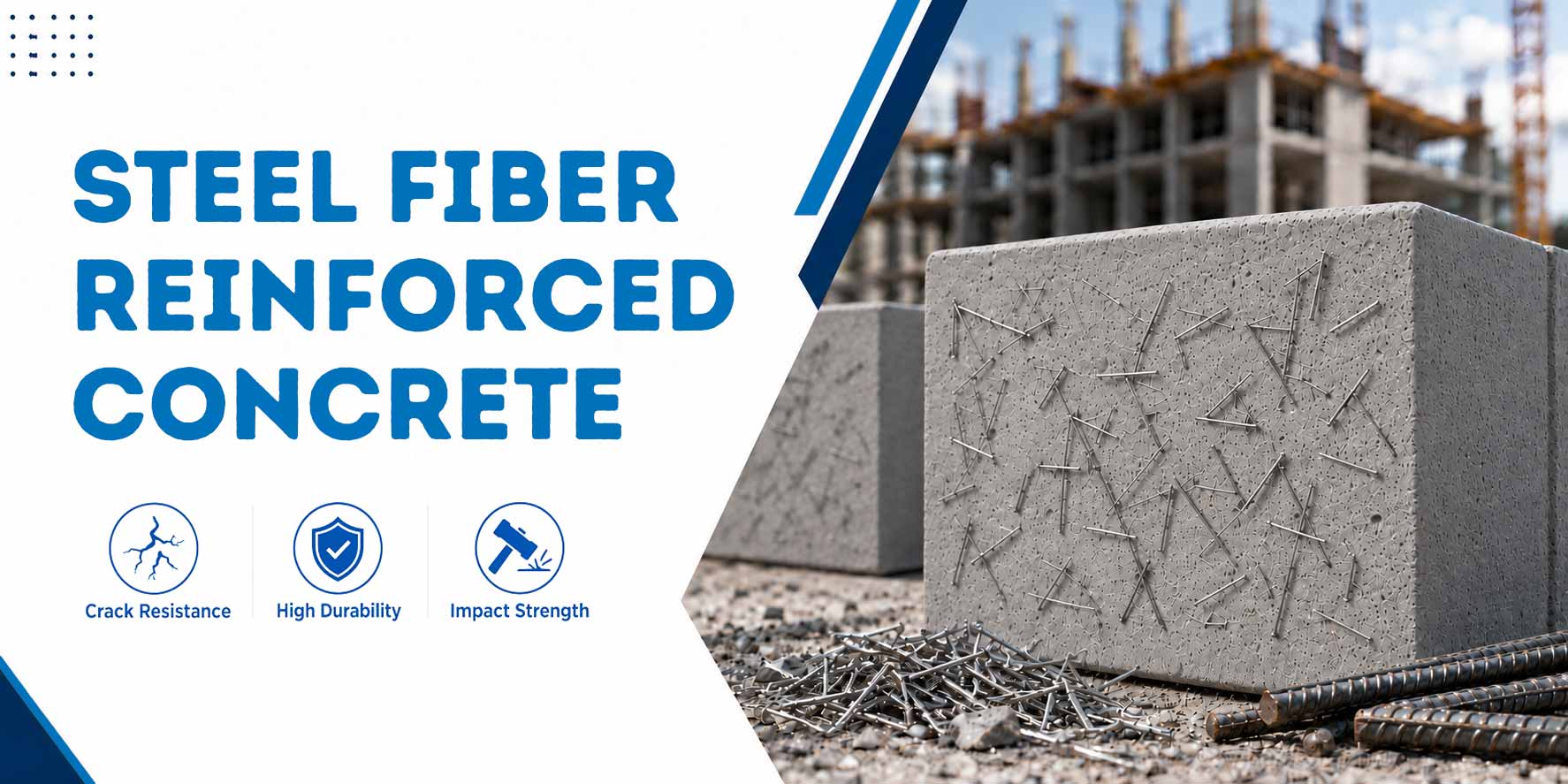
    Steel Fiber Reinforced Concrete (SFRC) is concrete in which short steel fibers are distributed throughout the concrete matrix to improve its post-cracking performance. Depending on the fiber geometry, length, diameter, aspect ratio, and dosage, steel fibers can improve crack control, residual strength, impact resistance, fatigue performance, and flexural toughness.

    What Is Steel Fiber Reinforced Concrete?

    Plain concrete is strong in compression but comparatively weak in tension. Once tensile cracks form, its ability to carry load reduces significantly.

    Steel fiber-reinforced concrete addresses this limitation by introducing short steel fibers into the concrete matrix. The fibers bridge cracks as they form and help the concrete retain load-carrying capacity after cracking.

    Unlike traditional reinforcement, which is placed at predetermined locations, steel fibers are distributed throughout the concrete matrix. Their performance depends on factors such as fiber length, diameter, aspect ratio, geometry, and dosage.

    How Do Steel Fibers Work in Concrete?

    As cracks develop because of shrinkage, loading, or impact, steel fibers cross the crack and transfer stress across the opening. This improves the post-cracking behaviour of the concrete and increases its toughness and energy absorption capacity.

    The way a fiber anchors into concrete depends on its shape. Hooked and crimped fibers use mechanical anchorage, while straight fibers mainly rely on friction between the fiber and the surrounding concrete.

    Fiber length controls the anchoring length and the chance of a fiber bridging a crack. Fiber diameter and aspect ratio also affect post-crack strength and energy absorption.

    Types of Steel Fibers Used in Concrete

    Steel fibers are available in different shapes and sizes. The geometry affects how well a fiber anchors into concrete and resists being pulled out.

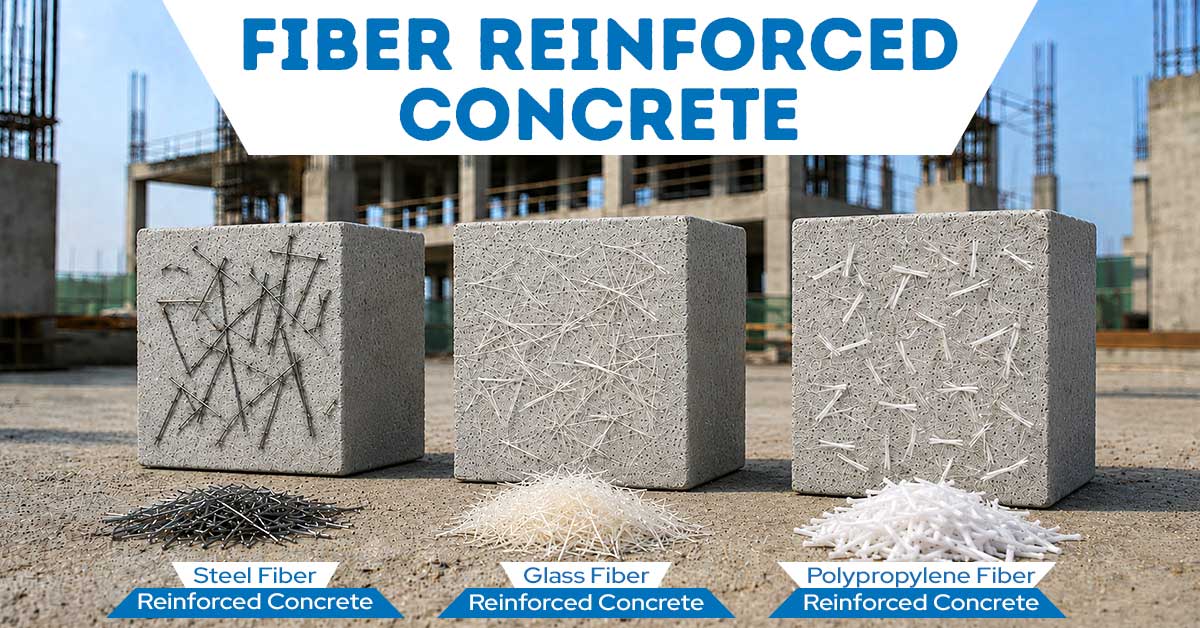
    Common types include hooked-end, micro, crimped/wavy, and straight fibers.

    Hooked-End Fibers

    Hooked-end fibers have bent ends that provide strong mechanical anchorage inside the concrete. They are used in applications including industrial floors, warehouse slabs-on-grade, precast tunnel segments, and pavement overlays.

    Typical lengths include 30 mm, 35 mm, 50 mm and 60 mm, with aspect ratios of 50–65. The hooked ends act as small anchors and require more energy to pull out of the concrete.

    Micro Steel Fibers (Brass/Copper-Coated)

    Micro steel fibers are short, fine fibers used in applications such as Ultra-High-Performance Concrete (UHPC), military blast slabs, bank vaults, and specialised structural repair grouts.

    Typical lengths include 6 mm and 13 mm, with aspect ratios of 60–80. Brass/copper-coated micro fibers have a high surface area and high tensile wire strength.

    Crimped/Wavy Fibers

    Crimped or wavy fibers have a continuous wave shape that provides mechanical anchorage along the fiber length. They are used in applications including wet- and dry-mix shotcrete, infrastructure tunnels, slope stabilisation and high-impact industrial hardstandings.

    Typical lengths include 25 mm, 30 mm and 50 mm, with aspect ratios of approximately 45–60.

    Straight Fibers

    Straight steel fibers have no mechanical deformation and rely mainly on friction with the surrounding concrete. They are used for secondary shrinkage control, thin-sheet architectural paneling and specialised mixes.

    Typical lengths include 12 mm, 20 mm and 30 mm, with aspect ratios of approximately 60–80.

    Steel Fiber Classifications and Specifications

    Fiber type Typical length Typical aspect ratio (L/d) Main applications
    Hooked-end 30, 35, 50, 60 mm 50–65 Industrial floors, warehouse slabs, tunnel segments, pavements
    Micro (brass/copper-coated) 6, 13 mm 60–80 UHPC, specialised repair grouts, high-impact applications
    Crimped/wavy 25, 30, 50 mm 45–60 Shotcrete, tunnels, slope stabilisation, industrial hardstandings
    Straight 12, 20, 30 mm 60–80 Shrinkage control, thin-sheet applications, specialised mixes

    Standard macro-fiber lengths generally range from 25–60 mm, while micro-fibers generally range from 6–13 mm. Fiber diameter typically ranges from 0.4–1.0 mm. Aspect ratio varies by fibre geometry and typically falls within the ranges shown in the table.

    Properties of Steel Fiber Reinforced Concrete

    SFRC changes the behaviour of concrete after cracking. The fibers help hold cracked sections together and allow the concrete to continue carrying load after cracks develop.

    Main Structural Benefits

    • Post-Crack Strength: Steel fibers improve the ability of concrete to carry load after cracking.
    • Impact Resistance: Fibers improve energy absorption when concrete is subjected to sudden or repeated impacts.
    • Fatigue Resistance: SFRC can provide improved performance under repeated loading, making it useful in floors, pavements and other heavily trafficked applications.
    • Crack Control: Fibers distributed throughout the concrete matrix help control crack development and crack opening.
    • Flexural Toughness: Fiber bridging improves energy absorption and residual performance after cracking.

    What Fibers Do Not Do?

    Steel fibers should not be considered a direct replacement for all conventional reinforcement. Their structural contribution depends on the fiber type, dosage, concrete mix and project-specific design.

    Steel fibers are designed to improve the behaviour of concrete after cracking. They should not be treated as a universal replacement for primary reinforcement.

    Property Plain concrete Steel fiber reinforced concrete
    Post-crack behaviour Rapid loss of load capacity Improved residual load-carrying capacity
    Impact resistance Lower Higher
    Fatigue performance Lower Improved
    Crack control Limited Improved
    Flexural toughness Lower Higher
    Compressive strength Primarily governed by the concrete mix Primarily governed by the concrete mix

    Steel Fiber Dosage and Mix Design

    Steel fiber dosage is generally specified in kilograms per cubic metre (kg/m³) or as a percentage by volume. The required dosage depends on the application, loading conditions, concrete grade, fiber characteristics and required post-crack performance.

    Dosage can be broadly grouped into low, medium and high ranges based on the required performance and application.  Low dosages are mainly used to control plastic and drying shrinkage cracking. Medium dosages can improve fatigue resistance, impact strength and shear performance. Higher dosages are used for applications exposed to high dynamic, seismic or other extreme forces.

    Indicative Steel Fiber Dosage Rates

    Application Indicative dosage
    Floor slabs / slabs-on-grade / industrial floors 20–40 kg/m3
    Road pavements / sprayed shotcrete/tunnel linings 30–60 kg/m3
    Precast structural elements / high-load structural nodes 40–80 kg/m3
    Steel micro-fibers for early crack control / UHPC 10–20 kg/m3

    These ranges are indicative. The final dosage should be selected based on the project requirements and approved design.

    Steel fiber dosage can also be expressed by volume. Based on a steel density of approximately 7,850 kg/m³, 0.5% steel fiber by volume is equivalent to approximately 39.25 kg/m³.

    Disclaimer: Final fiber dosage must be determined based on project-specific structural requirements and the approved mix design.

    Understanding Aspect Ratio and Fiber Balling

    Aspect ratio is the ratio of fiber length (L) to its nominal diameter (d). It affects the fiber’s ability to bridge cracks, anchor into concrete, and contribute to post-crack strength.

    Higher aspect ratios can improve post-cracking residual strength and energy absorption. However, when the aspect ratio becomes too high, fibers can become more flexible and interlock with each other during batching. Aspect ratios above 80 can increase the risk of fiber balling.

    How to Prevent Fiber Balling?

    • Add fibers gradually into an actively mixing concrete batch
    • Use glued fiber bundles where suitable
    • Make sure the concrete contains enough mortar to surround the fibers
    • Control aggregate grading, fiber dosage, and mixing procedures
    • Avoid adding fibers too quickly, as this can cause fibers to form tangled lumps

    Workability and Standards

    Adding steel fibers can reduce fresh concrete workability because the fibers increase internal friction within the concrete matrix.

    IS 10262:2019 provides the basic framework for calculating the quantities of water, cement, fine aggregate, and coarse aggregate for concrete mix proportioning. However, it does not contain a separate mix-design procedure specifically for steel fiber concrete.

    Fine aggregate: The fine-aggregate proportion should be increased by around 5–10% over standard IS 10262 proportions to provide a suitable mortar layer around the fibers.

    Aggregate size: The nominal maximum aggregate size should be limited to 20 mm, and for dense, high-dosage structural mixes it may be preferable to use 10–12.5 mm aggregate.

    Chemical admixtures: PCE-based superplasticisers can be used to improve workability and slump retention without increasing water content.

    Large aggregates such as 40 mm can interfere with fiber distribution and increase the risk of segregation in high-dosage mixes.

    External references such as ACI 544.3R and the UK Concrete Society’s TR34 may also be used for fiber reinforced concrete proportioning and production where appropriate.

    Important: Water should not be added simply to restore workability because this can change the water cement ratio and affect concrete strength and performance.

    Steel Fiber Reinforced Concrete vs Rebar

    Steel fibers and conventional reinforcement serve different purposes and should not automatically be treated as interchangeable.

    Steel fibers can be used in applications where distributed reinforcement is appropriate. In certain slabs, pavements, and similar applications, they may replace wire mesh or secondary reinforcement when permitted by the structural design.

    They cannot automatically replace primary reinforcement in beams, columns or other structural elements where reinforcement is specifically designed to resist calculated forces.

    Aspect Rebar / Mesh Steel Fibers
    Where reinforcement acts At designed locations based on structural calculations Distributed throughout the concrete matrix
    Placement Requires positioning and fixing Incorporated into the concrete mix
    Crack control Controls cracks at reinforcement locations Provides distributed crack control
    Typical use Primary and secondary reinforcement where structurally designed Floors, pavements, shotcrete and other designed SFRC applications
    Limitation Requires correct positioning and fixing Cannot automatically substitute for calculated primary reinforcement

    Advantages and Limitations of SFRC

    Advantages

    Distributed Crack Control: Fibers are distributed throughout the concrete matrix rather than being concentrated along specific reinforcement lines.

    • Reduced Reinforcement Placement: In applications designed for fiber reinforcement, the need for cutting, placing, and tying conventional mesh can be reduced.
    • Improved Toughness: Fibers improve post-cracking energy absorption and resistance to impact and repeated loading.
    • Potentially Larger Pour Areas: In suitably designed floor applications, SFRC can allow larger panels and help optimise joint layouts.

    Limitations

    • Higher Material Cost: SFRC generally costs more than plain concrete because of the additional fiber material.
    • Reduced Workability: Higher fiber dosages can make concrete more difficult to place and finish.
    • Fiber Exposure: Poor finishing or incorrect fiber selection can result in exposed fiber ends at the surface.
    • Mixing Requirements: Proper batching and mixing are important to prevent fiber balling and ensure uniform distribution.

    Applications of Steel Fiber Reinforced Concrete

    SFRC is used in applications where improved crack control, toughness, impact resistance and post-crack performance are required.

    • Industrial and Warehouse Floors: SFRC is widely used in industrial floors and slabs-on-grade subjected to forklift traffic, storage loads and repeated wheel loading.
    • Tunnel Linings and Shotcrete: Steel fibers can be incorporated into wet- and dry-mix shotcrete for tunnel linings, infrastructure tunnels and slope stabilisation, where improved toughness and crack control are required.
    • Roads and Pavements: Fiber-reinforced concrete can be used in pavement applications subjected to repeated wheel loads and fatigue.
    • Precast Elements: SFRC can be used in precast structural and infrastructure elements, including tunnel segments and other components where crack control and handling resistance are important.
    • Airport Runways: SFRC can be considered for selected heavy-duty pavement applications, including airport pavement, subject to project-specific design.
    • Machine Foundations and Heavy-Duty Hardstandings: SFRC can be considered for areas exposed to repeated impact, vibration and heavy industrial loading.

    IRC: SP:46-2013 provides calculations for the structural contribution of fibres in suitable fibre-reinforced pavement designs. It also states that, for specific light-to-medium axle-load conditions, the design may allow a reduction in slab thickness of 15–20% and changes to conventional joint reinforcement requirements. These changes must be based on the applicable pavement design and project conditions.

    Codes and Standards for Steel Fiber Reinforced Concrete

    SFRC design and material compliance in India involves multiple standards rather than relying on a single document.

    ASTM A820/A820M

    ASTM A820/A820M provides material requirements for steel fibers used in fiber-reinforced concrete.

    ASTM A820/A820M identifies five manufacturing types:

    • Type I: Cold-drawn wire
    • Type II: Cut sheet
    • Type III: Melt-extracted
    • Type IV: Mill-cut
    • Type V: Modified cold-drawn wire

    ASTM A820/A820M specifies requirements for fibre tensile strength, dimensions, bending performance and dimensional tolerances. High-performance steel fibres can have tensile strengths exceeding 1,100 MPa, depending on the fibre type and manufacturer. The standard also includes a cold-bend test.

    EN 14889-1

    EN 14889-1 specifies requirements for steel fibers used in concrete and provides a conformity-assessment framework.

    EN 14889-1 provides two relevant conformity-assessment pathways:

    • System 1 – Structural Use: Used when fibers are designed to contribute to load-bearing capacity or structural stability. This requires independent testing of residual flexural tensile strength.
    • System 3 – Non-Structural Use: Used when fibers are primarily intended for secondary crack or shrinkage control.

    EN 14651

    EN 14651 specifies the test method for determining the flexural tensile strength of fibre-reinforced concrete, including residual flexural tensile strength after cracking.

    ASTM C1609

    ASTM C1609 evaluates the flexural performance of fibre-reinforced concrete, including its load-carrying behaviour after cracking.

    fib Model Code 2010

    fib Model Code 2010 provides guidance for the design and performance assessment of fibre-reinforced concrete, including the use of residual tensile performance in structural design.

    IS 10262:2019

    IS 10262:2019 provides the basic framework for concrete mix proportioning. For SFRC, additional engineering adjustments are required to account for the effect of fibers on workability, aggregate balance and fresh-concrete behaviour.

    IS 456:2000

    IS 456:2000 provides the general requirements for plain and reinforced concrete design. SFRC projects may require additional standards and guidelines depending on the application, material performance, and structural design requirements.

    IRC: SP:46-2013

    IRC: SP:46-2013 guides the design of fibre-reinforced concrete pavements. Depending on the pavement design, loading conditions, and project requirements, fibre reinforcement can contribute to the structural performance of the slab and may influence slab thickness and conventional reinforcement requirements.

    IRC:112-2020

    IRC:112-2020 provides the structural framework for concrete road bridges and includes provisions relevant to integrating fiber reinforcement into applicable bridge structures.

    How Ready-Mix SFRC Is Produced and Delivered?

    Producing SFRC begins with an engineered base concrete mix, with the required fiber dosage incorporated as part of the approved mix design.

    Planned Mix

    The required fiber type, length, diameter, aspect ratio and dosage are determined according to the project’s performance requirements.

    Controlled Fiber Addition

    Steel fibers are introduced into the mixing process in a controlled manner to promote uniform dispersion and reduce the risk of fiber balling.

    Quality Control

    A wash-out test can be used to verify the actual fiber content in fresh concrete before it is discharged.

    The wash-out test is an important QC measure because it is not possible to visually confirm the fibre dosage once the fibres are dispersed through fresh concrete.

    Wash-Out Test

    A representative fresh concrete sample of around 5–10 litres can be taken from the middle third of the transit mixer’s discharge.

    The sample is weighed first. It is then washed through a suitable mesh while being agitated to remove the cement paste, admixtures and fine particles.

    The remaining coarse aggregate and steel fibers are separated. Because steel is magnetic, magnetic separation or manual sorting can be used to isolate the fibers.

    The recovered fibers are dried and weighed. The dry fibres should be weighed using a calibrated digital scale with a resolution of approximately ±0.1 g.

    The recovered fiber mass is divided by the known sample volume to calculate the actual fiber dosage in kg/m³. This value is then compared with the plant batch ticket. Where required, individual fibers can also be counted to check distribution.

    Aparna RMC SFRC

    Aparna RMC supplies plant-batched steel fiber-reinforced concrete as Ducticrete, with fiber dosage selected according to the requirements of the application. Contact Aparna RMC for project-specific requirements and quotations.

    Frequently Asked Questions On Steel Fiber Reinforced Concrete

    Steel Fiber Reinforced Concrete (SFRC) is concrete containing discontinuously distributed steel fibers that bridge cracks and improve post-cracking behaviour, flexural toughness, impact resistance and crack control.

    SFRC generally costs more than conventional concrete of the same grade because of the additional steel fiber material. The final cost depends on the fiber type, dosage, concrete grade, application and project requirements.

    For a project-specific quotation, contact the Aparna RMC technical team.

    No. Steel fibers cannot automatically replace primary reinforcement in beams, columns or other structural elements requiring designed reinforcement.

    However, in specific slab, pavement and other applications, steel fibers may replace wire mesh or secondary reinforcement where permitted by the structural design.

    The required dosage depends on the application and structural requirements. Indicative ranges include 20–40 kg/m³ for industrial floors, 30–60 kg/m³ for road pavements, sprayed shotcrete and tunnel linings, 40–80 kg/m³ for precast structural and high-load applications, and 10–20 kg/m³ for steel micro-fibers used for early crack control or UHPC.

    SFRC is governed through a framework of relevant Indian standards rather than one standalone code. Relevant standards and guidelines include IS 456:2000, IS 10262:2019, IRC: SP:46-2013 and IRC:112-2020, depending on the application and design requirement.

    SFRC is commonly used in industrial floors, slabs-on-grade, pavements, tunnel linings, shotcrete, precast elements, and other applications that require improved crack control, toughness, impact resistance, and post-cracking performance.

    The concrete’s alkalinity generally protects steel fibres embedded in concrete under normal conditions. However, protection depends on crack width, concrete cover and exposure conditions. Marine or chloride-rich environments require additional consideration because corrosion can occur where fibres are exposed through cracks.

  • M10 Concrete Ratio: Mix Proportion, Quantities and Uses

    M10 Concrete Ratio: Mix Proportion, Quantities and Uses

    M10 concrete has a nominal mix ratio of 1:3:6, meaning 1 part cement, 3 parts sand, and 6 parts coarse aggregate by volume. It has a characteristic compressive strength of 10 MPa (10 N/mm²) at 28 days and is mainly used for non-structural plain cement concrete (PCC) applications such as blinding, levelling courses and flooring bases. One cubic metre requires approximately 4.4 bags of 50 kg cement.

    Note: M10 also refers to a 10 mm metric bolt or screw thread. This page covers the M10 concrete grade only.

    Key Takeaways

    • The M10 mix ratio is 1:3:6 (cement : sand : coarse aggregate), by volume.
    • Characteristic compressive strength is 10 MPa (10 N/mm²) at 28 days.
    • One cubic metre of M10 concrete needs about 4.4 bags of cement (not 8 — that figure belongs to M20).
    • M10 is a PCC-only grade and is not permitted for reinforced concrete (RCC).
    • Mainly foundation blinding, levelling courses, flooring bases, pathways and drain bedding.
     

    This guide covers what M10 Grade Concrete Is, and its ratio, strength, water-cement ratio, workability, density, uses, and comparison with other grades.

    What Is M10 Grade Concrete?

    M10 grade concrete is a low-strength, non-structural concrete mix with a characteristic compressive strength of 10 N/mm² (10 MPa) measured on a standard cube at 28 days. It is one of the leanest concrete grades, so it is not specified for carrying structural load.

    What Does M10 Mean?

    In the “M10” designation, M stands for Mix, and 10 is the characteristic compressive strength in N/mm² that the concrete must achieve after 28 days of curing.

    For reference, 1 N/mm² is equal to 1 MPa, so M10 concrete and ‘10 MPa concrete’ mean the same thing.

    Why M10 Is Called a Lean Mix?

    M10 is called a lean mix because it contains a relatively high proportion of aggregate compared with cement. Its lower cement content makes it economical for applications where high structural strength is not required.

    M10 Concrete Ratio: 1 : 3 : 6

    The standard M10 concrete mix ratio is 1 : 3 : 6 — 1 part cement, 3 parts sand (fine aggregate), and 6 parts coarse aggregate. Put together, that’s 10 total parts.

    What the Ratio Means?

    For every unit of cement used, you add three equivalent units of sand and six equivalent units of coarse aggregate, measured by volume. This proportion gives M10 its target strength of 10 MPa at 28 days when mixed with a suitable water-cement ratio.

    Is the M10 Ratio by Volume or by Weight?

    The 1:3:6 ratio is by volume, not by weight. On site, this is typically measured using standard-sized boxes or gauge boxes for consistency, rather than weighing each material separately. To convert volume into weight requires applying the bulk density of each material, which is exactly what the quantity calculation below does.

    M10 Is a Nominal Mix, Not a Design Mix

    IS 456:2000 permits nominal (fixed-ratio) mixes for grades up to and including M20. Because M10 falls within the grades for which IS 456 permits nominal mixes. The standard 1:3:6 proportion is therefore used as the nominal mix ratio, rather than being treated as a project-specific design mix.

    Nominal mix ratios by grade

    The table outlines the standard nominal mix ratios and total parts for different grades of concrete.

    Grade Ratio (Cement : Sand : Aggregate) Total Parts
    M5 1 : 5 : 10 16
    M7.5 1 : 4 : 8 13
    M10 1 : 3 : 6 10
    M15 1 : 2 : 4 7
    M20 1 : 1.5 : 3 5.5

    M10 Concrete Quantities Per Cubic Metre

    Here is a step-by-step calculation of the cement, sand, aggregate, and water required for one cubic metre of M10 concrete.

    List per 1 m³

    • Cement:4 Bags (50kg each)
    • Sand:3 Cubic Feet (cft)
    • Stones:6 Cubic Feet (cft)
    • Water: 111 to 133 Litres

    The 3-Step Math Breakdown

    1. The Shrinkage Rule: Materials shrink when mixed, so you need 1.54 m³ of dry mix (raw cement powder, dry sand, and unmixed gravel/stones before any water is added) to make 1 m³ of wet concrete.
    2. The 10-Part Recipe: M10 concrete uses a 1:3:6 ratio, totaling 10 parts (1 cement + 3 sand + 6 stones).
    3. The Final Shares: Divide the 1.54 m³ dry mix into 10 shares:
    • Cement (1 share): Equals 4.4 bags
    • Sand (3 shares): Equals 16.3 cubic feet
    • Stones (6 shares): This is twice the sand quantity in the 1:3:6 M10 nominal mix, giving 32.6 cubic feet.
     
    Material Parts Volume (cft) Quantity
    Cement 1 5.4 4.4 Bags
    Sand 3 16.3 16.3 cft
    Stones 6 32.6 32.6 cft
    Water — — 111–133 Litres

    How Many Cement Bags for M10 Concrete?

    You need about 4.4 bags of 50 kg cement per cubic metre of M10 concrete, based on the standard 1:3:6 ratio and a 1.54 dry-volume conversion factor.

    Quantities for Common Volumes

    The data provided corresponds to a standard 1 : 3 : 6 nominal mix proportion (Cement : Sand : Aggregate) for M10 grade concrete.

    M10 Nominal Proportion Table

    Material Mix Ratio (by Volume) Quantity per 1 Bag of Cement (50 kg)
    Cement 1 part 1 Bag (approx. 1.23 cft / 35 Litres)
    Sand 3 parts 3.7 cft
    Aggregate 6 parts 7.4 cft
    Water 0.5–0.6 (Water-Cement ratio) 25–30 Litres

    M10 Concrete Strength (Compressive Strength)

    M10 concrete is designed to reach a characteristic compressive strength of 10 MPa (10 N/mm²) when tested on a standard cube after 28 days of curing.

    Strength Gain Over Time

    Curing Period Approx. Strength % of Strength
    1 day 1.6 MPa 16%
    3 days 4.0 MPa 40%
    7 days 7.0 MPa 70%
    14 days 9.0 MPa 90%
    28 days 10.0 MPa 100%

    Is M10 Tested?

    Concrete strength is usually tested at 7, 14, and 28 days, but small sites rarely test M10 concrete because it is only used for simple, non-structural tasks like levelling. Larger projects using M10 for sub-base or bedding work may still specify testing as part of quality control.

    Water-Cement Ratio and Workability

    • Water-Cement Ratio for M10: The water cement ratio for M10 concrete falls between 0.50 and 0.60. IS 456:2000 caps the water-cement ratio for plain concrete at 0.60 under mild exposure conditions. In litres, this works out to roughly 111–133 litres per cubic metre.
    • Slump for M10: M10 concrete requires a 25–75 mm slump because it is manually placed and compacted for leveling, unlike structural concrete, which must flow through dense reinforcement.
    • Curing: M10 concrete should be properly cured to support strength development. For OPC-based concrete, a minimum curing period of 7 days is generally specified, while blended cement and hot or dry conditions may require longer curing.

    M10 Concrete Density and Weight

    M10 concrete weighs 2,200–2,400 kg/m³ (2.2–2.4 tonnes), which is slightly lighter than higher grades due to less cement and more aggregate.

    Where M10 Concrete Is Used?

    • M10 for PCC (Plain Cement Concrete): The standard choice for low-cost, unreinforced, non-structural concrete due to its low strength.
    • Foundation Blinding and Levelling Courses: M10 is commonly laid as a thin blinding layer (50–100 mm thick) beneath footings and foundations, providing a clean, level working surface before reinforcement and formwork go in.
    • Flooring Bases and Sub-Bases: M10 serves as a sub-base or base layer under flooring, giving a stable, even foundation for finished floor layers above it.
    • Pathways, Drain Bedding and Non-Load-Bearing Fill: Provides a hard, stable surface for garden pathways, drainage pipe bedding, and general fill where strength is not required.

    Where M10 Must NOT Be Used?

    M10 concrete must not be used for reinforced concrete (RCC) work, which means that M10 should never be used for:

    • Slabs
    • Beams or columns
    • Any footing or foundation element that carries structural load
    • Water-retaining structures

    M10 Concrete for Plain Concrete as per IS 456:2000

    Exposure Condition Min. Cement Content Max. Water-Cement Ratio Min. Grade
    Mild 220 kg/m3 0.60 M10
    Moderate 240 kg/m3 0.60 M15
    Severe 250 kg/m3 0.50 M20

    At the standard 1:3:6 ratio, M10 delivers approximately 221.8 kg/m³ of cement, which is just above the 220 kg/m³ minimum specified by IS 456 for plain concrete under mild exposure.

    Under moderate exposure, the minimum cement content rises to 240 kg/m³, which the nominal M10 (1:3:6) no longer satisfies. In moderate exposure conditions, M15 becomes the minimum practical grade for plain concrete work.

    Standards referenced: IS 456:2000, IS 10262:2019, IS 383:2016.

    M10 vs Other Concrete Grades

    Grade Ratio (Cement : Sand : Stone) Best Use
    M5 1 : 5 : 10 Dirt barrier, filling
    M7.5 1 : 4 : 8 Cheap foundation base
    M10 1 : 3 : 6 Ground leveling mat
    M15 1 : 2 : 4 Walkways, kerbs
    M20 1 : 1.5 : 3 House pillars, beams, slabs (with steel)
    M25+ Design mix High-rises, bridges

    M10 vs M15 vs M20: Which Should You Use?

    • M10: Best for light-duty, non-load-bearing PCC work such as blinding, levelling courses and flooring bases.
    • M15: Suitable where higher strength or moderate-exposure requirements make M10 unsuitable.
    • M20: Minimum grade generally specified for reinforced cement concrete (RCC), including structural slabs, beams and columns, as per IS 456.

    M10 Concrete Rate and Cost

    M10 is a low-cement, economical concrete grade, requiring around 4.4 bags of cement per cubic metre compared with roughly 8 bags for M20. M10 is commonly used for blinding layers, levelling courses, flooring bases and pathway bedding where high structural strength is not required. Ready mix rates vary depending on raw material costs, transportation distance, location, and order quantity.

    Aparna RMC supplies ready mix concrete across its network of plants in India. Contact the team to confirm M10 availability, minimum order quantity and pricing for your location.

    Frequently Asked Questions On M10 Concrete

    The M10 concrete ratio is 1:3:6 — 1 part cement, 3 parts sand, and 6 parts coarse aggregate, measured by volume.

    Approximately 4.4 bags of 50 kg cement per cubic metre. This is often confused with the 8-bag figure, which applies to M20, not M10.

    M10 grade concrete approximates a nominal mix ratio of 1:3:6 by volume, giving a target compressive strength of 10 MPa at 28 days.

    M10 is used mainly for plain cement concrete (PCC) work — foundation blinding, levelling courses, flooring bases, pathways and drain bedding.

    M10 is not suitable for structural reinforced-concrete slabs. It is a non-structural PCC grade and should not be used where the concrete is required to carry structural loads.

    M10 concrete may develop a significant portion of its 28-day strength by 7 days. The exact strength depends on the cement type, curing conditions and mix. The specified characteristic compressive strength of M10 is 10 MPa at 28 days.

    The water-cement ratio for M10 is typically 0.50 to 0.60, which determines how much water you mix with the cement to achieve the right strength and workability.

    As per Indian Standard IS 456:2000, concrete grades up to M20 can use standard pre-set proportions (nominal mix) rather than expensive laboratory designs because their strength requirements are low.

    The PCC M10 ratio is the same as the standard M10 ratio: 1:3:6 (cement : sand : coarse aggregate) by volume. This mix achieves a compressive strength of 10 MPa (N/mm²) after 28 days of curing.

  • How Ready Mix Concrete Is Made: The RMC Manufacturing Process, Step by Step

    How Ready Mix Concrete Is Made: The RMC Manufacturing Process, Step by Step

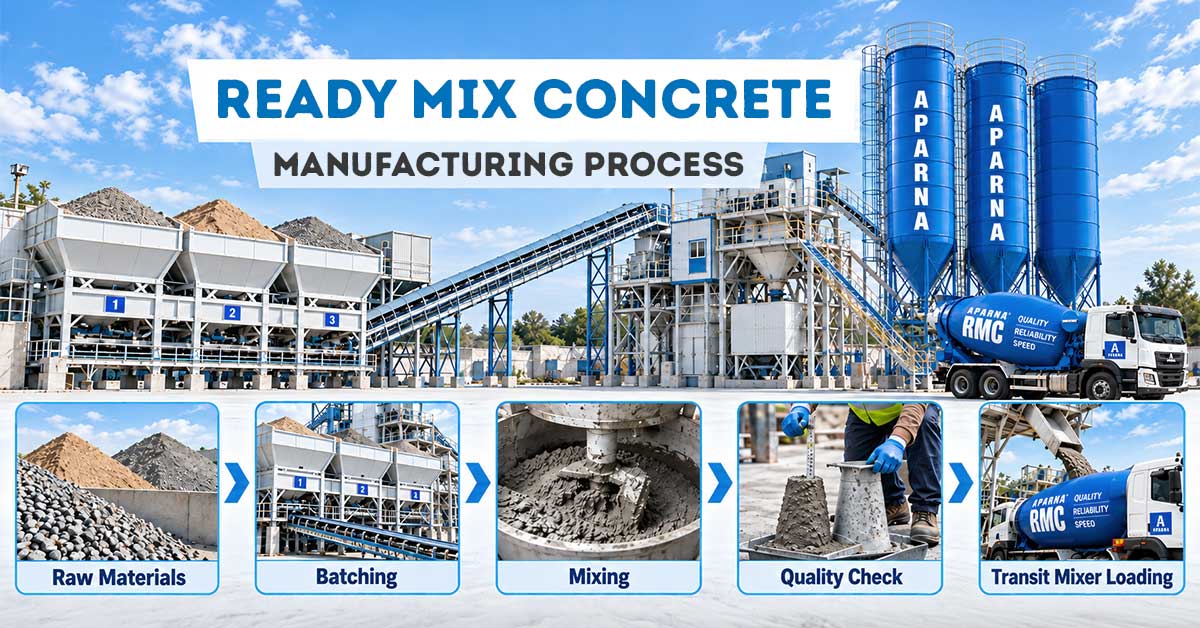
    Ready mix concrete is made in a plant, not on site. Cement, sand, stone aggregate, water and admixtures are weighed to a fixed recipe, mixed under machine control, and sent out in a rotating transit mixer that must discharge within two hours of the water being added. Every load is weighed the same way, so the concrete that arrives on Tuesday matches the concrete that arrived on Monday.

    That is the short answer. The rest of this page walks through what actually happens at each stage, what the plant is required to control, and where the process changes from one job to the next.

    What Ready Mix Concrete Is Made Of?

    Ready mix concrete is made of five things: cement, fine aggregate (sand), coarse aggregate (crushed stone), water and admixtures. Some mixes also include fly ash or slag in place of part of the cement. Nothing else goes in.

    By volume, a typical mix is roughly 10–15% cement, 60–75% aggregate and 15–20% water, with a small amount of admixture and some trapped air. Most of what you are pouring is stone and sand. The cement is the smallest part by volume and the most important part by cost and behaviour.

    Ingredient What it does What can vary
    Cement Reacts with water to form the paste that binds everything together and gives the concrete its strength Type — OPC, PPC or PSC — and grade. Chosen for the exposure and the strength required
    Fine aggregate (sand) Fills the gaps between the stone and makes the mix workable enough to place and finish Natural river sand or manufactured sand (M-sand). Its moisture content changes daily
    Coarse aggregate (stone) The bulk of the concrete. Carries load and limits shrinkage Size, usually 10 mm or 20 mm. Shape and grading affect how much water the mix needs
    Water Triggers the cement reaction and makes the mix flowable The single most controlled quantity in the plant. Too much water means weaker concrete
    Admixtures Small chemical doses that keep the mix workable longer, reduce water, or slow the set for long hauls Type and dose change with distance, weather and grade
    Fly ash or slag Replaces part of the cement. Improves durability and reduces heat and cement consumption Used depending on grade, exposure and specification

    Why the proportions change from one load to the next?

    They do not, in the sense that matters. The recipe — the mix design — is fixed for a given grade and stays fixed for the whole pour.

    What changes is the water. Sand and stone arrive from the stockyard wet, and how wet they are changes with the weather and with which part of the pile the loader took from. That water is already in the mix before any water is added from the tank. So the plant measures the moisture in the aggregate and subtracts it from the water it adds. Two loads of the same grade can therefore take different amounts of tank water and still end up identical.

    Moisture correction is one of the key controls used to maintain consistency between batches, and it is covered properly further down. If you want the full grade-by-grade picture, see our guide to concrete grades and their applications.

    Why it is called “ready mix”

    Because it arrives ready to place. The mixing has already happened — at the plant, or in the drum on the way — so nothing has to be batched, measured or mixed at the site. The truck reverses up, discharges, and the concrete goes straight into the formwork.

    The RMC Manufacturing Process at a Glance

    Stage What happens What is being controlled
    1. Mix design The recipe is set for the required grade and conditions Strength, workability, durability
    2. Materials in Cement, aggregates, water and admixtures are received, tested and stored separately Material quality and contamination
    3. Moisture check Aggregate moisture is measured and the batch water is adjusted Water-cement ratio
    4. Weigh batching Every ingredient is weighed to a set tolerance Proportions
    5. Mixing Materials are combined until uniform, at the plant or in the drum Uniformity
    6. Checks and dispatch Slump is checked, the delivery ticket is raised, the truck leaves Workability at dispatch
    7. Transport The drum turns throughout the journey Time and segregation
    8. Site arrival The load is re-mixed, sampled and accepted Workability on arrival
    9. Records Cubes are cast and tested at 28 days; documents are filed Strength, traceability

    Quality control is not a stage in this list. It runs across the whole of it, and that is explained in its own section below.

    Stage 1: The Mix Design

    Before anything is weighed, someone decides what the concrete has to do. Strength, how far it has to travel, how it will be placed, and what it will be exposed to once it hardens.

    Out of that comes a mix design — the recipe. It fixes how much cement, how much of each aggregate size, how much water and how much admixture go into every cubic metre.

    There are two ways this gets agreed, and the difference decides who is answerable if the concrete underperforms:

    • Designed mix — you specify the performance you need and the producer works out how to reach it. The producer carries the result. This is how most RMC is supplied.
    • Prescribed mix — you specify the proportions yourself, and the responsibility for whether they deliver the strength is yours.

    Most buyers want a designed mix and do not realise there was a choice. Either way, the design is proved with trial batches in the lab before it goes into production, and the plant keeps a record of every design it is currently running.

    Stage 2: Materials, Testing and Storage

    Nothing goes into a batch until it has been checked.

    Cement is tested on arrival. Aggregates are checked for grading — the spread of particle sizes — and for silt, clay and organic matter. Water is tested for impurities. Admixtures are checked against the supplier’s specification.

    Storage is part of the control, not an afterthought:

    • Cement goes into sealed, weatherproof silos, one per type and grade, with no possibility of two cements mixing. Cement that picks up moisture in storage is already partly reacted and will not perform.
    • Aggregates are stockpiled on free-draining ground, each size in its own bay, kept from spilling into one another. A 20 mm pile contaminated with 10 mm stone changes the grading of every batch made from it.

    This is the least glamorous part of the process and the one that quietly decides whether the rest of it works.

    Stage 3: Weigh Batching — Where the Precision Actually Is

    This is the stage that makes ready mix concrete different from concrete mixed at a site.

    Everything is weighed. Not measured by the box, not counted in headpans — weighed, on load cells, by the kilogram. And the plant is not allowed to be casually close. It has to be inside a set tolerance on every batch:

    What is weighed Allowed variation
    Cement, and fly ash or slag ±2%
    Aggregates ±3%
    Water ±3%
    Chemical admixtures ±3%

    On a batch carrying 350 kg of cement, ±2% is seven kilograms. That is the whole margin. Anything outside it is a failed batch.

    Those weighing systems drift, so they are checked against known weights on a schedule — mechanical systems at least every two months, load-cell systems at least every three, and admixture dispensers every month. Calibration records are kept and signed.

    The moisture correction

    Here is the part almost no explanation of RMC includes, and it is the reason plant concrete is consistent.

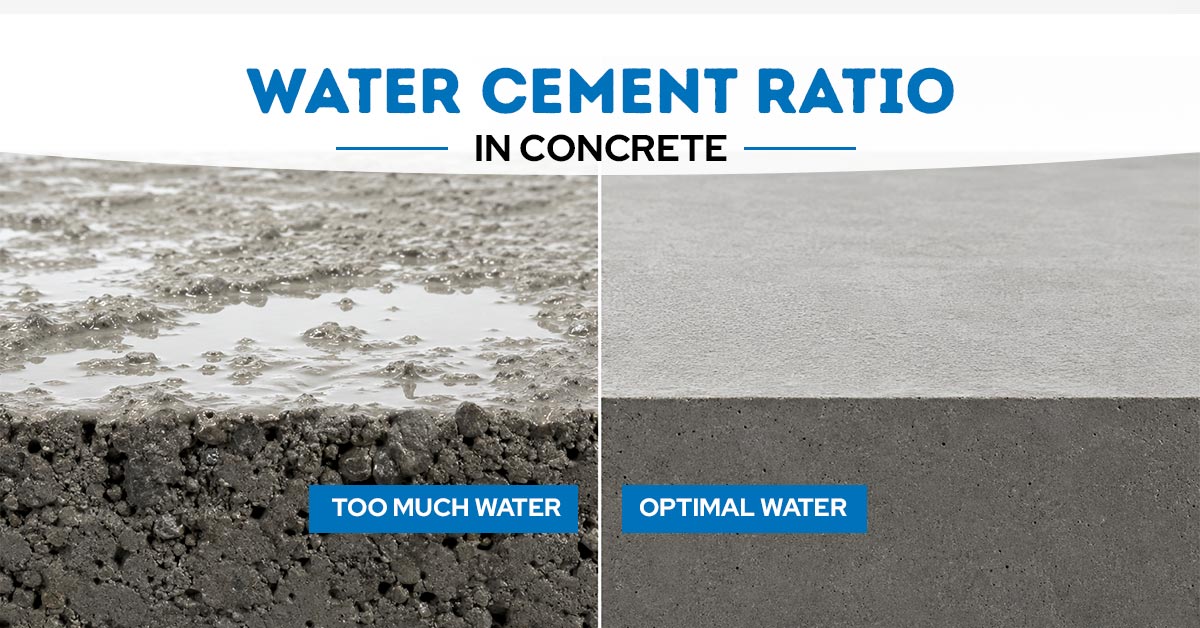
    Aggregate arrives wet. That water counts. If the mix design calls for 160 litres of water per cubic metre and the sand is already carrying 30 litres of it, the plant must add 130 — not 160. Add the full 160 and you have quietly made the concrete weaker, because the water-cement ratio has gone up and nobody can see it.

    So the plant measures the free moisture in the aggregate, subtracts it from the water it adds, and adjusts the aggregate weight too, because part of what it just weighed was water rather than stone.

    On site, this correction is rarely made. Sand is sand, water is added by the bucket, and the mix gets wetter every time it rains. That gap is one of the reasons batch-to-batch consistency is harder to hold on site. Our page on why batching precision affects structural performance goes into what that does to the finished structure.

    Modern plants run this whole sequence through an automated control system, which weighs, corrects and records each batch without an operator adjusting anything by hand. More on that in our piece on automation in RMC production.

    Stage 4: Mixing — and the Three Ways It Can Be Done

    Once everything is weighed, it has to be combined until every part of the batch is the same as every other part.

    Where that mixing happens is a real choice, and it is worth knowing which one your supplier uses:

    Route Where the mixing happens What it means for you
    Central mixed Fully mixed in a stationary mixer at the plant. The truck only agitates it in transit Most consistent. The plant sees the mixed concrete before it leaves. Needs a mixer at the plant
    Shrink mixed Partly mixed at the plant, finished in the drum on the way A middle option. Reduces plant mixing time while still checking the mix before dispatch
    Transit mixed Dry materials loaded into the truck and mixed entirely in the drum during the journey Cheapest plant setup. The concrete is not seen mixed until it arrives, so it depends most on the drum and the driver

    For truck mixing, the requirement is not a stopwatch — it is drum revolutions. The drum has to turn at least 60 times at mixing speed, and that speed has to be at least 7 revolutions a minute. Turn it fewer times and the batch is not uniform; turn it far more and you start working air and water out of it.

    One correction worth making: you will often read that concrete is mixed for “30 to 90 seconds”. There is no fixed mixing time in the Indian code for a plant mixer. It is whatever the mixer manufacturer specifies for that machine, and the machine’s ability to produce a uniform batch is proved by a formal efficiency test at least once a year. The fixed number is the truck-mixer revolution count, not a stopwatch reading.

    Stage 5: Checks Before the Truck Leaves

    Before dispatch, the fresh concrete is checked — workability first, because it is the one property you can see and the one that tells you whether the batch behaved. Temperature is noted where it matters.

    Then the delivery ticket is raised, and this document is more important than most buyers realise. It is your evidence of what you bought. A proper ticket carries:

    • The plant, the ticket serial number and the date
    • The truck number
    • The grade and the target workability
    • The minimum cement content and the cement type and grade
    • The maximum free water-cement ratio
    • The maximum aggregate size
    • The admixture used
    • The quantity in cubic metres
    • The time of loading
    • Space for the site to record arrival time, discharge completion time, anything added on site, and where it was poured

    If a pour is ever questioned — a cube fails, a slab cracks, a certifier asks — the delivery tickets are the primary record of what was supplied and when. They will not resolve a dispute on their own, but without them there is very little to work from. Keep them, and fill in the site half.

    For what happens between placing the order and the truck arriving, see ordering and scheduling a pour.

    Stage 6: Transport, and the Two-Hour Clock

    The drum keeps turning all the way to site. That is not to keep mixing it — it is to stop the stone settling out of the mix and the whole load separating.

    Under IS 4926, concrete is generally required to be discharged within two hours from the time water is added to the mix. Not from when the truck leaves the gate — from when the water went in.

    A longer period is permitted where the mix has been specifically designed to maintain the required properties for it, typically with a retarding admixture or by chilling the concrete. Both are normal practice for long hauls and hot weather. But that is a deliberate decision taken at the plant when the batch is designed, not something arranged at the site when the truck is running late.

    A common error worth flagging: a great deal of material written about ready mix concrete quotes a “90-minute rule”. That figure comes from an American standard. In India, the applicable limit under IS 4926 is two hours, subject to the conditions stated above.

    For the full journey from plant to placement, see the complete delivery timeline.

    Stage 7: Arrival, Re-Mix and Acceptance

    The truck arrives. Before anything is discharged, concrete that was mixed at the plant is re-mixed in the drum for at least two minutes, so that whatever settled on the way is brought back into suspension.

    Then the load is sampled — and there is a correct way to do it, which almost nobody follows:

    • Let the first one-third of a cubic metre discharge and discard it. The front of the load is not representative.
    • Take at least four separate scoops from across the rest of the load, not one bucket from one moment.
    • Do not sample the last cubic metre

    The sample is checked for workability. If a 100 mm slump was specified, the load is acceptable within ±25 mm — or within one-third of the specified value, whichever is the smaller window. Cubes are cast from the same sample for strength testing later.

    Who can add water at the site?

    Nobody, by default.

    Once the concrete leaves the plant, no extra water goes into that drum beyond what was needed for the specified workability — unless the purchaser asks for it and signs for it. It is written down because adding water is the fastest way to destroy a load, and because when the cubes fail six weeks later, somebody needs to know who made that call.

    If a load has genuinely stiffened in transit, the correct fix is usually an additional dose of admixture, agreed between the producer and the buyer. Not a hosepipe.

    Where manufacturing ends?

    It ends here.

    Placing, compacting, finishing and curing are site operations. They are governed by a different code and carried out by a different party, and they are outside the scope of ready mix concrete manufacturing entirely.

    This matters more than it sounds. Most explanations of the RMC process run straight through to curing, which blurs the line of responsibility. The producer is answerable for the concrete up to the point of discharge. What happens after that — how it is vibrated, how long it is cured — determines whether that concrete performs, and it belongs to the site.

    How Quality Is Controlled Across the Whole Process?

    Quality control is not step 4 of 9. It runs in three layers, all the time, in parallel with everything above.

    Layer When What it covers
    Before production Materials arriving Cement, aggregate, water and admixture testing. Mix designs and trial batches. Equipment calibration
    During production Every batch, every load Moisture correction, batch weights inside tolerance, mixing, workability at dispatch and at site
    After delivery Days and weeks later Cube strength at 28 days, batch records, delivery tickets, corrective action

    The third layer is the one people mean when they say “concrete testing”, and it is also the one that arrives too late to save a bad pour. By the time a 28-day cube result comes back, the slab has been standing for a month. Which is exactly why the first two layers exist.

    On testing frequency, the minimum is one sample for every 50 cubic metres produced, or every 50 batches, whichever comes round sooner — with three cubes cast from each sample for the 28-day test. Batching records, delivery tickets, calibration records and test results are kept for at least a year.

    Our detailed piece on how RMC is tested for strength covers the test methods themselves.

    What Changes Between Plants, Grades and Sites?

    The sequence above is the same everywhere. What varies is the detail.

    • By plant type. A plant with a stationary mixer produces central-mixed concrete and sees the mix before it leaves. A dry-batch plant loads the materials and lets the drum do the work. Both are legitimate; they cost differently to build and behave differently.
    • By grade. Higher grades carry more cement, a lower water-cement ratio, and often fly ash or slag replacing part of it. More checkpoints, tighter margins.
    • By distance and season. A pour forty kilometres away in May and one four kilometres away in December do not get the same admixture dose. Retarders go up for long hauls and hot weather, and chilled water is sometimes used to bring the load temperature down. See temperature-controlled concrete.
    • By exposure. A coastal structure and an internal column are specified differently, and that feeds straight back into the mix design at stage 1.

    None of this changes the process. It changes the numbers inside it.

    How Aparna RMC Manufactures Ready Mix Concrete?

    Aparna RMC operates 36 plants across Telangana, Andhra Pradesh, Karnataka, Tamil Nadu and Maharashtra, all built on Schwing Stetter batching equipment.

    Concrete is batched through an automated control system, tested in a central laboratory, and delivered through an owned fleet of 350 transit mixers, 70 concrete pumps. Trial mixes are carried out and tested before a mix design goes into production.

    The company is certified to ISO 9001:2015, ISO 45001:2018 and ISO 14001:2015, and its plants hold RMC Plant Capability certification under the Quality Council of India scheme.

    See our plant network for locations, or the full Aparna RMC concrete range for grades and specialised mixes.

    Frequently Asked Questions

    RMC stands for ready mix concrete — concrete produced to a fixed mix design in an automated plant and delivered to site in a transit mixer, ready to place. The manufacturing happens at the plant; the site only receives and places it.

    Cement, fine aggregate (sand), coarse aggregate (crushed stone), water and chemical admixtures. Many mixes also use fly ash or slag to replace part of the cement. By volume, aggregate makes up the majority of the mix.

    Ordinary Portland Cement, Portland Pozzolana Cement or Portland Slag Cement, depending on the grade and the exposure the structure will face. The type is fixed in the mix design and recorded on the delivery ticket — it is not chosen at the truck.

    Either, and it depends on the plant. Central-mixed concrete is fully mixed at the plant. Transit-mixed concrete is mixed entirely in the truck drum during the journey. Shrink-mixed sits between the two. All three are valid; central mixing gives the plant the most control.

    Under IS 4926, concrete is generally required to be discharged within two hours from the time water is added to the mix, unless the mix has been specifically designed to maintain the required properties for a longer period. The 90-minute figure often quoted online comes from an American standard, not the Indian one.

    Not without the purchaser’s written authorisation. Adding water raises the water-cement ratio and reduces strength, and the damage is invisible until the cubes are tested. If a load has stiffened, the correct remedy is an agreed dose of admixture, not water.

    It is rejected before discharge. Workability is checked against the specified slump within ±25 mm, or one-third of the specified value, whichever is smaller. A load outside that window should not go into the formwork — rejecting it costs far less than breaking out hardened concrete later.

    It is a rough hand-mixing proportion — four parts stone, two parts sand, one part cement — used for small site-mixed jobs. Ready mix concrete does not work this way. Plant mixes are designed by weight for a target strength and adjusted for aggregate moisture, which a volume rule of thumb cannot do.

    At minimum, one sample for every 50 cubic metres or every 50 batches, whichever is more frequent, with three cubes cast per sample for the 28-day strength test. Material testing and workability checks happen far more often than that — on every batch.

    The sequence does not; the numbers do. Summer means more retarder, sometimes chilled water, and tighter timing. Monsoon means the moisture correction is doing far more work, because the stockpiles are wet. Both are handled at the plant, before the truck loads.

  • What Is Ready Mix Concrete? A Complete Guide to RMC in Construction

    What Is Ready Mix Concrete? A Complete Guide to RMC in Construction

    Ready mix concrete (RMC) is concrete that is batched and mixed to a specified design at a central batching plant and delivered to the construction site in a transit mixer, ready to place. Every ingredient is weighed electronically to an engineered recipe rather than measured by hand at site.

    This guide covers what RMC is, what goes into it, how it is produced and delivered, how grades and mix designs are decided, which Indian Standards govern it, and how to check its quality on site.

    What Is Ready Mix Concrete?

    Ready mix concrete is a factory-produced, purpose-designed concrete supplied fresh to site in a fresh (unhardened) state. Three things define it:

    • Proportioned by weight, not volume. Batching plants weigh cement, aggregates and water electronically and correct for moisture already present in the sand and aggregate.
    • Designed, not guessed. The mix is engineered to a target strength, workability and durability class for a specific element and exposure condition.
    • Delivered within a controlled window. From the moment water meets cement, a clock starts.

    Each load arrives with a delivery challan stating grade, quantity, slump, batching time and mix reference — a paper trail site-mixed concrete does not have.

    RMC Full Form in Civil Engineering

    In civil engineering, RMC stands for Ready Mix Concrete, written as ready-mixed concrete in Indian Standards and occasionally as pre-mixed concrete in older specifications. The production facility is called an RMC plant or batching plant.

    How RMC Developed?

    The history of ready mix concrete begins in 1903, when German architect Jürgen Heinrich Magens patented the concept. The first delivery of off-site mixed concrete took place in Baltimore in 1913. Adoption was slow — around 25 plants operated in the US by 1925, rising past 100 by 1929.

    In India, ready-mixed concrete appeared in the 1950s as captive plants serving large infrastructure works, the Bhakra Nangal and Koyna dams among the earliest. Commercial RMC sold to third parties only arrived in the early-to-mid 1990s. It still accounts for a smaller share of Indian concrete consumption than in most developed markets, which is why site mixing remains common and the quality gap between the two still matters.

    Advantages of RMC

    • Consistent, verifiable quality from weigh batching, moisture correction and a documented mix design.
    • Faster construction — large pours placed continuously rather than in mixer-sized increments.
    • Lower material wastage through precise batching.
    • Reduced labour for mixing and material handling.
    • Access to specialised mixes — self-compacting, fibre-reinforced, temperature-controlled, high-grade — that cannot practically be produced at site.
    • A cleaner, safer, quieter site with no cement and aggregate stockpiles.
    • Better durability, because water–cement ratio and cementitious content are genuinely controlled.
    • Traceability — every load carries documentation supporting quality audits and dispute resolution.

    RMC is not intrinsically stronger concrete. It is more reliably the concrete you specified. The full difference between ready mix concrete and site mix concrete — on cost, quality and time — is covered separately in ready mix concrete vs traditional site-mixed concrete.

    Types of Ready Mix Concrete

    Type

    What it does

    Where it is used

    Standard gradeGeneral structural concreteSlabs, beams, columns, footings
    High-grade concreteM60 and aboveHigh-rise columns, bridges, transfer slabs
    Self-compacting concreteFlows into place and consolidates under its own weight, no vibrationCongested reinforcement, complex formwork, architectural finishes
    Fibre-reinforced concreteSteel, polypropylene or glass fibres control cracking and add toughnessIndustrial floors, pavements, precast panels
    Green concreteHigh SCM content, manufactured sand, lower embodied carbonSustainability-rated and general construction
    Lightweight concreteReduced density using lightweight aggregateScreeds, insulation layers, load reduction on existing structures
    Temperature-controlled concreteDelivered at reduced temperatureMass pours, raft foundations, hot-weather placements
    Porous concreteInterconnected voids allow water to pass throughParking areas, walkways, stormwater management
    Colour and stamped concretePigments and surface texturingLandscaping, driveways, decorative flatwork

    What Is Ready Mix Concrete Made Of?

    Constituent

    Typical share by weight

    Function

    Cement10–15%Binder — hydrates to form the hardened paste
    Fine aggregate (sand or M-sand)25–30%Fills voids, contributes to workability and finish
    Coarse aggregate (10–20 mm)40–50%Bulk, dimensional stability, load-bearing skeleton
    Water5–8%Triggers hydration; the biggest single lever on strength
    Chemical admixturesUnder 1%Modify workability, setting and durability without adding water

    Aggregates are specified under IS 383:2016 and admixtures under IS 9103.

    Fly Ash and GGBS

    Most modern RMC replaces part of the cement with a supplementary cementitious material (SCM).

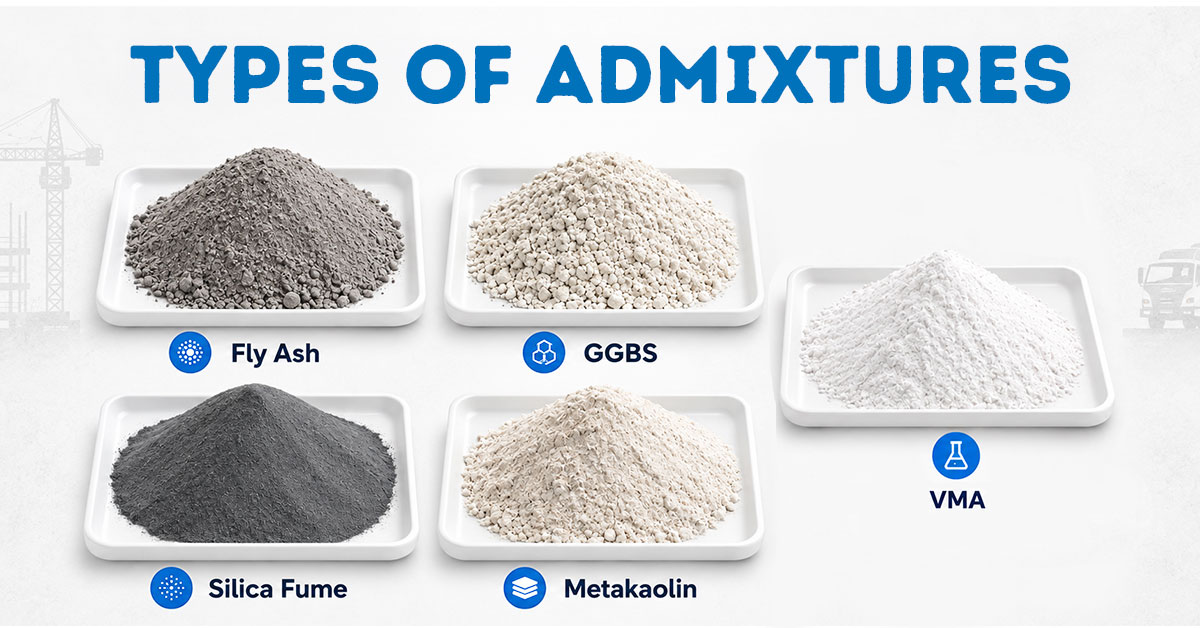
    • Fly ash, a by-product of coal-fired power generation, improves workability, reduces heat of hydration, refines pore structure and improves long-term durability. It gains strength more slowly than cement, so mixes containing it need longer curing. Specified under IS 3812.
    • GGBS (Ground Granulated Blast-furnace Slag), a by-product of iron making, offers similar benefits with strong resistance to sulphate and chloride attack — valuable in coastal environments. Specified under IS 16714.

    Chemical Admixtures

    Admixtures solve problems that water cannot solve without damaging strength.

    • Plasticisers and superplasticisers increase flow at the same water content.
    • Retarders slow setting for long hauls and hot-weather placements.
    • Accelerators speed early strength gain in cold conditions or urgent repairs.
    • Air-entraining agents improve freeze–thaw resistance.
    • Integral water-resisting admixtures reduce permeability.

    The rule that follows: never add water at site to improve flow. Specify a higher slump or an admixture dose at the plant instead.

    Lower-Carbon Mixes

    Concrete’s environmental footprint is dominated by cement clinker, so SCMs are the main lever. Replacing part of the cement with fly ash or GGBS, and river sand with manufactured sand, reduces both embodied carbon and pressure on riverbeds. Aparna RMC’s green concrete range is built on exactly this substitution.

    How Ready Mix Concrete Is Made?

    1. Material storage and testing — aggregates, cement, SCMs and admixtures stored separately, incoming materials tested against IS requirements.
    2. Moisture correction — probes measure free water in the aggregate and batch water is reduced accordingly. This is why plant concrete holds its water–cement ratio and site mixing rarely does.
    3. Weigh batching — each ingredient weighed to tight tolerance by an automated control system, usually SCADA-driven.
    4. Mixing — in a plant mixer or in the truck drum.
    5. Quality check — slump and, where required, temperature checked before dispatch; cube samples cast at the agreed frequency.
    6. Dispatch — the load leaves with a challan recording grade, volume, batching time and mix reference, with GPS tracking on modern fleets.

    Central-Mixed, Shrink-Mixed and Transit-Mixed Concrete

    Method

    Where mixing happens

    Typical use

    Central-mixedFully mixed in a stationary plant mixer; the drum only agitates in transitHighest uniformity; preferred for high grades and critical structural work
    Shrink-mixedPartially mixed at the plant, completed in the truck drumReduces plant mixer cycle time while retaining some plant control
    Transit-mixedMixed entirely in the truck drum en routeLonger hauls and lower-volume deliveries

    Shrink-mixed versus ready-mixed concrete is therefore not an either/or comparison — shrink mixing is one of three ways ready-mixed concrete is produced.

    Transportation and Transit Mixer Capacity

    RMC travels in a transit mixer, a truck-mounted revolving drum that keeps the concrete moving so it does not segregate or stiffen prematurely.

    In India, transit mixer capacity ranges from roughly 4 m³ to 10 m³, with 6 m³ the most common size in urban fleets. Larger 8–10 m³ units serve high-volume infrastructure work; 3–4 m³ units serve congested sites. Axle-load regulations, not drum size, are usually the binding constraint.

    Two practical implications: order in multiples of truck capacity where the pour allows, and check gate width, turning radius and ground bearing capacity before ordering — a loaded 6 m³ mixer weighs well over 25 tonnes.

    Ready Mix Concrete Grades and Mix Design

    Concrete grade is written as M followed by the characteristic compressive strength in N/mm² at 28 days, measured on 150 mm cubes. M25 means 25 N/mm² — the value below which no more than 5% of results are expected to fall. IS 456:2000 groups grades into ordinary (M10–M20), standard (M25–M55) and high strength (M60 and above).

    Grade

    28-day characteristic strength

    Typical application

    M5 / M7.55 / 7.5 N/mm²Lean concrete, levelling course, filling
    M10 / M1510 / 15 N/mm²PCC bedding, non-structural work
    M2020 N/mm²Light residential slabs, footings in mild exposure
    M2525 N/mm²Residential slabs, beams and columns
    M3030 N/mm²Columns and foundations, moderate to severe exposure
    M35 / M4035 / 40 N/mm²Multi-storey frames, water-retaining structures, precast
    M45–M5545–55 N/mm²High-rise cores, bridges, industrial floors
    M60–M8060–80 N/mm²High-rise columns, long-span bridges, specialised infrastructure

    Plants with wide capability cover most of this span; Aparna RMC produces grades from M5 to M80 across its 36 plants in five states.

    Ready Mix Concrete M25 Grade

    M25 is the default for Indian residential construction — enough strength for slabs and beams in G+1 and G+2 houses, enough cement content to meet moderate exposure limits, and no unnecessary cost. Going higher without a structural reason buys more cement, more heat of hydration and more shrinkage risk, not more safety. Suppliers offer mixes formulated specifically for individual house builders on exactly this basis.

    Nominal Mix vs Design Mix

    A nominal mix uses fixed volumetric ratios — 1:2:4, 1:1.5:3. Simple, but conservative and wasteful; IS 456 permits it only for lower grades and smaller works.

    A design mix proportions materials from tested material properties to a target mean strength deliberately set above the characteristic strength, allowing for normal production variation. Effectively all RMC is design mix concrete, proportioned under IS 10262:2019.

    The Water Cement Ratio

    The water–cement ratio — free water divided by cementitious material, by weight — is the most influential variable in concrete. Lower ratio means higher strength and lower permeability.

    IS 456:2000 caps it by exposure condition, alongside minimum cement content and minimum grade for reinforced concrete:

    Exposure

    Min. grade (RCC)

    Max. free water–cement ratio

    Min. cement content (kg/m³)

    MildM200.55300
    ModerateM250.50300
    SevereM300.45320
    Very severeM350.45340
    ExtremeM400.40360

    This is why grade cannot be chosen on strength alone. A coastal Visakhapatnam site and an inland Hyderabad site with identical loads may need different grades purely because of exposure.

    Ready Mix Concrete Ratio in Practice

    Because design mixes are proportioned by weight from tested materials, there is no universal RMC ratio. A typical M25 mix might run 320–360 kg of cementitious material, 700–800 kg of fine aggregate and 1,100–1,200 kg of coarse aggregate per cubic metre at a water–cement ratio near 0.45 — but these shift with aggregate grading, admixture type and SCM content. Work from the supplier’s approved mix design, never a generic ratio.

    Properties of Ready Mix Concrete

    • Compressive strength: Concrete reaches roughly 65–70% of its 28-day strength at 7 days under normal conditions, and the 28-day value is taken as the design strength. Fly ash and GGBS mixes continue gaining strength for months.
    • Workability and slump: Measured by the slump test under IS 1199 (Part 2): a cone of fresh concrete is filled, compacted, lifted, and the vertical drop recorded in millimetres.

    Placement method

    Typical slump range

    Lightly reinforced sections, manual placement25–75 mm
    Normal reinforced slabs and beams75–100 mm
    Pumped concrete100–150 mm
    Self-compacting concreteMeasured by flow spread, typically 550–850 mm

    Slump measures workability, not strength. A high slump achieved with admixtures is fine; the same slump achieved by adding water at site is not.

    • Density: Approximately 2,400 kg/m³ for plain normal-weight concrete and 2,500 kg/m³ for reinforced concrete, the difference being the steel.
    • Setting time: Initial set — when concrete can no longer be worked — typically occurs within 1 to 3 hours of batching. Final set follows over roughly 6 to 10 hours. Retarders extend both; high ambient temperature shortens both sharply. Setting is not strength gain; concrete that has set is still weak.
    • Durability: The ability to resist chloride ingress, sulphate attack, carbonation and abrasion. Governed largely by permeability, which is governed by water–cement ratio, cementitious content and curing. This is why IS 456 sets durability limits independently of strength — a structure can be strong and still fail early if it is permeable.
    • Temperature: Higher fresh concrete temperature means faster slump loss, faster setting, and greater plastic shrinkage cracking risk. Indian specifications commonly limit placing temperature to around 30–32 °C, with hot-weather practice covered by IS 7861 (Part 1). Plants manage this with chilled water, ice replacement, night pours and shaded stockpiles.

    Disclaimer: This information is for general guidance only. Actual strength, slump, and setting parameters vary by mix design and environment. So, to verify performance values against the project’s approved mix sheets and contract specifications prior to placement, contact the Aparna RMC team.

    What Is Ready Mix Concrete Used For?

    • Residential — slabs, beams, columns, footings, driveways.
    • Commercial — offices, malls and hotels, where floor cycle times drive the programme.
    • Infrastructure — roads, bridges, metro viaducts, tunnels, airports.
    • Industrial — factory floors, warehouses and plant foundations, often fibre-reinforced.
    • Institutional — hospitals, schools, campuses.

    How to Use Ready Mix Concrete on Site?

    1. Confirm formwork, reinforcement and cover blocks are inspected and ready before the truck arrives.
    2. Check the delivery challan against your order.
    3. Run a slump test on arrival, before discharge.
    4. Cast cube samples at the agreed frequency.
    5. Discharge, place and compact without delay; limit free-fall height to avoid segregation.
    6. Compact with needle vibrators — enough to expel air, not so much that the mix segregates.
    7. Finish the surface, then begin curing as early as it allows.

    Delivery, Placing and Curing

    The Delivery Window and RMC Expiry Time

    IS 4926:2003, the Indian code of practice for ready-mixed concrete, sets the transportation time limit at 2 hours from the addition of water to the cement and aggregate. The 2003 revision specifically made this window uniform at 2 hours. Contracts frequently tighten it further.

    Within that window the concrete must reach site, be discharged, placed and compacted. Retarders and temperature-controlled concrete extend the practical window; high ambient temperature shortens it regardless of what the specification allows. Once it closes, the load cannot be rescued by adding water and should be rejected.

    Pumping and Placing

    Concrete reaches its final position by chute, by crane and bucket, or most commonly by pump. A concrete pump uses twin hydraulic pistons operating in alternation — one cylinder draws concrete from the hopper while the other pushes its load into the delivery line, with a valve switching between them for near-continuous flow. Boom pumps mount the line on an articulated arm for placement at height; line pumps feed a flexible ground-level hose for horizontal distance and restricted access.

    Pumping imposes its own demands: the mix needs enough fines and a cohesive, well-graded aggregate profile to move through the line without segregating or blocking. That is a mix design decision, not a site fix.

    Curing

    Curing keeps concrete moist so hydration can continue. It is the step most often shortened and the one that most reliably destroys strength when it is.

    Begin as soon as the surface has hardened enough not to be damaged — generally within 12 to 24 hours — and maintain for a minimum of 7 days for ordinary Portland cement mixes, and 10 to 14 days for fly ash or GGBS mixes, which gain strength more slowly. Concrete that dries out early stops gaining strength permanently, and no testing or remediation afterwards recovers it.

    How to Check the Quality of Ready Mix Concrete?

    On Arrival

    • Read the challan — grade, quantity, batching time, mix reference and truck number against the order.
    • Check the clock — elapsed time since batching against the permitted window.
    • Slump test at the frequency your specification requires. Reject loads outside tolerance rather than diluting them.
    • Look at the mix — excessive bleed water, visible segregation or a stiff, crumbly appearance are all reasons to stop and question the load.

    Cube Testing and Sampling Frequency

    The cube test is the definitive measure of compressive strength. Samples are cast in 150 mm moulds, water-cured and crushed under IS 516, with acceptance judged at 28 days and 7-day results as an early indicator.

    IS 456:2000 sets the minimum sampling frequency by volume placed:

    Quantity of concrete in the work (m³)

    Minimum number of samples

    1–51
    6–152
    16–303
    31–504
    51 and above4 plus one for each additional 50 m³ or part thereof

    At least one sample must be taken per shift. Three specimens are made from each sample for 28-day testing, with additional cubes commonly cast for 7-day results.

    IS Codes and Standards for Ready Mix Concrete

    Standard

    Scope

    IS 4926:2003Ready-mixed concrete — code of practice. Production, delivery, transportation time, sampling
    IS 456:2000Plain and reinforced concrete — code of practice. Grades, durability limits, acceptance criteria
    IS 10262:2019Concrete mix proportioning — guidelines
    IS 383:2016Coarse and fine aggregates — specification
    IS 9103Concrete admixtures — specification
    IS 3812Pulverised fuel ash (fly ash) for use in concrete
    IS 16714Ground granulated blast furnace slag (GGBS) for use in concrete
    IS 1199 (Part 2)Fresh concrete — sampling and testing, including slump
    IS 516Hardened concrete — methods of test for strength
    IS 7861 (Part 1)Extreme weather concreting — hot weather practice

    Internationally, the equivalent specification is ASTM C94/C94M, Standard Specification for Ready-Mixed Concrete, used in the US and referenced in several multinational project specifications; Europe uses EN 206. The engineering logic is consistent across all three, but the numerical limits and test methods differ — never mix requirements across codes within one specification.

    Ordering Ready Mix Concrete

    Most RMC problems begin at the order. Specify all of the following:

    • Grade — from the structural design, not from habit
    • Exposure condition — this may raise the required grade independently of load
    • Quantity, with a stated tolerance for the final load
    • Slump required at site, and whether the concrete will be pumped
    • Maximum aggregate size, particularly for congested reinforcement
    • Special requirements — SCC, fibre, low heat, temperature control, waterproofing admixture
    • Pour date, start time and expected rate of placement
    • Site access constraints and pump requirement
    • Testing regime — sampling frequency and who witnesses the cubes

    Use an RMC volume calculator to convert element dimensions into a delivery quantity, and check plant locations to confirm you are inside a practical delivery radius.

    Allowable Wastage for Ready Mix Concrete

    Wastage in RMC is low but not zero. Industry practice typically allows 1–2% for ready mix concrete, against 5% or more for site-mixed work. The residual loss comes from concrete retained in the drum and pipeline, spillage during discharge, over-ordering on the final load, and formwork overbreak.

    Two practical notes: order in whole truck loads where the pour allows, and agree in advance who bears the cost of a part-used final load. This is a common billing dispute and entirely avoidable at the ordering stage.

    Key Takeaways

    • Ready mix concrete is factory-batched, purpose-designed concrete delivered fresh to site. The value is consistency, not convenience.
    • Cement is an ingredient of concrete, not a synonym for it.
    • The water–cement ratio governs strength and durability; adding water at site permanently damages both.
    • Grade selection is driven by structural design and exposure condition, per IS 456.
    • IS 4926:2003 sets a 2-hour transportation window from the addition of water.
    • Plant control ends at discharge. Compaction and curing are site-controlled, and are where most failures originate.

    Disclaimer: This article is for general information only and does not constitute engineering or construction advice. For project specifications, professional technical guidance, concrete solutions, and applicable Indian standards, get in touch with the Aparna RMC team.

    Frequently Asked Questions On Ready Mix Concrete

    Most suppliers set a practical minimum of around 3 m³ per delivery, because part-loaded drums mix less effectively and the delivery cost is largely fixed regardless of volume. Below that, bag concrete or site mixing is usually the better option. Confirm the minimum with your supplier at quotation stage, as it varies by plant and by city.

    It should be rejected and returned, not diluted with water or placed anyway. Commercially, responsibility depends on the cause — plant or traffic delays usually sit with the supplier, while site delays such as unready formwork or a blocked access route usually sit with the buyer. Agree this allocation in writing before the pour, because it is the most common source of dispute on RMC contracts.

    Failing cubes do not automatically indicate bad concrete. Compaction, curing, cube casting technique and specimen storage are all site-controlled and all affect results. Investigation normally examines the plant’s batching records and the site’s curing and sampling records together. Witnessed sampling, properly stored cubes and an accredited testing lab protect both parties.

    Light rain is manageable with covers, but heavy rain should stop the pour. Rainwater falling into fresh concrete raises the water–cement ratio uncontrollably and washes cement paste from the surface, leaving a weak, dusty finish. If a pour is interrupted, agree a proper construction joint rather than resuming over partly set concrete.

    The binding constraint is time, not distance. Since the concrete must be discharged inside the permitted window, and placing and compaction consume part of it, most plants work to a practical radius of 20–25 km in urban traffic. Retarding admixtures and temperature-controlled concrete extend this, but the delivery time — not the map distance — is what should be checked.

    A chute works for ground-level pours within a few metres of where the mixer can park — footings, plinths, driveways. Anything at height, at distance, or beyond a reachable access point needs a pump. Slab pours above the ground floor almost always need one. Pumped concrete also needs a higher slump and a more cohesive mix, so decide before ordering, not on the day.

    Yes, and slab pours are among the strongest cases for it, because a slab should ideally be placed in one continuous operation. A site mixer cannot sustain the output for that, which produces cold joints. Suppliers offer mixes specifically for individual house builders for exactly this reason.

    Yes, but the mix specification changes. Below-ground and water-retaining elements need a lower water–cement ratio, higher grade and often an integral water-resisting admixture, with GGBS commonly used where sulphates are present in the soil. Get a soil report before specifying, since the exposure classification — not the load — usually sets the grade here.

  • Fiber Reinforced Concrete (FRC): Types, Properties, Dosage and Applications

    Fiber Reinforced Concrete (FRC): Types, Properties, Dosage and Applications

    Fiber-reinforced concrete (FRC) is a type of concrete containing short, discrete fibers uniformly throughout the mix. The fibers are added to the concrete to control cracking and give toughness. Plain concrete cracks under tension, and so when cracks form, it fails. Fibers act as a bridge across the cracks and allow the concrete to continue carrying load after cracking.

    This guide covers the different fiber types available, properties FRC actually changes, applications, how FRC compares with conventional steel reinforcement, and how it is specified and tested.

    Key Takeaways:

    • FRC mixes thousands of tiny, separate fibers evenly through the mix, replacing long bars placed in one flat layer,
    • Fibers bridge cracks as they form, giving concrete a post-crack strength that plain concrete lacks.
    • Micro fibres help control plastic shrinkage cracking in fresh concrete, and macro fibers provide strength in hardened concrete. They cannot be interchanged.
    • Dosages range from under 1 kg/m³ for micro synthetic fibres and up to tens of kg/m³ for steel fibres.
    • Fibers can replace wire mesh [for non-structural temperature and shrinkage crack control] in ground slabs, but they can never replace primary steel in beams, columns, or elevated decks.

    What Is Fiber Reinforced Concrete?

    Fiber-reinforced concrete (FRC) is made by adding short pieces of steel, plastic, glass, or natural fibers directly into the concrete mix to control cracking and add strength after concrete cracks. FRC stands for fiber reinforced concrete, and terms like FRC concrete refer to the same material.

    How fibers work in concrete?

    Concrete is strong in compression and weak in tension. So if a section cracks, it loses its strength and breaks completely. Conventional rebars sit in one place and only engage once a crack reaches them. The fibers are distributed in three dimensions through the entire cross-section. They bridge micro-cracks when they are formed, holding the cracked concrete tightly together.

    That retained capacity after cracking is called post-crack residual strength. Fibers are added to change how concrete behaves after a crack forms, and not to increase its [ultimate flexural tensile] strength.

    Micro fibers vs macro fibers

    Micro fibers are fine, small, and synthetic fibres that stop plastic shrinkage cracks when concrete is fresh in the first hour after placing. They have no role in hardening the concrete (structural performance of the hardened concrete). Macro fibers are larger and longer, mixed to make hardened concrete tough after it cracks. They can replace wire mesh.

    Common misconception: Micro fibers do not add ductility or replace structural reinforcement. They only prevent early cracks in wet concrete; structural, post-crack strength requires macro fibers.

    Using fibers like straw in mud brick or horsehair is ancient, but modern engineered steel and synthetic fiber concrete started in the mid-twentieth century.

    Types of Fiber Reinforced Concrete

    Concrete fibers fall into a few distinct families. When picking one, focus on what you need it to do – prevent early shrinkage, add heavy-duty strength, or shape architectural details. There are different types of concrete fibers like steel fibers, macro synthetic fibers, micro synthetic fibers, glass fibers, natural fibers, and specialty fibers.

    1. Steel fibers: Steel fibers provide maximum tensile strength and post-crack capacity for heavy-duty applications like industrial floors, tunnel linings, shotcrete, and precast elements. However, they are susceptible to corrosion in harsh environments. So effective crack-width control is necessary to prevent moisture penetration and rusting.
    2. Macro synthetic fibers: Macro synthetic fibers are made of thick polypropylene or polyolefin, which provides post-crack strength without any risk of rusting. They can replace wire mesh in ground slabs, shotcrete, and precast concrete. They are less stiff than steel, so they must be used in higher dosages.
    3. Micro synthetic fibers: Micro synthetic fibers are fine polypropylene or similar thin polymer filaments. They offer early-stage protection and are used to control plastic shrinkage cracking during the initial hours of curing. Certain polypropylene microfibres, when specified at suitable dosages, can help reduce the risk of explosive fire spalling in concrete. They do not add any strengthening properties to hardened concrete, and only act as a plastic-shrinkage control measure.
    4. Alkali-Resistant (AR) Glass Fibers: AR Glass Fibers are used in GFRC/GRC (glass fiber reinforced concrete) for cladding panels, architectural mouldings and landscape elements. They are good for creating thin, lightweight sections with quality surface finishes. They only serve an architectural role and do not provide any structural support.
    5. Natural fibers: Natural fibers are sourced from coir, sisal, jute, bamboo, and other types of materials. They have been in use for a long time and are still studied because they are low-cost and eco-friendly. The natural fibers do not stop cracks in commercial concrete. They also raise durability concerns in the alkaline cement environment.
    6. Specialty fibers: Fibers like carbon, basalt, and PVA/PAN provide high strength, but they come at high cost. They are used for specialised engineering projects.

    Note: Fiber reinforced polymer (FRP) is different from FRC. FRP is a solid composite material [such as bars or laminates], and not loose fibers mixed into concrete.

    Fiber Type Comparison

    This table compares different types of fiber reinforced concrete:

    Fiber Type

    Main Purpose

    Where Used

    Biggest Downside

    SteelKeeps cracked concrete strongFactory floors, tunnels, precastCan rust if cracks are wide
    Macro SyntheticLong-term toughness, zero rustPavements, slabs, shotcreteRequires heavy doses to work
    Micro SyntheticStops cracks while concrete driesConcrete where plastic shrinkage or fire-spalling risk is being addressedDoes not strengthen dry concrete
    GlassHolds detailed shapes togetherThin architectural panels, moldsProvides no load-bearing strength
    NaturalLow-cost eco-friendly testingCheap housing, researchDurability concerns in the alkaline environment
    SpecialtyExtreme high performanceNiche engineering projectsExpensive for normal jobs

    Properties of Fiber Reinforced Concrete

    Some of the properties of FRC include compressive strength, flexural and post-crack residual strength, toughness and energy absorption, impact and abrasion resistance, crack control, fatigue and durability, workability, and density.

    • Compressive strength: Any gains are marginal because fibers are not added for compression. They are primarily used for crack propagation control.
    • Flexural and post-crack residual strength: Macro fibers allow the concrete to carry load by acting as tiny internal anchors when cracks occur. On the other hand, plain concrete cannot pull itself back when cracks occur.
    • Toughness and energy absorption: Fibers substantially boost toughness and shock absorption, which helps concrete resist sudden cracking and impact damage.
    • Impact and abrasion resistance: Protects concrete from heavy drops and surface friction, making it suitable for heavy-traffic factory floors, roads and pavements, roads, and pavements.
    • Crack control: Wet concrete uses microfibers to prevent surface cracks as it dries. Hardened concrete uses macro fibers to hold cracks tightly together, helping limit crack widths and reduce pathways for water ingress.
    • Fatigue and durability: By holding cracks tightly together under daily traffic, fibers help limit crack widths and reduce the potential for water and chemical ingress into the concrete and destroying it from within. It leads to increased durability.
    • Workability: Fibers make wet concrete stiff and hard to pour. This can be fixed with a chemical thinner (plasticiser), and [you should] never add extra water, or you will ruin the strength.
    • Density: At typical synthetic fibre dosages, the effect on concrete density is usually negligible. Higher steel fibre dosages can measurably increase density and should be accounted for during mix design.

    Factors affecting FRC properties

    The performance a given dosage delivers depends on: the fiber type and material; the aspect ratio (fiber length divided by diameter); the dosage itself; how uniformly the fibers are oriented and distributed through the section; and the overall mix design. Aspect ratio matters in a specific, causal way — a higher aspect ratio improves crack bridging but also worsens workability and increases the risk of balling (fibers clumping together instead of dispersing), so it is chosen as a balance, not maximised.

    Fiber Dosage: How Much Fiber Goes into Concrete?

    Fiber content is specified either as a dosage in kilograms per cubic metre (kg/m³) or as a volume fraction of the mix. The two are not directly interchangeable across fiber types, because fiber densities differ enormously — steel is roughly eight times denser than polypropylene — so a similar volume fraction of two different fiber types produces very different kg/m³ figures. This is the single most common source of confusion in fiber specification, and worth checking explicitly whenever a dosage is being compared across fiber types.

    Typical Fiber Dosage by Type

    Fiber Type

    Typical Dosage Range (kg/m³)

    Purpose at That Dosage

    Micro Synthetic0.6–1.5Plastic shrinkage crack control
    Macro Synthetic3.0–10.0Post-crack toughness/mesh replacement
    Steel20.0–80.0Structural toughness — industrial floors, shotcrete
    Glass (AR-Glass)10.0–40.0GFRC/GRC applications

    How FRC is mixed and batched?

    Fibers can be added at the plant or on site, but they must be mixed thoroughly to spread evenly. If you add it too fast, at a dose too high, or not mixed long enough, they will clump together (balling). The clumping can be prevented by adding the correct dosage, adequate mixing time, and slow addition. Mixing at the concrete plant gives a much more even blend than adding them on site.

    In general, plant batching gives more consistent dispersion than ad hoc addition on site. This is because, in the plant, fibers are dosed by weight under controlled conditions.

    Fiber Reinforced Concrete vs Rebar: Can Fibers Replace Steel?

    Fibres can replace wire mesh for secondary crack control in some applications, but they cannot replace primary reinforcement such as steel rebar in beams, columns, or structural slabs. Any such change should be based on a proper structural design.

    Rebar and fibres perform different functions. Rebar provides higher tensile strength at specific locations, while fibres are distributed throughout the concrete and help control cracks. For this reason, fibres may replace mesh in suitable cases, but they are not a direct replacement for structural steel.

    Fiber Reinforcement vs Conventional Steel Reinforcement

    Parameter

    Fiber Reinforcement

    Steel Rebar / Mesh

    LocationSpread evenly everywhere inside the concretePlaced in flat rows at exact spots
    Main JobControls cracks and adds toughnessCarries heavy structural pulling loads
    Site WorkMixed directly into the wet concreteCut, bent, and tied by hand on site
    RustingSynthetics never rust; steel fibers can rust at cracksRusts easily if concrete cracks or is too thin
    Best UsesGround slabs, warehouse floors, shotcreteBeams, columns, and building foundations
    Where It FailsCannot replace primary structural bars—

    Applications of Fiber Reinforced Concrete

    • Industrial and warehouse floors: Mesh replacement, faster placement and better crack control across large, uninterrupted pours.
    • Shotcrete for tunnels, mining and slope stabilisation: Fibers can be sprayed with the mix where placing mesh is slow and hazardous.
    • Pavements, hardstandings and external slabs: Impact and fatigue resistance under repeated wheel loading.
    • Precast elements: Thinner sections, better handling robustness and faster demoulding cycles.
    • Architectural cladding and panels (GFRC/GRC): Fibres help create thin, lightweight panels in complex shapes.
    • Repair, overlays and jacketing: Improved bond behaviour and crack resistance in thin repair sections.
    • Water-retaining and marine structures: Fibres help control cracks and improve durability. Steel fibres need extra care in marine conditions because of corrosion.
    • Residential slabs and driveways: Microfibres help control plastic shrinkage cracks.

    In each of these, fibers do a specific job defined by the specification — they are not a general-purpose upgrade added to any mix regardless of application.

    Advantages of Fiber Reinforced Concrete

    1. Post-crack toughness: Normal concrete loses much of its load-carrying capacity after cracking. In fibre-reinforced concrete, the fibres help hold the cracked concrete together. This allows the concrete to carry load even after cracks appear and reduces the risk of sudden failure.
    2. Uniform crack control: Fibres are distributed throughout the concrete mix, so they can help control small cracks in different areas. Rebar provides reinforcement mainly along the locations where the bars are placed. This makes fibres useful for controlling shrinkage and other fine cracks across the concrete surface.
    3. Faster construction: Steel mesh needs to be cut, placed and fixed before concrete is poured. With fibre-reinforced concrete, the fibres are added directly to the concrete mix. This can reduce the time needed for placing reinforcement and make the concreting process faster.
    4. Labour savings and safety: Handling steel bars or wire mesh takes more time and labour. When fibres are used instead of mesh in suitable applications, fewer workers may be needed for reinforcement work. This can reduce labour costs and make handling easier at the site.
    5. Abrasion & fatigue resistance: Dropped tools and heavy trucks chip or wear away normal concrete. But fiber concrete absorbs these hard hits and stops the surface from wearing down.
    6. Corrosion-free (synthetic fibres): Water and salt rust traditional steel, breaking the concrete from inside. Synthetic plastic fibers do not rust, so they are perfect for coastal areas or harsh environments.

    Limitations and Considerations

    • Higher material cost: The fiber concrete costs more upfront than standard concrete. But it helps you save money on workers’ time because you don’t have to spend money laying down steel mesh.
    • Reduced workability: The fibers make the wet concrete thick, stiff, and hard to pour. You must never add water because water weakens concrete, and instead use plasticisers to maintain workability.
    • Balling risk: If you add too many fibers or mix them poorly, they clump into hairy balls, leaving empty air pockets inside the concrete, making it weak.
    • Not a structural substitute: Fibres help control crack formation and crack widths, but they do not replace structural reinforcement designed to carry concentrated tensile loads. So for columns, beams, or heavy walls, you need traditional, thick steel bars.
    • Corrosion and rough finish: Steel fibers can corrode where cracks are wide or when exposed. Surface fibers may also cause staining on exposed surfaces.
    • Mixing quality: Fibers must be spread evenly to work. This is very hard to do by hand on a building site. It is much safer to let a concrete factory mix it using machines.
    • Requires test data: Engineers must look at official test data to make sure the mix is strong enough to hold weight even after it starts to crack. So you cannot guess how many fibres to add.

    Specifying and Testing FRC

    Fiber-reinforced concrete (FRC) needs a performance class based on residual strength after cracking, not just a fiber amount. So a fiber dosage on its own, without a performance class, is not a complete specification.

    The test approach: A notched beam is loaded in a three-point bend test [conforming to standards like IRC:SP:46 or ASTM C1609], and the load the beam still carries at defined crack-mouth opening displacements is measured. These residual strength values feed directly into the structural design. Indian FRC practice follows both national and international rules. Request specific test data from your supplier based on your exact project dosage and design needs.

    Fiber Reinforced Concrete from Aparna RMC

    Aparna RMC delivers high-performance Fiber Reinforced Concrete (FRC) by focusing on uniform fiber mixing for industrial floors, and warehouse, building construction projects, and pavements.

    Aparna RMC mixes fibers at the plant by weighing every batch precisely according to the mix design. This plant-controlled process ensures your specified dosage is exactly what is delivered to the site. Do you have any fiber concrete requirements for an upcoming pour? 📞Talk to the Aparna RMC team to know the details of the required type and dosage.

    Frequently Asked Questions On Fiber Reinforced Concrete

    Fibre-reinforced concrete costs more upfront than normal concrete because fibres are added to the mix. The cost depends on the type and quantity of fibre used. However, FRC can reduce labour requirements and repair costs in some applications, which may help offset the higher initial cost.

    FRC does not require a separate curing method from conventional concrete. However, proper curing remains essential for strength and durability. Microfibres can help reduce plastic shrinkage cracking, but they do not eliminate the need for curing.

    Fibres are not visible on a properly finished concrete surface. But some fibres may be visible on exposed or ground finishes. They can usually wear off or be removed by light abrasion.

    Yes, steel fibers exposed at the surface can rust, but they are cosmetic. Synthetic fibers or a surface treatment are best where staining is unacceptable.

    Yes, it can be pumped, but fibers make the mix stiff. So plasticisers must be added to plan [the mix properly] and never add water on site. So always discuss pump requirements with the supplier.

    Yes, microfibers can be added to small concrete mixes to help control plastic shrinkage. Use only the recommended dosage given on the product packaging. Macro and steel fibres are different, as they need the right dosage and proper mixing to work effectively. They are better suited for professionally designed concrete applications.

    Store fibres in a dry, clean and covered place. Keep them sealed and off the ground to protect them from moisture and dirt. Wet or contaminated fibres can form clumps and affect mixing. It is also better to follow the storage instructions given by the manufacturer.

    Fibre-reinforced concrete can be more sustainable in some applications. It can reduce the amount of steel needed in concrete, which can lower the use of materials and energy. However, it depends on the type of fibre, the quantity used and the application.

  • Dry Mix Concrete: Grades, Quantity, Site Use and When to Choose It

    Dry Mix Concrete: Grades, Quantity, Site Use and When to Choose It

    Dry mix concrete is a pre-blend of cement, sand, and graded coarse aggregate, which is offered dry in sealed bags. The hydration process starts only when water is added on site, so the material can be stored and used batch by batch. It is used for small concreting jobs where a full ready-mix delivery is not practical.

    Key facts:
    • Grade range: M10 to M35
    • Bag weight: 40 kgs
    • Water per bag: 3.5 -4 litres per bag
    • Shelf life from packing: 2 months from the date of packing

    What Is Dry Mix Concrete and What Goes Into It?

    Dry mix concrete is a pre-proportioned, factory-blended mixture of cement, sand, and graded coarse aggregate. They are supplied dry in sealed bags, and later on, water is added as and when required. This is what separates this from the wet-delivered form of concrete.

    The composition is simple, and each component performs a specific job:

    • Cement: It acts as the binder, reacting with water to form the hardened matrix that holds the mix together.
    • Fine aggregate (sand): This fills the voids between coarse particles and contributes to workability and finish.
    • Graded coarse aggregate: It carries the majority of the load once the concrete sets, and its grading controls strength and density.
    • Chemical admixtures (where used): They are used to adjust setting time, workability or durability for specific site conditions.
    • Weigh-batching measures ingredients by weight instead of volume, which eliminates the inconsistencies of using standard containers on site.

    Sand is pre-washed and graded to maintain uniform particle size and minimal silt.  This means every scoop in the bag behaves the same way once water is added.

    The hydration process is one of the main reasons why dry mix concrete is  can be manufactured in one location, stored, transported, and used batch by batch on demand.

    Grades Available and What They Correspond To

    Concrete Grade

    Nominal Cement : Sand : Aggregate Ratio

    Best Applied For

    M101 : 3 : 6Pipe bedding, pathways, basic foundations
    M151 : 2 : 4Small footings, structural starters
    M201 : 1.5 : 3Concrete stairs, basic structural parts
    M25Use the manufacturer’s approved grade.Pathway repairs, garden post setting
    M30Use the manufacturer’s approved grade.Driveway & ramp repairs, pump pads
    M35Use the manufacturer’s approved grade.Patching small leaks, securing solar panel racks

    Note: Nominal ratios shown here are conventional reference ratios and should not be interpreted as the actual factory batching proportions of PortCrete.

    Fixed nominal ratios are only permitted up to grade M20. Mixes above M20 must be custom-designed in a lab per IS 10262.

    Dry Mix Concrete, Ready-Mix, Site-Mixed and Dry Mortar — What’s Actually Different

    Dry-Mix, Ready-Mix, Site-Mixed concrete, and Dry Mortar may sound similar, but they are different products. The table below compares them:

    Material

    What It Is

    Water Added

    Where Mixed

    Dry Mix ConcreteFactory dry bags with stonesOn siteOn site
    Ready-Mix (RMC)Wet mix from a plantAt plantAt plant / transit
    Site-MixedRaw materials measured by handOn siteOn site
    Dry MortarFactory dry bags with fine sand onlyOn siteOn site

    Dry mortar lacks coarse aggregates, and it is used only for plaster, masonry, and tile-laying purposes. Dry-batched concrete is a plant-batched method for wet read mix concrete. These are not similar to dry mix concrete.

    Disclaimer: Even though M25, M30, and M35 are major structural grades, pre-blended dry concrete bags are only intended for minor repairs and small-scale applications. They must not be used for casting major, large-scale structural elements.

    Dry Mix Concrete vs Wet Ready-Mix Concrete

    The table below compares factory-blended bagged dry mix concrete with wet ready-mix concrete:

    Factor

    Dry Mix Concrete

    Wet Ready-Mix Concrete

    Water AddedOn-siteAt the factory
    Minimum OrderSingle bag10 cubic meters
    Time Limit2 months from the manufacturing date (stored dry)90 minutes from the factory
    ConsistencyVaries by on-site mixingHigh plant-controlled uniformity
    Site EquipmentMixer or manual toolsPlacement and finishing tools
    Testing LogsNone providedFull batch and cube test data
    Best Used ForSmall patches and repairsLarge slabs and structures

    Strength depends on mix design, water content, compaction, and curing, not the delivery format. The operational differences depend entirely on four factors: volume, placement speed, storage space, and the need for formal quality certificates.

    Which One Should You Use for a Small Project?

    The choice between ready-mix and bagged dry-mix concrete depends entirely on your project size, site access, and paperwork needs.
    1. Small Volumes: Below minimum ready-mix delivery limits, transit mixers are unavailable or uneconomical. Bagged dry-mix is practical because it has no minimum order quantity.
    2. Medium Volumes: Up to the bag-handling limit, bagged dry-mix is best. It provides factory quality with no delivery minimums, bought and mixed as needed.
    3. Large Volumes: Above the bag-handling threshold, wet ready-mix is superior. Manually opening and mixing bags creates a labor bottleneck.
    4. Quality Control: When documented mix designs, batching records, or cube testing are required, wet ready-mix is mandatory regardless of volume.
    5. Restricted Access: If a transit mixer cannot reach the site (narrow lanes, upper floors, tight plots), bagged dry-mix is the only workable option.

    Volume

    Access

    Documentation

    Recommended Option

    Small Restricted Not required Dry mix concrete
    Small Open Required Wet ready-mix
    Medium / Large Open Either Wet ready-mix
    Medium / Large Restricted Not required Dry mix concrete

    What Affects the Quality and Performance of Dry Mix Concrete?

    The quality of concrete depends on both factory precision and proper site execution. The factory ensures material accuracy, but the site worker controls the water, mixing, and curing. So too much water on-site destroys the concrete’s strength, irrespective of how perfectly the dry mix is made in the factory.


    Controlled by the Manufacturer

    Controlled at Site

    Cement type and gradeWater quantity added
    Coarse aggregate grading and sizeMixing method and duration
    Sand fineness and silt contentBatch consistency between bags
    Weigh-batching accuracyPlacement and compaction
    Blend uniformity and segregation controlCuring duration and method
    Packaging moisture barrierWeather and ambient temperature
    Packing age and supply-chain storageOn-site storage before use

    Concrete quality relies on two pillars – factory precision and site execution.

    • Factory precision: The manufacturer weigh-batches the exact cement grade, graded gravel, and clean sand before sealing the bag. Site workers cannot fix these ingredients if they are incorrect, making factory consistency mandatory.
    • Site execution: The site team controls water addition, mixing time, compaction, and curing. Adding too much water to make placement easier permanently destroys concrete strength, and shortchanging the mixing or curing process completely ruins the factory-built quality.

    How to Use Dry Mix Concrete on Site?

    1. Check the bag: Check the packing date, make sure the bag is sealed properly, and look for any hard lumps before opening it.
    2. Measure the water: Measure the specified quantity of clean water for the selected PortCrete grade. Follow the product-specific water requirement on the packaging or technical data sheet. For Aparna RMC’s dry mix concrete, it is 3.5 to 4 litres per bag.
    3. Add water to the mix: Add the dry material to the measured water and not the other way around. This helps the mix properly.
    4. Mix well: Mix until the concrete becomes even and there are no lumps.
    5. Use it within the working time: Initial setting occurs within 120–180 minutes, and final setting completes within 480–600 minutes under standard temperatures. Place the concrete before it starts to set.
    6. Compact the concrete: Tap or vibrate the concrete to remove trapped air.
    7. Finish the surface: Level the concrete while it is still wet. Once the surface water is gone, smooth or brush it as needed.
    8. Cure the concrete: As per IS 456:2000 (Clause 13.5.1), cure the concrete for at least 7 days for OPC and 10 days for blended cements. In hot and dry weather, longer curing may be needed.

    Common Mixing and Curing Mistakes to Avoid

    • Do not add extra water.
    • Do not add water after the mix starts to stiffen.
    • Do not mix part of a bag without reducing the water in the same ratio.
    • Do not skip proper compaction.
    • Do not skip curing, even for a small batch.

    Curing in India’s weather

    Rain and heat can affect curing. During the monsoon, protect fresh concrete from rain until it sets. In hot, dry weather, start curing early and keep the concrete wet to stop it from drying too quickly.

    How Many Bags of Dry Mix Concrete Do You Need?

    Each 40 kg bag provides approximately 0.018 m³ of concrete. At a yield of 0.018 m³ per bag, approximately 56 bags are required to produce 1 m³ of concrete.

    The number of bags required depends on the volume of concrete needed. At a yield of approximately 0.018 m³ per 40 kg bag, divide the required concrete volume by 0.018 to estimate the number of bags. Round up to the nearest whole bag and allow for reasonable material wastage.

    Always add extra for waste and round up to whole bags, as partial bags are hard to mix with water accurately.

    Storing Dry Mix Concrete: Shelf Life, Moisture and Monsoon Conditions

    Dry concrete bags last 2 months from packing if kept dry and sealed. Moisture exposure can cause premature hydration, hardening and loss of performance. Keep unopened bags dry and protected from moisture.

    Storage Checklist:

    • Keep bags off the ground on pallets.
    • Keep away from damp walls and keep covered.
    • Use older bags first.

    Signs it is damaged:

    Use older bags first and check each bag before use. Look for hard lumps, changes in weight, or discolouration. If you notice any of these signs, do not use the bag. Indian monsoon humidity and open storage can reduce the usable life of the mix, so treat the stated 2-month shelf life as a best-case period, not a guarantee.

    Where Dry Mix Concrete Works — and Where It Doesn’t?

    Application

    Suitable Use

    Trench fillingFilling and levelling non-structural trenches
    Pathway repairsSmall-scale pathway and surface repairs
    Pothole repairsSmall pothole and localised concrete repairs
    Small pads and basesNon-structural bases for suitable small installations
    Garden/post settingSetting posts and similar small non-structural items
    Minor repair workSmall repairs where the specified concrete grade is appropriate

    Dry mix concrete is not the right choice for every job. Do not use it for:

    • Large Structural Pours: Hand-mixing separate small batches creates weak seams (“cold joints”) and inconsistent strength across the structure.
    • Certified Jobs: Any project requiring official lab test records, cube test results, and documented batch records.
    • Engineered structural applications: Projects requiring a documented design mix, formal testing or certified batch records should use the specified concrete product and grade.

    For any of these, use wet ready-mix concrete (RMC) instead.

    Can You Make Your Own Dry Mix Concrete?

    Yes, you can make your own cement, sand, and coarse aggregate can be mixed dry at your job site. However, buying a pre-blended factory mix gives you better results because of four main advantages:

    • Exact Weight: Factory mixes use precise automated scales instead of manual buckets or gauge boxes.
    • Cleaner Sand: Factories use washed, graded sand with very low silt content.
    • Better Stone Sizes: Factories ensure stones are perfectly sized and evenly graded.
    • Moisture Protection: Factory bags have a moisture barrier that a loose pile on site lacks.

    PortCrete Dry Mix Concrete from Aparna RMC

    PortCrete is Aparna RMC’s bagged dry mix concrete, built for small pours, repairs and jobs where a full ready-mix delivery isn’t practical.

    Specification

    Detail

    Grades availableM10, M15, M20, M25, M30, M35
    Bag weight40 KG
    Water per bag3.5 to 4.0 liters of clean water per bag
    Yield per bagApproximately 0.018 m3
    Initial and final setting timeInitial: 120–180 Minutes
    Final: 480–600 Minutes
    Shelf life2 months from the date of packing
    Manufacturing standardIS 18685 – 2024
    Cities availableAcross all Aparna RMC plants

    Frequently Asked Questions On Dry Mix Concrete

    Strength depends on mix design, water content, compaction and curing, not on the delivery format. A correctly mixed and cured product can achieve its specified strength. However, structural applications should use the concrete product and grade specified by the project design.

    Load-bearing foundations should be based on the project’s approved design and specified concrete grade. Consult the project engineer or technical team before selecting a concrete product.

    Additional water lowers the strength of the hardened concrete, even though it makes the mix easier to place. It cannot be corrected again once the water goes in. So everything must be measured properly before mixing.

    Yes, you can mix half a bag of dry mix concrete. But you also need to add only half the water mentioned per bag. It must be mixed thoroughly to avoid uneven hydration across the batch.

    Yes, you have to do curing for the bagged dry mix concrete. Curing is a must for any concrete type, and the process is identical to that for any other concrete. Hot, dry weather and monsoon conditions must be taken into consideration while curing.

    This depends on grade, curing conditions, and ambient temperature. Ensure the timeframe with the supplier before you walk on it.

    Yes, but with precautions. Protect the mixed concrete from rainfall until it reaches initial set. Properly store unopened bags by covering them, and they must not be placed on wet ground to prevent moisture ingress before use.

    Avoid using bags with hard lumps because it compromises strength. So do not use concrete bags with hard lumps for any structural work.

    Bagged dry mix concrete may cost more per unit than buying individual raw materials because it includes factory proportioning, packaging, and convenience. For small jobs, however, it can reduce material handling, labour, and wastage.

    No, do not add extra cement because it unbalances the mix design and it can also affect workability, shrinkage, and durability.

    Structural applications should be based on the project’s approved design and specified concrete grade. Do not select a grade solely based on a general application table. For structural columns, foundations, staircases or other load-bearing elements, consult the project engineer or technical team and use the specified concrete product and grade.

  • Types of Admixtures in Concrete: Chemical & Mineral Explained

    Types of Admixtures in Concrete: Chemical & Mineral Explained

    Admixtures are materials added to concrete, other than cement, water and aggregates, to change how it behaves when fresh or after it hardens. They fall into two families: chemical admixtures, dosed at under 5% by mass of cement, and mineral admixtures, which replace 15–70% of the cement itself. In India, chemical admixtures for concrete are specified under IS 9103:2016.

    Types Of Admixtures At A Glance

    Family

    Type

    Primary Function

    Typical Dosage

    ChemicalWater-reducing (plasticiser)Cuts water demand 5–12% at the same workability0.3–1.5% by mass of cement
    ChemicalSuperplasticiser (high-range water reducer)Cuts water demand 15–30%; produces flowing concrete0.5–2.0% or up to 2.5%
    ChemicalRetarderDelays setting; protects long transit and hot-weather pours0.05–0.3%
    ChemicalAcceleratorSpeeds up setting and early strength gain0.5–2.0%
    ChemicalAir-entrainingCreates stable microscopic air voids for freeze-thaw resistance0.005–0.05%
    ChemicalIntegral waterproofingReduces capillary absorption and permeability0.5–2.0%
    ChemicalCorrosion-inhibitingProtects embedded reinforcement in aggressive exposurePer manufacturer
    ChemicalShrinkage-reducingLowers drying shrinkage and cracking risk1.0–2.0%
    ChemicalViscosity-modifying (VMA)Prevents segregation in high-flow mixes0.05–0.5%
    MineralFly ashReduces heat of hydration; improves long-term durability15–35% cement replacement
    MineralGGBSImproves sulphate and chloride resistance25–70% cement replacement
    MineralSilica fumeProduces very high strength and very low permeability5–10% cement replacement
    MineralMetakaolinHigh early pozzolanic reactivity, light colour5–15% cement replacement

    What Is an Admixture in Concrete?

    An admixture is any material other than cement, aggregates, water and reinforcement that is added to a concrete mix immediately before or during mixing, in order to modify one or more of its properties. IS 456:2000 permits their use provided they conform to the relevant Indian Standard and do not impair the durability of the concrete.

    The properties admixtures are used to control are specific and measurable: workability and slump retention, setting time, rate of early strength gain, permeability, heat of hydration, shrinkage, and resistance to chemical attack.

    Admixture vs Additive: The Distinction That Matters

    The two words are used interchangeably online, but they are not the same thing in practice. An admixture is introduced at the concrete mixing stage. An additive is interground or blended at the cement manufacturing stage, before the cement ever reaches a batching plant.

    The distinction matters commercially. When fly ash is interground at a cement plant, the result is Portland Pozzolana Cement — the fly ash is an additive and the proportions are fixed. When the same fly ash is dosed at a ready mix concrete plant, it is a mineral admixture and the proportion can be adjusted for each individual mix design.

    How Much Admixture Actually Goes into Concrete?

    This is where most explanations of admixture types become misleading, because the two families operate at completely different scales.

    Chemical admixtures are dosed at under 5% by mass of cement, and most are used at well under 1%. A superplasticiser at 1% in a mix containing 350 kg of cement means 3.5 kg — roughly three and a half litres in a full cubic metre of concrete. At that scale, a dosing error of a few hundred millilitres is a significant proportional error.

    Mineral admixtures are dosed at 15% to 70% by mass of cement, because they are not modifiers — they replace part of the cement. They are more accurately described as supplementary cementitious materials.

    Any article that presents these two families as parallel items in one list is hiding a difference of two orders of magnitude.

    How Admixtures Are Classified?

    There are three classification systems in common use, and they answer different questions. Understanding which one a specification is referring to prevents a great deal of confusion on site.

    Classification by Material: Chemical and Mineral

    This is the broadest split and the one most commonly used in Indian practice.

    Chemical admixtures are organic or inorganic compounds, usually supplied as liquids, that modify fresh or hardened concrete properties at very low dosages. They do not contribute to the binder.

    Mineral admixtures are finely divided solid materials — mostly industrial by-products — that participate in the hydration reaction and form part of the binder system. They are also called supplementary cementitious materials, or SCMs.

    IS 9103:2016 — The Indian Classification

    Concrete Admixtures — Specification, is the governing Indian Standard for chemical admixtures. It sets out requirements for accelerating, retarding, water-reducing, air-entraining and superplasticising admixtures, along with the uniformity and performance tests each must satisfy.

    Two practical consequences follow from this. First, when a specification says “admixture conforming to IS 9103”, it is a chemical admixture that is being referred to — mineral admixtures are covered by their own separate standards. Second, an admixture that does not conform to IS 9103 has no place in structural concrete, regardless of what the supplier’s literature claims.

    ASTM C494 — The Type A to Type G Classification

    International specifications, and most multinational admixture manufacturers, use the ASTM C494 standard classification. It is worth knowing because it appears on product data sheets sold in India.

    ASTM C494 TypeWhat It DoesIndian Equivalent Term
    Type AWater-reducingPlasticiser
    Type BRetardingRetarder
    Type CAcceleratingAccelerator
    Type DWater-reducing and retardingRetarding plasticiser
    Type EWater-reducing and acceleratingAccelerating plasticiser
    Type FWater-reducing, high rangeSuperplasticiser
    Type GWater-reducing, high range, and retardingRetarding superplasticiser
    Type SSpecific performanceSpeciality admixture

    Types D, E and G are the ones that matter most in Indian ready mix concrete. A single product that both reduces water and retards setting solves the two problems a concrete truck faces simultaneously — it has to stay workable through transit and still reach design strength.

    Types of Chemical Admixtures in Concrete

    1. Water-Reducing Admixtures (Plasticisers)

    Plasticisers reduce the water needed to achieve a given workability by approximately 5–12%. They work by dispersing cement particles that would otherwise clump together, releasing the water trapped between them.

    That water reduction can be taken in one of three ways, and the choice is a mix design decision, not a site decision:

    • Keep the water and cement the same, and gain workability
    • Reduce the water at the same cement content, and gain strength
    • Reduce both water and cement proportionally, and reduce cost at the same strength

    Common base chemistries are lignosulphonates and hydroxycarboxylic acids. Typical dosage is 0.3–1.5% by mass of cement.

    1. Superplasticisers (High-Range Water Reducers)

    Superplasticisers achieve water reduction of 15–30% — two to three times what a conventional plasticiser can deliver. They are the reason modern high-grade concrete exists at all. Producing M60 or M80 concrete with a water-cement ratio around 0.30 is not possible without them.

    Modern superplasticisers are almost entirely polycarboxylate ether based, usually written as PCE. Earlier generations — sulphonated naphthalene formaldehyde (SNF) and sulphonated melamine formaldehyde (SMF) — are still available and cheaper, but lose slump considerably faster.

    That slump retention difference is the whole argument in ready mix concrete. A naphthalene-based superplasticiser may hold workability for 30 to 45 minutes; a PCE designed for slump retention can hold it for 90 minutes or more. In city traffic, that is the difference between concrete that can be placed and concrete that is rejected at the gate.

    1. Retarding Admixtures

    Retarders delay the initial setting of concrete. They are essential in three situations: hot weather concreting, long transit distances, and large continuous pours where a cold joint must be avoided between successive layers.

    In Hyderabad and across Telangana, summer ambient temperatures make retardation a routine requirement rather than a special measure. Cement hydration accelerates sharply with temperature, and concrete that would remain workable for two hours in January can stiffen in under an hour in May.

    Common retarders include sugars, hydroxycarboxylic acids and their salts, and lignosulphonates. Typical dosage is 0.05–0.3% by mass of cement.

    One caution that matters more than the dosage figure: retarder overdosing does not simply delay setting by a proportionate amount. Beyond a threshold, it can prevent the concrete from setting properly at all, and there is no remedy for that once it has been placed.

    1. Accelerating Admixtures

    Accelerators speed up setting, early strength gain, or both. They are used for early formwork removal, emergency repairs, shotcrete, and cold-weather concreting.

    Calcium chloride is the classical accelerator and it must not be used in reinforced concrete. Chlorides promote corrosion of embedded steel. IS 456:2000 places limits on the total chloride content of concrete, and any chloride contributed by an admixture counts towards that limit.

    The practical rule is straightforward: for any concrete containing steel, use a chloride-free accelerator, and ask the supplier for the chloride content in writing.

    1. Air-Entraining Admixtures

    Air-entraining admixtures deliberately introduce stable microscopic air bubbles — typically 4–7% of the concrete volume — distributed evenly through the paste. Those voids give freezing water somewhere to expand into, which is what protects concrete from freeze-thaw damage.

    In most of India this is not a relevant durability requirement. Freeze-thaw cycling is a genuine concern only in high-altitude and Himalayan projects. Most global writing on admixtures is North American or European in origin, which is why air entrainment is given far more prominence in online articles than Indian conditions justify.

    Where air entrainment is used in Indian practice, it is usually for a secondary benefit — improved cohesion and reduced bleeding in harsh or gap-graded mixes. It carries a real cost: roughly 5% strength loss for each 1% of entrained air, so it should never be specified without a reason.

    1. Integral Waterproofing and Damp-Proofing Admixtures

    These reduce the capillary absorption and permeability of hardened concrete. They work either by blocking pores with fine particles or by lining them with water-repellent compounds. Common constituents include stearates, silicates and fine pore-blocking fillers.

    The honest limitation is worth stating clearly. An integral waterproofing admixture reduces permeability through sound, well-compacted concrete. It does nothing about a honeycomb, a badly formed construction joint, or a crack. Most water ingress in Indian buildings comes through those three defects, not through the body of the concrete. The admixture is one layer of a waterproofing strategy, not a substitute for one.

    1. Corrosion-Inhibiting Admixtures

    Corrosion inhibitors protect reinforcement in chloride-rich environments — coastal structures, marine works, and buildings exposed to de-icing salts or industrial chemicals. Calcium nitrite is the most widely used, working by stabilising the passive oxide film on the steel surface.

    They are most effective when combined with a low-permeability mix. A corrosion inhibitor in porous concrete addresses the symptom rather than the mechanism; the durable answer is dense concrete first, inhibitor second.

    1. Shrinkage-Reducing Admixtures

    Shrinkage-reducing admixtures lower the surface tension of the pore water inside hardening concrete, which reduces the internal stresses that cause drying shrinkage cracking. Typical dosage is 1.0–2.0% by mass of cement — high by chemical admixture standards, which is reflected in the cost.

    They are specified where cracking would be functionally unacceptable: water-retaining structures, large industrial floors, and podium or terrace slabs where restrained shrinkage cracking would compromise waterproofing.

    1. Viscosity-Modifying Admixtures (VMA)

    VMAs increase the cohesion of the paste so that a highly fluid mix does not segregate. They are what makes self-compacting concrete possible — SCC has to flow into place under its own weight without vibration, and without the aggregate settling out of the paste as it goes.

    They are also used in underwater concreting and in mixes made with poorly graded sand, where the fines content is insufficiet to hold the mix together.

    1. Bonding Admixtures

    Bonding admixtures improve adhesion between hardened concrete and a fresh layer placed on top of it. They are polymer emulsions — styrene-butadiene rubber (SBR), polyvinyl acetate (PVA) and acrylic polymers are the common types.

    A correction worth noting: several widely circulated articles list polyvinyl chloride (PVC) as a bonding admixture. This is incorrect. PVC is a rigid thermoplastic and is not used as a concrete bonding agent. The polymer intended is polyvinyl acetate.

    A second practical point: PVA-based bonding agents re-emulsify in water and should not be used in permanently wet or externally exposed locations. SBR and acrylics are the appropriate choice there.

    1. Anti-Washout Admixtures

    Anti-washout admixtures are used for concrete placed underwater — bridge foundations, marine works, and pile caps below the water table. They dramatically increase cohesion so that cement paste is not washed out of the mix as it falls through water. Cellulose-based and welan gum thickeners are typical.

    1. Gas-Forming and Air-Detraining Admixtures

    Gas-forming admixtures — usually aluminium powder — release small quantities of hydrogen gas during hydration, causing slight expansion that compensates for settlement. They are used in grouts, particularly for filling under base plates and in post-tensioning ducts, where a shrinkage gap would defeat the purpose of the grout.

    Air-detraining admixtures do the opposite of air entrainers: they remove unwanted air introduced by another admixture or by a particular aggregate. Tributyl phosphate and certain water-insoluble alcohols are used. This is a corrective admixture, used in response to a specific problem identified in trial mixes.

    1. Colouring Admixtures (Pigments)

    Colouring admixtures are finely ground pigments, usually iron oxides, added to produce coloured concrete for architectural applications — decorative flooring, paving, landscape features and stamped concrete.

    Two practical points govern the outcome. Pigment loading is typically 2–8% by mass of cement, and beyond about 10% the strength penalty becomes significant. More importantly, colour consistency depends on absolute batch-to-batch consistency in cement source, water content and curing — which is why coloured concrete is far more reliable when plant-batched than site-mixed.

    Chemical Admixtures Compared

    Admixture Type

    What It Changes

    Typical Dosage

    Common Base Chemistry

    Main Watch-Out

    PlasticiserWater demand ↓ 5–12%0.3–1.5%LignosulphonateModest slump retention
    SuperplasticiserWater demand ↓ 15–30%0.5–2.0%Polycarboxylate etherCement compatibility varies
    RetarderSetting time ↑0.05–0.3%Sugars, hydroxycarboxylic acidsOverdose can prevent setting
    AcceleratorEarly strength ↑0.5–2.0%Calcium nitrate, formatesNever use chloride-based in RCC
    Air-entrainerFreeze-thaw resistance ↑0.005–0.05%Vinsol resin, synthetic surfactants~5% strength loss per 1% air
    Integral WaterprooferPermeability ↓0.5–2.0%Stearates, silicatesDoes not fix cracks or honeycombs
    Corrosion InhibitorSteel protection ↑Per manufacturerCalcium nitriteNeeds a dense mix to work
    Shrinkage ReducerDrying shrinkage ↓1.0–2.0%Glycol ethersHigh cost per cubic metre
    VMASegregation resistance ↑0.05–0.5%Welan gum, cellulose ethersCan reduce flow if overdosed
    Bonding AgentOld-to-new adhesion ↑Per manufacturerSBR, PVA, acrylicPVA re-emulsifies when wet

    Types of Mineral Admixtures (Supplementary Cementitious Materials)

    Mineral admixtures replace part of the cement rather than modifying the mix. Every one of the materials below is an industrial or agricultural by-product, which is why they sit at the centre of low-carbon concrete practice.

    1. Fly Ash

    Fly ash is the fine ash captured from the flue gases of coal-fired power stations. It is a pozzolan: it has no cementing value on its own, but reacts with the calcium hydroxide released during cement hydration to form additional binding compounds.

    Typical replacement is 15–35% of the cement, What it delivers:

    • Lower heat of hydration — the single most important property for mass pours such as raft foundations and transfer slabs, where internal heat build-up causes thermal cracking
    • Improved workability — the spherical particle shape acts as a lubricant in the mix
    • Reduced long-term permeability — the pozzolanic reaction refines the pore structure over months

    The trade-off is slower early strength gain, because the pozzolanic reaction is slower than cement hydration. Fly ash concrete continues to gain strength well past 28 days, which is an advantage in service but requires the specification and formwork schedule to account for it. Fly ash for use in concrete is covered IS 3812 (Part 1):2023.

    1. Ground Granulated Blast-Furnace Slag (GGBS)

    GGBS is produced by rapidly quenching molten slag from iron manufacture and grinding it to a fine powder. Unlike fly ash, GGBS is latently hydraulic — it has cementing properties of its own, activated by the alkaline environment inside concrete.

    Replacement levels are much higher: 25–70%, and levels above 50% are used routinely in marine and sulphate-exposed structures.

    GGBS is the strongest option available for sulphate resistance and chloride ingress resistance, which makes it the standard choice for coastal construction, sewage-exposed structures, and foundations in aggressive soils. Like fly ash, it lowers the heat of hydration and slows early strength gain.

    1. Silica Fume

    Silica fume is an ultrafine by-product of silicon and ferrosilicon alloy manufacture, with particles roughly a hundred times smaller than cement grains. It is used at only 5–10% replacement because it is extremely reactive and physically fills the voids between cement particles.

    It is the route to very high strength and very low permeability — high-grade structural concrete, industrial floors subject to abrasion and chemical attack, and marine structures where chloride penetration must be minimised.

    It comes with real handling demands. Silica fume concrete is sticky, needs a superplasticiser as a matter of course, and is very sensitive to plastic shrinkage cracking because it bleeds almost none. Curing must begin immediately.

    1. Metakaolin

    Metakaolin is made by calcining purified kaolin clay. Unlike the other mineral admixtures, it is a manufactured product rather than a by-product, which makes it more expensive and more consistent.

    At 5–15% replacement it delivers performance broadly comparable to silica fume, with two differences that matter architecturally: it is off-white rather than grey, so it does not darken the concrete, and it is easier to handle. It is used in white and coloured architectural concrete where silica fume would ruin the appearance.

    1. Rice Husk Ash

    Rice husk ash is produced by controlled burning of rice husks. When the burn is properly controlled, it is highly pozzolanic with a very high amorphous silica content.

    Its use in India is limited by consistency rather than by performance. Uncontrolled burning crystallises the silica and destroys the reactivity, so the quality of commercially available material varies widely. It is used in specialised and research applications rather than routine structural concrete.

    Mineral Admixtures Compared

    Material

    Source

    Typical Replacement

    Principal Benefit

    Early Strength Effect

    Fly ashCoal-fired power stations15–35%Low heat of hydration; workabilitySlower
    GGBSIron manufacture25–70%Sulphate and chloride resistanceSlower
    Silica fumeSilicon alloy manufacture5–10%Very high strength; very low permeabilityFaster
    MetakaolinCalcined kaolin clay5–15%Silica-fume-like performance, light colourFaster
    Rice husk ashBurnt rice husks10–20%High pozzolanic reactivityVariable

    Cementitious vs Pozzolanic: What the Difference Actually Means?

    Mineral admixtures are often split into “cementitious” and “pozzolanic” categories without explaining the consequence.

    A pozzolanic material — fly ash, silica fume, metakaolin, rice husk ash — has no binding value by itself. It needs the calcium hydroxide produced by cement hydration to react with. That means there is a ceiling on how much cement it can replace: use too much, and there is not enough calcium hydroxide to activate it all.

    A latently hydraulic material — GGBS — has binding capability of its own once activated. That is precisely why GGBS can replace up to 70% of the cement while fly ash typically cannot exceed about 35%.

    Which Admixture Solves Which Problem?

    Site Problem

    Admixture to Consider

    Why It Works

    Concrete stiffening before it reaches the pourRetarding superplasticiser (ASTM Type G)Delays setting while holding slump through transit
    Congested reinforcement, vibrator cannot reachSuperplasticiser + VMAProduces flowing concrete that will not segregate
    Large raft or transfer slab, thermal cracking riskFly ash or GGBSLowers peak hydration temperature
    Coastal or marine structureGGBS or silica fume + corrosion inhibitorReduces chloride ingress and protects steel
    Formwork needed back in 24 hoursChloride-free acceleratorFaster early strength gain without corrosion risk
    Basement or water tank leakage riskIntegral waterproofer + low w/c mixReduces capillary permeability
    Large industrial floor, crack control criticalShrinkage-reducing admixtureLowers drying shrinkage stresses
    Underwater foundation pourAnti-washout admixturePrevents cement washout during placement
    Architectural or decorative finishPigments + metakaolinColour without the darkening silica fume causes
    May–June pour in HyderabadRetarder + temperature-controlled concreteCounters accelerated hydration in high ambient heat

    Admixture Dosage: How Much Is Actually Added

    Dosage is always expressed as a percentage by mass of cementitious material, not by volume of concrete and not by mass of the whole mix. Getting this reference wrong is one of the more common site errors.

    Worked Example: Dosage for 1 m³ of M30 Concrete

    Take a mix with a total cementitious content of 380 kg/m³ — say 300 kg of OPC plus 80 kg of fly ash.

    • Superplasticiser at 0.8%: 380 × 0.008 = 3.04 kg per m³
    • At a product density of about 1.1 kg/litre, that is roughly 2.8 litres per cubic metre
    • For a 6 m³ transit mixer load: approximately 17 litres per load

    Two things follow from those numbers. The dosage is calculated on the total cementitious content including the fly ash, not on the OPC alone — using 300 kg instead of 380 kg would under-dose by 21%. And at under three litres per cubic metre, a measuring error of half a litre is a 17% dosage error. This is exactly why plant dosing is done through calibrated metering equipment rather than by hand.

    Why Overdosing Is Worse than Underdosing?

    Underdosing produces concrete that is stiffer than intended. It is visible immediately, and it can be corrected in the next batch.

    Overdosing produces failures that appear hours or days later, when nothing can be done:

    • Superplasticiser overdose causes severe bleeding and segregation — the aggregate settles and the paste rises
    • Retarder overdose can delay setting for days, or prevent proper setting altogether
    • Air-entrainer overdose costs roughly 5% of compressive strength for every extra 1% of air
    • Accelerator overdose causes flash setting in the mixer

    Admixtures have a saturation dosage — a point beyond which more product delivers no additional benefit and begins to cause harm. That point is specific to the cement and admixture combination in use, which is why it can only be established by trial mix.

    Admixture Compatibility: The Failure Nobody Warns You About

    The single most common admixture problem in practice is not choosing the wrong type. It is a compatibility failure between a perfectly good admixture and a perfectly good cement.

    Superplasticiser performance depends on the interation between the polymer and the cement’s chemistry — particularly its C₃A content, its alkali content and the form of sulphate present. The same PCE superplasticiser at the same dosage can hold slump for 90 minutes with one cement and 30 minutes with another.

    The symptoms of incompatibility are recognisable:

    • Rapid slump loss despite correct dosage
    • Excessive bleeding or segregation at normal dosage
    • Erratic setting times between batches of nominally identical concrete
    • Air content varying batch to batch without any change in the mix

    The cause is almost always a change in cement source, cement batch, or ambient temperature — not the admixture itself.

    Why Trial Mixes are Not Optional?

    Compatibility cannot be established from data sheets. It has to be measured with the actual cement, the actual aggregates and the actual admixture, at the temperature the concrete will be produced in.

    Pre-pour admixture checklist:

    • Admixture conforms to IS 9103:2016 and the test certificate is on file
    • Chloride content confirmed in writing, especially for any accelerator
    • Compatibility trial run with the current cement source and batch
    • Saturation dosage established, not assumed from the data sheet
    • Slump retention verified for the actual transit time to site
    • Dosing equipment calibrated and calibration recorded
    • Dosage calculated on total cementitious content, including any SCM
    • Trial repeated if the cement source changes
    • Ambient temperature at time of pour accounted for in the dosage

    Storage conditions checked — most admixtures have a shelf life and can freeze or separate

    What IS 456:2000 Says About Using Admixtures?

    IS 456:2000 addresses admixtures directly, and the requirements are short enough to summarise:

    • Admixtures may be used, but must not impair the durability of the concrete or attack the reinforcement, per Clause 5.5.
    • Any admixture used must conform to the relevant Indian Standard, which for chemical admixtures is IS 9103:2016.
    • The chloride contributed by an admixture counts towards the total permitted chloride content of the concrete —under Clause 8.2.5.2 and Table 7.
    • The supplier must state the chloride content of the product

    The practical implication for anyone specifying concrete is that “we added an admixture” is not a defensible position on its own. What is defensible is a named product, conforming to IS 9103:2016, with a stated chloride content and a trial mix result behind the dosage.

    Admixtures in Ready Mix Concrete: How They Are Actually Dosed

    Everything above applies to any concrete. What changes in ready mix concrete is the level of control that is achievable — and the level that is necessary.

    Why RMC Dosing Differs From Site Mixing?

    Site-mixed concrete is placed within minutes of mixing. Ready mix concrete has to survive batching, loading, road transit, queueing at site, and discharge — commonly 60 to 120 minutes between water contact and final placement — and still meet its slump and strength specification on arrival.

    That is an admixture problem before it is anything else. Three things have to be true at once: the concrete must remain workable throughout transit, it must not segregate while being agitated in a drum, and it must still reach design strength.

    The corresponding practical differences:

    • Dosing is metered, not measured by hand. Plant systems dose to a fraction of a litre against a stored mix design.
    • Water is corrected for aggregate moisture in real time, so the water-cement ratio the admixture was designed around is the one actually delivered.
    • Dosage is adjusted for ambient temperature, which changes several times over a summer working day.
    • Every batch is recorded, so a dosage can be traced back after the fact if concrete underperforms.

    Slump Retention Over Transit Time

    Slump retention is the single most important admixture property in ready mix concrete, and it is the one least discussed in general articles on admixture types.

    The failure mode is well known on any site: concrete arrives stiff, and water is added at the gate to make it placeable. That single act can convert an M30 mix into something closer to M20, and it invalidates the cube results entirely — the cubes were cast from concrete that no longer matches what went into the structure.

    The correct response is not water at the gate. It is a retarding superplasticiser selected and dosed for the actual transit time, verified by a slump retention trial before the pour, not after.

    Admixtures Behind Specialised Concrete

    Most specialised concretes are not different materials. They are ordinary concrete plus a specific admixture strategy:

    • Self-compacting concrete — high-range PCE superplasticiser plus a viscosity-modifying admixture, so it flows into congested formwork without vibration
    • Temperature-controlled concrete — retarders plus mineral admixtures to lower peak hydration temperature, alongside chilled water or ice
    • Green concrete — high-volume fly ash or GGBS replacement, cutting embodied carbon
    • High-grade concrete (M60 and above) — silica fume plus PCE superplasticiser at very low water-cement ratios
    • Coloured and stamped concrete — pigment dosing with tightly controlled batch consistency

    How Aparna RMC Handles Admixture Dosing?

    Aparna RMC dispenses admixtures through computer-controlled batching systems that dose against a stored mix design for every batch, with water corrected for measured aggregate moisture. Admixture and cement compatibility is established by trial mix before a mix design is released for supply, and dosage is adjusted for ambient temperature during summer production.

    The specialised mixes in the Aparna RMC range are built on the admixture combinations described above — self-compacting concrete, temperature-controlled concrete for summer pours, green concrete using fly ash and GGBS, and high-grade concrete for structural applications.

    Planning a pour with a specific requirement — long transit, congested reinforcement, a large raft, or a coastal site? Share the mix specification and site conditions with the Aparna RMC technical team and they will confirm the appropriate mix design and admixture strategy.

    Common Mistakes with Concrete Admixtures

    • Adding water on site after an admixture has been dosed. This defeats the entire purpose of a water reducer and voids the mix design. It is the most damaging and most common of all admixture errors.
    • Assuming an admixture will perform the same across different cements. Compatibility is specific to the cement in use. A change of cement source requires a fresh trial.
    • Using a chloride-bearing accelerator in reinforced concrete. This introduces a corrosion risk that will not appear for years, and cannot be reversed when it does.
    • Calculating dosage on OPC content instead of total cementitious content. In a mix with 25% fly ash, this under-doses by about 25%.
    • Treating an integral waterproofer as a waterproofing system. It reduces permeability through sound concrete. It does nothing about cracks, cold joints or honeycombing.
    • Specifying air entrainment where there is no freeze-thaw exposure. In most of India this buys nothing and costs measurable compressive strength.
    • Ignoring shelf life and storage. Many admixtures separate, settle or degrade over time, and some are damaged by extremes of temperature. A drum that has been standing through a summer may not perform as labelled.
    • Combining admixtures from different manufacturers without testing. Two products that each work well can interact badly. Where more than one admixture is used, they should be trialled together and, wherever possible, sourced from a single manufacturer.

    Frequently Asked Questions

    No. An admixture is added during concrete mixing; an additive is interground during cement manufacture. Fly ash blended at a cement plant produces Portland Pozzolana Cement — that is an additive. The same fly ash dosed at a concrete plant is a mineral admixture, and its proportion can be varied per mix.

    IS 9103:2016 covers concrete Admixtures — specification, is the governing Indian Standard for chemical admixtures. IS 456:2000 sets the conditions under which admixtures may be used in structural concrete. Mineral admixtures are covered by separate standards for each material.

    Yes, and combinations are routine — a retarding superplasticiser with a VMA, for example. The requirement is that they are trialled together before use. Two individually sound products can interact badly, so wherever possible they should come from the same manufacturer, whose products are formulated to be compatible.

    Most do not; several increase it, because reducing water at constant cement content raises strength. The exception is air entrainment, which costs roughly 5% of compressive strength for each 1% of entrained air. Strength loss from admixtures is almost always a dosing or compatibility failure rather than a property of the admixture.

    As a percentage by mass of total cementitious content — cement plus any fly ash, GGBS or silica fume in the mix. For a mix with 380 kg/m³ of cementitious material, a 0.8% dose is 3.04 kg per cubic metre. Calculating on cement alone, ignoring the SCM, is a common and significant error.

    The effect depends on the type, and none of them are recoverable once placed. Excess superplasticiser causes severe bleeding and segregation. Excess retarder can prevent the concrete from setting. Excess accelerator can cause flash setting in the mixer. Every admixture has a saturation dosage beyond which more product does harm rather than good.

    Yes. Most have a stated shelf life, typically 6 to 12 months, and many separate or settle on standing and need re-agitation before use. Extremes of temperature can permanently damage some products. Storage conditions and stock rotation matter as much as selecting the correct product.

    Yes, though usually without the homeowner knowing. Any ready mix concrete delivered for a house slab contains at least a water-reducing admixture, and normally a retarder as well. In site-mixed concrete, admixtures are less common because there is no reliable way to dose accurately at that scale.

    Integral waterproofing admixtures based on stearates or silicates reduce capillary absorption through the body of the concrete. They are one component of waterproofing, not the whole of it — most leaks travel through cracks, cold joints and honeycombs, which no admixture can address.

    Both descriptions are correct. They are classified as mineral admixtures, and functionally they replace part of the cement, which is why they are also called supplementary cementitious materials. This is what distinguishes them from chemical admixtures: they participate in the binder rather than modifying the mix around it.

    A retarding admixture, or a retarding superplasticiser where workability also has to be maintained. Retardation counters the accelerated hydration caused by high ambient temperature. For large pours in peak summer, mineral admixtures such as fly ash or GGBS are usually added as well, to lower the peak temperature the concrete reaches internally.

    No. Admixtures modify sound concrete; they do not compensate for poorly graded aggregates, an incorrect water-cement ratio, inadequate compaction or insufficient curing. An admixture added to correct a mix problem usually creates a second problem alongside the first.

  • Water Cement Ratio in Concrete: Formula, Ideal Values & Strength

    Water Cement Ratio in Concrete: Formula, Ideal Values & Strength

    The water cement ratio (w/c ratio) is the weight of water divided by the weight of cement in a concrete mix. For most structural concrete, practical water-cement ratios generally fall between 0.40 and 0.55, although lean mixes and special applications may use different values. It is one of the most critical factors in determining concrete’s strength, durability, and workability.

    For many structural concrete applications, a water-cement ratio between 0.45 and 0.50 provides a practical balance of strength, durability, and workability. High-strength or high-performance concrete typically uses lower water-cement ratios, often between 0.25 and 0.35, along with suitable chemical admixtures. Adding more water makes the concrete easy to pour but leaves microscopic holes when it dries, making the final structure weak and brittle.

    Water isn’t just a mixing convenience – it triggers hydration, the chemical reaction between water and cement that hardens the paste and binds the aggregates together. The water-cement ratio exists to balance two competing needs: enough water for complete hydration and workable placement, but not so much that it weakens the finished concrete. It’s expressed as a decimal — a ratio of 0.50 means 50 litres of water for every 100 kg of cement. A lower w/c ratio gives stronger, denser concrete but is harder to place; a higher w/c ratio is easier to pour but produces weaker, more porous concrete.

    Water Cement Ratio Formula & How to Calculate It

    w/c ratio = Weight of water (kg) ÷ Weight of cement (kg)

    • Worked example 1 — ratio to water quantity: For a standard 50 kg cement bag at a 0.50 w/c ratio: 0.50 × 50 kg = 25 litres of water per bag.
    • Worked example 2 — quantities to ratio: If a mix uses 180 litres of water with 360 kg of cement, 180 ÷ 360 = 0.50 w/c ratio.

    A useful shortcut: 1 litre of water weighs 1 kg, so water’s volume and weight are interchangeable in this formula, you don’t need to convert units on site. For modern concrete mixes incorporating admixtures like fly ash or GGBS, the ratio should be calculated as water-to-cementitious material (w/cm).

    Quick Reference: Water Required Per 50 kg Bag of Cement

    Choosing the correct water-to-cement (W/C) ratio is critical for the strength, durability, and workability of your concrete. Use this quick reference chart to calculate exactly how much water to add for every 50 kg bag of cement based on your project requirements.


    W/C Ratio Water per 50 kg Bag Mix Workability Best Use Case
    0.40 20.0 Litres Very Stiff (Requires mechanical vibration) High-strength structural beams, heavy loads
    0.45 22.5 Litres Medium-Stiff (Standard structural) Pillars, columns, suspended slabs
    0.50 25.0 Litres Medium (Optimal workability & strength) Residential foundations, driveways, patios
    0.55 27.5 Litres Plastic (Easy to pour and finish) General floor screeds, garden pathways
    0.60 30.0 Litres Fluid (High workability, lower strength) Lean concrete bedding, non-structural leveling

    Crucial Site Disclaimers

    • Wet Sand/Gravel: Rain or dew adds hidden moisture. Deduct water from your bucket if your aggregates are wet.
    • Chemical Additives: If you use plasticizers or water-reducers, always lower your water content.
    • The Golden Rule: Never add extra water just to make pouring easier. It causes cracks and permanently weakens the concrete.

    Water Cement Ratio for Different Grades of Concrete

    The water-cement (w/c) ratio is the mass of water divided by the mass of cement used in a concrete mix. Lower ratios yield higher strength and durability, while higher ratios improve workability.

    Standard Indian engineering guidelines define the ideal bounds by structural grade and environmental exposure. The table below gives the recommended values per IS 456:2000 and IS 10262.

    Note: Per IS 456, nominal mixes are only permitted for grades M20 and below. Grades M25 and above strictly require an engineered design mix based on site conditions.

    Recommended Water-Cement Ratios (per IS 456 & IS 10262)

    Concrete GradeIS 456 ExposureMax w/c Ratio (Code Limit)Target w/c Range (Practical Design)Typical Applications
    M20Mild0.550.50 – 0.55General PCC, indoor residential slabs
    M25Moderate0.500.45 – 0.50Standard RCC beams, columns, house foundations
    M30Severe0.450.42 – 0.45External walls, coastal structures, commercial RCC
    M35Very Severe0.450.40 – 0.44Industrial floors, heavy traffic zones, liquid tanks
    M40Extreme0.400.36 – 0.40Bridges, dams, pre-stressed concrete, high-rise

    Key Rules of Thumb

    • The Inverse Rule: As the w/c ratio goes down, the compressive strength and durability go up.
    • The Water Trade-Off: While adding water makes the concrete easier to pour, it drastically weakens the hardened concrete by leaving behind porous air pockets as the water evaporates.
    • Admixture Usage: If a very stiff, low w/c ratio mix is used for high-strength applications, chemical admixtures (like superplasticizers) are introduced to maintain flowability without adding extra water.
    • The Minimum Cement Guardrail: Lowering the water content means you must maintain the code-mandated minimum cement content to prevent the reinforcement steel from rusting over time.

    Nominal vs. Design Mixes

    Nominal mixes (fixed cement:sand:aggregate ratios) are permitted only up to grade M20. Grades M25 and above must use a laboratory-designed mix rather than a fixed site ratio. This is because nominal proportions cannot reliably control concrete strength once aggregate moisture, shape variability, and high target strengths become critical.

    Optimizing the M20 Grade

    M20 is the most commonly specified concrete grade for residential slabs and beams. For this specific grade, keeping the water-cement ratio near the lower end (around 0.45 to 0.50) provides the ultimate balance between structural strength and long-term durability. To ensure the mix remain highly workable at this lower water content without losing strength, a plasticizer admixture should be used to maintain flow on-site.

    Minimum and Maximum Limits — What IS 456 Actually Allows

    There are strict rules on how low or high your water content can go.

    • The Absolute Floor (0.38 – 0.40): Cement chemically needs about 23% water to react, plus 15% to fill its internal pores. Below a water-cement ratio of 0.40, the powder cannot fully bond without advanced chemical additives.
    • The Upper Cap: This isn’t a single number. IS 456 (Table 5) sets strict legal maximums based on how harsh the weather and environment are where you build.

    Here are the official limits for Reinforced Concrete (RCC):

    Exposure Condition Max W/C Ratio Min Cement Needed Typical Example
    Mild 0.55 300 kg/m3 Protected indoor slabs
    Moderate 0.50 300 kg/m3 Sheltered from heavy rain
    Severe 0.45 320 kg/m3 External pillars & walls
    Very Severe 0.45 340 kg/m3 Sea water spray/freezing zones
    Extreme 0.40 360 kg/m3 Tidal zones & harsh chemicals

    Code Checkpoints

    RCC vs. PCC: These numbers are strictly for concrete with steel bars. Plain concrete (PCC) allows slightly more water and less cement , with legal maximum w/c limits scaling up to 0.60 for mild environments under Table 5 of IS 456.

    • The Cement Ceiling: While you must hit the minimum cement limits above, never exceed 450 kg/m³ of cement (per Clause 8.2.4.2 of IS 456:2000). Too much cement causes the mix to overheat due to a high cumulative heat of hydration and crack.
    • Surface Water Only: This chart counts “free water.” Do not count the hidden water that gets trapped deep inside the pores of the gravel and sand.

    Verdict:There is no single magic number. For most everyday house construction, a ratio of 0.45 to 0.50 is the practical sweet spot. It gives you excellent strength without making the concrete too stiff to pour.

    How the Water-Cement Ratio Affects Strength?

    Concrete compressive strength is inversely proportional to the water-cement ratio. This scientific rule is known as Abrams’ Law.

    The mechanism is simple: any water added beyond what is needed for chemical hydration eventually evaporates. As it leaves the mix, it leaves behind microscopic holes called capillary pores. More pores mean less density and a much weaker structure.

    The Strength Scale (Indicative Only)

    • 40 W/C Ratio: Can achieve high-strength performance (roughly 40 MPa or higher class concrete).
    • 70 W/C Ratio: Typically plummets well below 25 MPa.

    Note: Actual strengths depend heavily on your cement type, aggregate quality, and proper curing on-site.

    Common Misconception: Does More Water Mean More Strength?

    No. Compressive strength always drops as the water-cement ratio increases.

    • High W/C Ratio Results In: Porous, weak, leaky concrete that shrinks and cracks easily. It lets water seep in, which rusts the internal steel rebars and ruins the building.
    • Low W/C Ratio Results In: High strength, dense concrete, and long-term durability.

    The Low Water Danger: Honeycombing

    You cannot simply cut out water completely. If a low w/c mix is too dry, it becomes impossible to shovel or vibrate. This traps large pockets of empty air around your steel columns and beams—a fatal structural defect known as honeycombing. For ultra-high-strength concrete (w/c of 0.30 or lower), workers must use superplasticizers to keep the mix flowing instead of adding extra water.

    Water-Cement Ratio and Workability: The Trade-Off

    Workability is simply a measure of how easily fresh concrete can be mixed, transported, placed, and compacted without losing its uniformity.

    This creates the ultimate construction dilemma: raising the water-cement ratio increases workability (making it easy to pour), but drastically reduces the final strength of the building. This constant tension sits at the center of every job site mixing decision.

    Measuring Workability: The Slump Test

    The standard way to measure workability on-site is the Slump Cone Test. Fresh concrete is packed into a metal cone mold in three equal layers, with each layer tamped exactly 25 times using a steel rod. The cone is then lifted vertically, and the distance the concrete slumps or drops downward is measured in millimeters.

    Structural Application Target Slump Range Degree of Workability
    Mass concrete, shallow foundations 25 – 75 mm Low
    Hand-placed canal linings & pavements 25 – 75 mm Low
    Standard slabs, beams, and walls 50 – 100 mm Medium
    Normal RCC columns 50 – 100 mm Medium
    Pumped concrete / Slipform work 75 – 125 mm (higher with structural VMAs) Medium
    Trench fills & in-situ piling 125 – 180 mm High

    Critical Slump Checklist

    • True Slump (Pass): The concrete subsides uniformly, retaining its general shape. This means your mix is uniform and ready to pour.
    • Shear Slump (Fail): One side of the concrete slides or breaks away completely. This indicates a lack of cohesion, meaning the mix is poorly proportioned and will separate.

    Collapse Slump (Fail): The concrete completely dissolves into a flat puddle. This is an immediate red flag that too much water has been added, permanently ruining the concrete’s strength.

    Why Site Mixed Concrete Gets the Ratio Wrong — And How RMC Controls it?

    On a typical site, water often gets added by eye to make concrete easier to pour — a practice known as retempering. It seems harmless in the moment, but every extra bucket of water per bag can push the w/c ratio from 0.50 to 0.60 or higher, silently cutting strength by a quarter or more.

    In a proper mix design under IS 10262, the water-to-cement ratio is calculated from the target strength and exposure condition, then locked in — it isn’t adjusted on a whim. Batching plants weigh water digitally, accounting for moisture already present in the aggregates, and use admixtures to manage workability rather than adding water.

    This is the core quality argument for ready-mix concrete: at Aparna RMC, the water-to-cement ratio is fixed in the mix design and batched by weight — not judged by eye at the site.

    Why Ready-Mix Concrete (RMC) Wins?

    On a normal construction site, workers often add water by eye just to make the concrete easier to shovel and pour.

    While this seems harmless in the moment, it is a big mistake. Every extra bucket of water throws off your mixing ratio, silently cutting your building’s final strength by 25% or more.

    Digital Accuracy vs Job Site Guesswork

    Professional concrete mixes are calculated carefully in a lab. Once the water amount is set, it should never be changed on a whim.

    Modern concrete factories eliminate human guesswork. They use digital scales to weigh every drop of water. They even check if the sand is already wet from rain and automatically lower the mixing water to match. If the mix needs to be more fluid, they use safe fluid additives instead of raw water.

    This is the main reason to choose ready-mix concrete over mixing it by hand on-site. At Aparna RMC, your water levels are locked into a computer and weighed by digital machines, and never guessed by eye on the job site.

    Key Takeaways

    • Water-cement ratio = weight of water ÷ weight of cement. For most structural concrete, practical water-cement ratios generally range from about 0.40 to 0.55.
    • Lower ratio → stronger, more durable, less workable. Higher ratio → more workable, weaker, more porous.
    • IS 456 sets maximum w/c by exposure condition (0.40 for extreme exposure up to 0.55 for mild).
    • A ratio of 0.23 is necessary for chemical binding, while a baseline of 0.36 to 0.38 serves as the practical floor below which cement cannot properly develop structural hydration.
    • Always maintain the specified water-cement ratio by measuring water accurately—never add extra water on site to improve workability.
    • Nominal mixes are only valid up to M20; M25 and above require a design mix.

    Frequently Asked Questions On Water Cement Ratio

    A standard 50 kg bag of cement requires between 22.5 and 28 liters of water for standard structural concrete. However, the exact volume depends entirely on your target water-cement (W/C) ratio.  At a 0.50 w/c ratio, a 50 kg bag needs about 25 litres of water; at 0.45, about 22.5 litres.

    No — once excess water is mixed in, the resulting strength loss is permanent, and adding more cement afterward rarely restores the original design strength. Prevention through plant-batched water and admixtures is the real fix.

    Yes. Clause 5.4 of IS 456:2000 specifies that water used for mixing and curing concrete should be clean and free from harmful quantities of oils, acids, alkalis, salts, sugars, and organic matter. Poor-quality water can interfere with cement hydration, reduce strength, and accelerate reinforcement corrosion.

    Plastering mortar typically uses a higher effective w/c ratio (roughly 0.0–0.60, judged by workability) than structural concrete, but it’s controlled through mix proportion — such as 1:4 or 1:6 — rather than a precisely designed w/c ratio.

    Or, it can be roughly 20% of the total dry material weight (about 20 to 24 liters of water for a 50 kg bag of cement).

    Hot weather directly increases concrete water demand by roughly 3 to 5 litres per cubic meter for every 5°C temperature rise, while specifications mandate maximum w/c ratios of 0.40–0.45 for durability under severe exposure. Adding on-site water to counteract slump loss, such as an extra 15 litres, breaches these limits and results in a 15% to 20% loss in 28-day compressive strength. To maintain workability without compromising strength, use high-range water-reducing/retarding admixtures, substitute water with flaked ice, and keep concrete mix temperatures strictly below the 30°C code limit mandated by IS 456:2000.

    Disclaimer: For general guidance only without engineering warranty. Always verify adjustments via laboratory trials and secure QA/QC engineer approval.

  • What Is Lightweight Concrete? Types, Advantages & Where It’s Used

    What Is Lightweight Concrete? Types, Advantages & Where It’s Used

    Lightweight concrete (LWC) is a specialised ready-mix concrete that has a lower density than normal concrete. The density ranges from 300 to 1,840 kg/m³, which is lower than that of conventional concrete (2,300–2,400 kg/m³).

    This lower unit weight is achieved by the use of lightweight aggregates like clay, pumice, perlite, or sintered fly ash. LWC is also produced by trapping air or gas bubbles inside the mix via foaming or autoclaving.

    LWC reduces the dead load on structural frames, offers superior thermal insulation, and enhances fire resistance when compared to conventional concrete.

    In India, this concrete is used for high-rise residential towers, precast panel systems, blocks, roofs, and terrace insulation layers. This specialised concrete is increasingly supplied as ready-mix by producers such as Aparna RMC.

    Types of Lightweight Concrete

    Lightweight concrete is classified into two types: by production method, and density & strength range.

    By Production Method

    1. Lightweight Aggregate Concrete (LWAC): It is produced by replacing natural aggregates with expanded clay, expanded shale or slate, pumice, perlite, vermiculite, or sintered fly-ash aggregates.
    The porous nature of the aggregate reduces the unit weight and maintains the continuous cement paste matrix. LWAC can achieve a compressive strength of 15 MPa and above, making it the most common form used in structural applications.
    1. Cellular Lightweight Concrete & Autoclaved Aerated Concrete: This concrete is made by trapping tiny air bubbles inside a cement mix using two methods:
    • Cellular Lightweight Concrete (CLC): In this method, pre-made foam is directly added to the cement slurry.
    • Autoclaved Aerated Concrete (AAC): Produced through a chemical reaction between aluminium powder and alkaline slurry, releasing hydrogen gas that expands the mix.

    The density of concrete produced through these methods ranges between 400 and 800 kg/m³.

    1. No-Fines Concrete: This type is produced using only coarse aggregate, and it completely lacks fine aggregate (sand). The concrete thus produced is porous and open-textured and is primarily used for drainage layers, permeable paving, and cavity-fill applications.
    The density ranges from 1,600 kg/m³ to 2,000 kg/m³.

    By Density & Strength

    Lightweight concrete is sub-classified into three concrete categories – low-density (insulating), moderate-density (semi-structural), and structural density.

    Any concrete with an oven-dry density under 2,000 kg/m³ is considered lightweight, as per Eurocode 2 (EN 1992-1-1)

    The table below compares all lightweight concrete types by density, unit weight, and grades.

    Density, Unit Weight & Grades

    Category

    Density (kg/m³)

    Unit Weight (kN/m³)

    Grade Notation

    Typical Use

    Low-density/insulating 300–800 3.0–7.8 — Thermal insulation, screeds, void fill
    Moderate-density 800–1,350 7.8–13.2 LC8–LC15 Blocks, partitions, semi-structural
    Structural LWC 1,350–1,840 13.2–18.0 LC20–LC60+ Load-bearing slabs, precast, high-rise
    Normal-weight (reference) 2,300–2,400 22.6–23.5 C20–C60 Conventional RCC

    Lightweight Concrete Materials

    This table shows the main materials used to make lightweight concrete lighter:

    Aggregate

    Source

    Density (kg/m³)

    Usage

    Pumice Natural volcanic rock 480–900 Blocks, low-density LWAC
    Perlite Expanded volcanic glass 30–240 Insulating fills, plaster mixes
    Vermiculite Exfoliated mineral 60–130 Fireproof coatings, insulating screeds
    Expanded clay / LECA Kiln-fired clay pellets 300–700 Structural LWAC, drainage
    Expanded shale/slate Kiln-fired shale 500–900 Structural LWAC
    Sintered fly-ash aggregate Fly ash sintered under heat 700–1,000 Sustainable LWAC
    Foamed slag By-product of iron smelting 600–1,000 Blocks, semi-structural

    Role of Admixtures & Foaming Agents

    Lightweight concrete requires admixtures, such as foaming agents and air-entraining agents, to create small air bubbles in the mix. The foam is mixed with water and air before it is added to wet cement. Also, high-range water reducers or superplasticizers are added to make concrete easy to pour without extra water. The size of the air bubble determines the concrete strength.

    How Lightweight Concrete Is Made: Step-by-Step

    1. Pre-soak Aggregates

    Aggregates like expanded clay and pumice are soaked in water for 30–60 minutes before batching. This is done to prevent aggregates from drawing water out of the paste after mixing.
    1. Batch & Weigh Materials

    Cement, aggregate, sand, chemicals, and water are weighed according to the required mix proportion. Before adding the required water quantity, the pre-soak water absorbed by the aggregate is also considered.
    1. Mix Thoroughly

    Materials are mixed thoroughly in a drum or pan mixer, but it takes a little longer than regular mixing. This ensures proper coating of the porous aggregates. For CLC, foam is injected into the cement slurry during or after the mixing process.
    1. Place with Care

    Compaction is carried out without over-vibrating or making the mix too wet. This is crucial to keep the mix even and prevent the lightweight aggregates from floating to the top.
    1. Cure for Strength

    Porous aggregates hold moisture and need a longer curing time. Proper curing restricts the surface from drying fast, avoiding cracking, and allowing the concrete to achieve its full compressive strength.

    Lightweight Concrete Mix Design & Ratio

    Lightweight concrete mix design follows the same basics as normal concrete. It can be customised to achieve specific strength and durability, but extra variables are added. So, there is no fixed mix ratio.

    Key Design Variables

    • Target density: The target concrete weight depends on your project’s structural requirements. So, aggregate and cement choices are selected based on your needs.
    • Target strength: Structural concrete needs higher strength. To achieve this, less water and denser aggregates like expanded shale are used instead of pumice.
    • Sand for Pumping: Natural sand keeps the concrete wet and slippery inside the pumps, allowing smooth flow and avoiding blockage in pump hoses.
    • Admixture dosing: Use water-reducers and air-entrainers to improve workability. Ensure you do not add too much air, or else the concrete will lose its strength.

    Properties & Characteristics of Lightweight Concrete

    Go through the table below to understand the key properties of the LWC:

    Property

    What it Means

    Thermal InsulationExcellent, as it traps heat and cold
    Fire ResistanceTop tier: blocks fire for up to 4 hours.
    Acoustic InsulationGood; blocks airborne noise effectively.
    Lower Elastic ModulusFlexible, bends more, and is less stiff.
    DurabilityLong-lasting; durable if kept sealed and dry.
    Compressive Strength2 to 60+ MPa, (full engineering spectrum range)m, 15 MPa (non-structural insulation applications)

    Advantages of Lightweight Concrete

    LWC offers advantages like reduced dead load, better thermal insulation, fire resistance, sound insulation, and easy handling.

    • Reduced Dead Load: Lightweight concrete puts less weight on the building’s columns, beams, and foundations, saving overall costs.
    • Better Thermal Insulation: Lightweight concrete traps millions of microscopic air pockets, acting as an excellent thermal barrier, lowering heat transfer. This improves homeowners’ comfort and saves on power bills.
    • Good Fire Resistance: Lightweight concrete resists fire because its tiny air bubbles block and slow down the heat. The aggregates used are made in high-heat kilns, so they do not melt or break down in a fire. This gives the structure protection and safety during fire accidents.
    • Better Sound Insulation: The porous structure of LWC traps sound, helping reduce noise between rooms and creating a quieter indoor environment.
    • Easy to Transport: This concrete is easy to transport, lift, and install due to its lightweight, accelerating project completion and reducing labour costs.

    Lightweight Concrete Disadvantages

    Lightweight concrete comes with a few limitations that you need to know before using it.

    • Longer Drying and Curing Time: It takes more time for lightweight concrete to dry and achieve its maximum strength because it holds moisture more than ordinary concrete.
    • Higher Shrinkage and Lower Stiffness: Engineers must add more reinforcement steel to prevent concrete cracking and deflection because lightweight concrete is stiff and shrinks more as it dries, causing it to flex and sag more under strong structural loads.
    • Higher Material Cost: The material cost is higher because aggregates are more expensive than sand and stone. The porous aggregates absorb more water, requiring specialised mixes and experienced labour.
    • Care Required During Placement and Pumping: Handling the LWC during mixing, pumping, and installation requires proper care to ensure a strong finish and avoid segregation.

    Applications & Uses of Lightweight Concrete

    Structural Applications

    • High-rise floors and slabs: For floor slabs in tall structures, structural LWC (LC30–LC50) is used for lower column sections, lighter foundations, and more stories without changing the structural frame.
    • Bridges and elevated structures: Structural lightweight aggregate concrete lowers superstructure weight and can extend possible spans in situations where minimising dead loads is crucial for span geometry or bearing capacity.
    • Precast lightweight concrete panels: Lightweight aggregate concrete is used to cast wall panels, cladding units, and facade components to reduce crane lift weights and streamline on-site installation operations.

    Non-Structural Applications

    • Lightweight concrete blocks: In India, partition walls and external infill panels in framed construction are the most common non-structural uses for CLC and AAC blocks. They act as a substitute for clay brick due to their low heat conductivity and simplicity of cutting.
    • Terrace and roof insulation: In Indian residential and commercial buildings, low-density LWC (300–800 kg/m³) is applied as an insulating screed over structural roof slabs to minimise heat gain, especially on flat terraces.
    • Screeds and floor levelling: Compared to sand-cement screed, moderate-density LWC offers a lighter levelling layer over structural slabs, lowering the loads placed on upper floors.
    • Void filling and sub-base: Cavities, abandoned tunnels, and spaces beneath slabs where little self-weight addition is required are filled using low-density foamed concrete.

    Indian Standards & Codes for Lightweight Concrete

    In India, lightweight concrete specifications are regulated by the Bureau of Indian Standards (BIS). Various BIS standards also specify the requirements for lightweight concrete materials and products.

    Standard

    Purpose

    IS 9142 (Part 1)Covers lightweight aggregates used in concrete [Sintered fly ash coarse aggregate]
    IS 9142 (Part 2)Pre-formed expanded clay aggregate
    IS 2185 (Part 3)Standard for AAC blocks
    IS 2185 (Part 4)Standard for CLC blocks
    ACI 213RGuide for structural lightweight concrete
    IS 456Plain/Reinreinforced concrete

    Takeaway

    Lightweight concrete is a building material with a density ranging between 300 and 1,840 kg/m³. Its lower weight lessens structural load and offers good thermal insulation. Depending on the mix, LWC can be used for roof insulation, floor screeds, and load-bearing structural elements.

    With demand for high-rise buildings, lightweight concrete is becoming a preferred option. It is easy to handle, offers long-term benefits, and provides improved performance.

    Aparna RMC offers high-quality lightweight concrete for both structural and non-structural applications, including commercial and residential projects.

    Disclaimer: This article is intended for general informational purposes only. Always consult a qualified engineer or relevant professional before making structural or construction decisions.

    Frequently Asked Questions On Lightweight Concrete

    Yes, structural lightweight concrete can achieve a compressive strength of 15 MPa, and it can be extended up to 60 MPa or higher. Non-structural grades do not bear load and are only used for void filling.

    No, it is not waterproof because it is more porous than regular concrete. If left unprotected, the open-pore structure of cellular mixtures and lightweight aggregates allows water ingress. So surfaces exposed to moisture must have a waterproofing membrane.

    As porous particles hold more water, lightweight concrete requires a longer drying time. Light foot traffic is usually safe after 24 to 36 hours. For structural loading, the waiting period is 7 to 28 days, depending on grade.

    No, it doesn’t crack if proper care is taken. Inadequate curing may result in cracking, and it can be avoided by pre-soaking aggregates, prompt use of curing agents, and proper joint spacing.

    No, lightweight concrete costs more, as it uses more expensive ingredients. But it can lower the total project cost through reduced steel use, lighter foundations, and cheaper handling.

    Lightweight concrete lasts for decades with the right mix design. However, the durability can be reduced in wet conditions if the porous surface is left unsealed.

    Yes, it is one of its most common applications for slabs and floor systems. LWC reduces dead loads on supporting beams and columns and improves thermal insulation.

    Lightweight concrete has a minimum density of about 300 kg/m³. This kind is mostly utilised for non-load-bearing floor screeds, thermal insulation, and filling in gaps. It is not appropriate for load-bearing or structural applications due to its extremely low strength.

  • What Is Glass Fiber Reinforced Concrete (GFRC)? Properties, Uses & Benefits

    What Is Glass Fiber Reinforced Concrete (GFRC)? Properties, Uses & Benefits

    Glass Fibre Reinforced Concrete (GFRC) is a cement-based composite, reinforced with alkali-resistant glass fibres instead of steel. The finished GFRC panel weighs up to 75% less than an equivalent precast panel because of using glass fibres instead of steel, making it lighter.

    It resists cracking and can be moulded into thin, complex shapes. So, it is widely used as a finishing and architectural material rather than a structural one. Its applications include facades, cladding, jaali, mouldings, and decorative elements.

    GFR concrete is preferred where weight, mouldability, and surface finish are important. Aparna RMC manufactures GFRC/GRC for facade, cladding, and architectural applications by applying a consistent mix design and quality control to every batch.

    This special concrete was first developed in the 1940s, but it was widely used practically in the 1970s, after alkali-resistant glass fibre was invented.

    What is the Difference Between GRC vs GFRC vs GFRP?

    GRC (Glass Fibre Reinforced Concrete) and GFRC (Glass Fiber Reinforced Concrete) are two names for the same material – a cement-based composite with AR glass fibre. GFRP (Glass Fibre Reinforced Plastic) is a polymer-based composite. Though they both use glass fibers, their base materials and primary construction applications vary.

    Material

    What It Actually Is

    Same as GFRC?

    GRC/GFRC The Indian/British name for glass-fibre reinforced concrete (cement matrix + AR glass fibre) Yes
    GFRP/FRP Glass fibre in a polymer (plastic) matrix, not cement No

    What Is GFRC Made Of?

    Glass fibre reinforced concrete consists of these five main ingredients:

    • Portland cement
    • Fine sand
    • Alkali-resistant (AR) glass fibre
    • Acrylic polymer + admixtures
    • Water

    Component

    Role

    Typical Proportion

    Portland cement Binder/matrix ~1:1 cement-to-sand (fine aggregate) ratio
    Fine sand/aggregate Body & surface finish ~1:1 with cement
    Alkali-resistant (AR) glass fibre Reinforcement (replaces steel) 1–3% of total mix weight
    (2–5% of total mix weight for traditional spray-up methods, and 2–3% for premixed casting methods.)
    Acrylic polymer + water + admixtures Curing, flexibility, shrinkage control Per manufacturer’s dosage
    (Dosage optimized as specified by the chemical manufacturer).

    Regular glass fibres get destroyed in the alkaline environment inside concrete. Alkali-Resistant (AR) glass fibres do not degrade in highly alkaline concrete environments, which ensures long-term panel durability)

    GFRC is produced by spraying the cement-fibre slurry onto a mould (spray-up) or by premixing fibre into the slurry before pouring.

    Properties of GFRC

    The integrated matrix of glass fibres renders GFRC tough, flexible, and exceptionally lightweight, resulting in a durable, impact-resistant material with superior fire and weather resistance ) The table below lists the properties of GFRC:

    Property

    Typical Value

    Density Equivalent to approximately 19–21 kg/m² for a 10 mm panel profile
    Compressive strength 40–80 MPa
    Flexural strength 10–30 MPa
    Tensile strength 4–7 MPa (equivalent to 580–1,015 psi)*
    Panel thickness (typical) 8–20 mm (vs ~40 mm+ for precast)
    Dead load comparison to conventional panels Up to 75% lighter
    Fire rating Classified as A1 or A2 non-combustible material based on composition.
    Lifespan Comparable to precast concrete when correctly made & installed

    Advantages of Glass Fibre Reinforced Concrete

    Beyond its lightweight nature, GFRC offers high tensile capacity, micro-crack mitigation, architectural flexibility, and extreme environmental resilience.

    • High strength-to-weight ratio: The high flexural and tensile capacities derived from the internal glass-fibre network actively resist structural micro-cracking during dynamic loading and seismic events.
    • Thinness & Mouldability: The composite can be precision-cast down to cross-sections of 8–15 mm into complex architectural geometric configurations, including structural domes, jaalis, ornamental cornices, and premium cladding panels. )
    • Low Permeability and Environmental Resistance: Its tightly packed microstructure exhibits exceptionally low permeability, effectively blocking moisture and gas ingress to withstand severe UV exposure, freeze-thaw cycles, and extreme marine conditions.)
    • Inherent Fire Performance: GFRC is completely non-combustible due to its inorganic, cementitious matrix, which provides excellent thermal insulation and prevents flame spread. The minor percentage of acrylic polymer required for curing is entirely encapsulated within the dense matrix and does not degrade the fire rating.
    • Architectural Versatility: The material can be fully customized across any pigment, aggregate texture, or surface finish, allowing it to mimic natural stone or timber for facades, urban planters, and bespoke elements.
    • Ecological Sustainability: The severe reduction in component thickness translates directly to a lower raw material footprint per square meter, drastically curbing total embodied carbon and reducing transport-associated emissions.

    Disadvantages of GFRC

    • Elevated Raw Material Costs: The unit cost per kilogram is higher than that of conventional concrete due to the inclusion of premium Portland cement, acrylic polymers, and specialized AR glass fibres.
    • Structural Limitations: GFRC is strictly engineered for non-load-bearing elements—such as architectural cladding, facades, and decorative panels—and cannot be used as a primary structural member to support dead or live building loads.
    • Process Sensitivity: The mechanical properties are highly sensitive to manufacturing precision; methods like simultaneous spray-up demand specialized equipment and certified, skilled labour to guarantee structural uniformity.
    • Long-Term Degradation Risks: Inadequate hydration curing cycles or the accidental substitution of standard glass fibres for true AR filaments will cause a severe loss of tensile capacity over time )
    • Recycling Challenges: The integrated acrylic polymer content makes cured GFRC more complex to recycle compared to plain, unmodified concrete aggregates )
    • Post-Curing Modification Constraints: Cured panels are highly brittle and difficult to field-cut or core-drill post-hydration without causing edge delamination, micro-cracking, or fibre fraying.
    • Crazing and Aesthetics: Improper batching or sudden thermal shifts can induce fine hairline surface cracks (crazing) over time, which compromises the architectural finish.

    Where Is GFRC Used?

    GFRC is primarily deployed for non-structural architectural systems where high strength-to-weight ratios and strict aesthetic parameters are required. Standard applications include the following systems:

    • Building Facades & Cladding: Lightweight external building envelopes optimized for high-rise installations.
    • Jaali / Elevation Screens: Highly detailed, perforated architectural screens utilized for decorative exterior elevations.
    • Architectural Mouldings: Complex geometric features including cornices, column capitals, structural domes, and window architraves.
    • Countertops & furniture — thin, mouldable interior surfaces
    • Urban Landscape Architecture: Weather-resistant external furniture, including public benches, commercial planters, and water features.

    Aparna RMC supplies engineered concrete solutions for facade, cladding, and architectural applications like these.

    Key Takeaways

    GFRC (glass fibre reinforced concrete) is a cement composite reinforced with alkali-resistant glass fibre instead of steel

    • It is up to 75% lighter than precast concrete
    • It is strong, crack- and fire-resistant, and freely mouldable
    • GFRC is optimized for building skins and decorative components; it is completely restricted from primary structural load-bearing member design.

    Glass Fibre Reinforced Concrete provides architects and structural engineers with the authentic aesthetic of stone or solid concrete at a fraction of the structural dead weight, driving design freedom for modern external envelopes, open-work screens, and complex detailing)

    Planning a project that needs GFRC or GRC? Aparna RMC manufactures engineered, quality-controlled concrete solutions for facade, cladding, and architectural applications. Talk to our team about your requirements.

    Frequently Asked Questions On GFRC

    How long does GFRC last?

    GFRC can last for over  50 years. When properly designed, it can exceed the lifespan of natural stone and conventional concrete. Because it contains zero structural carbon steel, it is entirely immune to chloride-induced corrosion and rust-expansion cracking in humid or coastal microclimates, significantly extending its service life.

    Is GFRC Impermeable?

    GFRC exhibits exceptionally high water resistance but is classified as hydro-resistant rather than absolutely waterproof.

    Does GFRC crack?

    GFRC is more resistant to cracking when compared to precast concrete because fibre arrests microcracks. It can still crack under severe stress, poor curing, or structural movement.

    What is the Fire Performance Rating of GFRC?

    GFRC offers good resistance to fire because it is non-combustible. But it can degrade at extreme heat over long periods.  Also, GFRC wall systems prevent fire penetration for up to two hours.

    What is the difference between GFRC and conventional precast concrete?

    GFRC utilizes a high-volume matrix of alkali-resistant glass fibres in place of heavy carbon steel reinforcing bars, enabling significantly thinner profiles and a drastic reduction in dead weight)